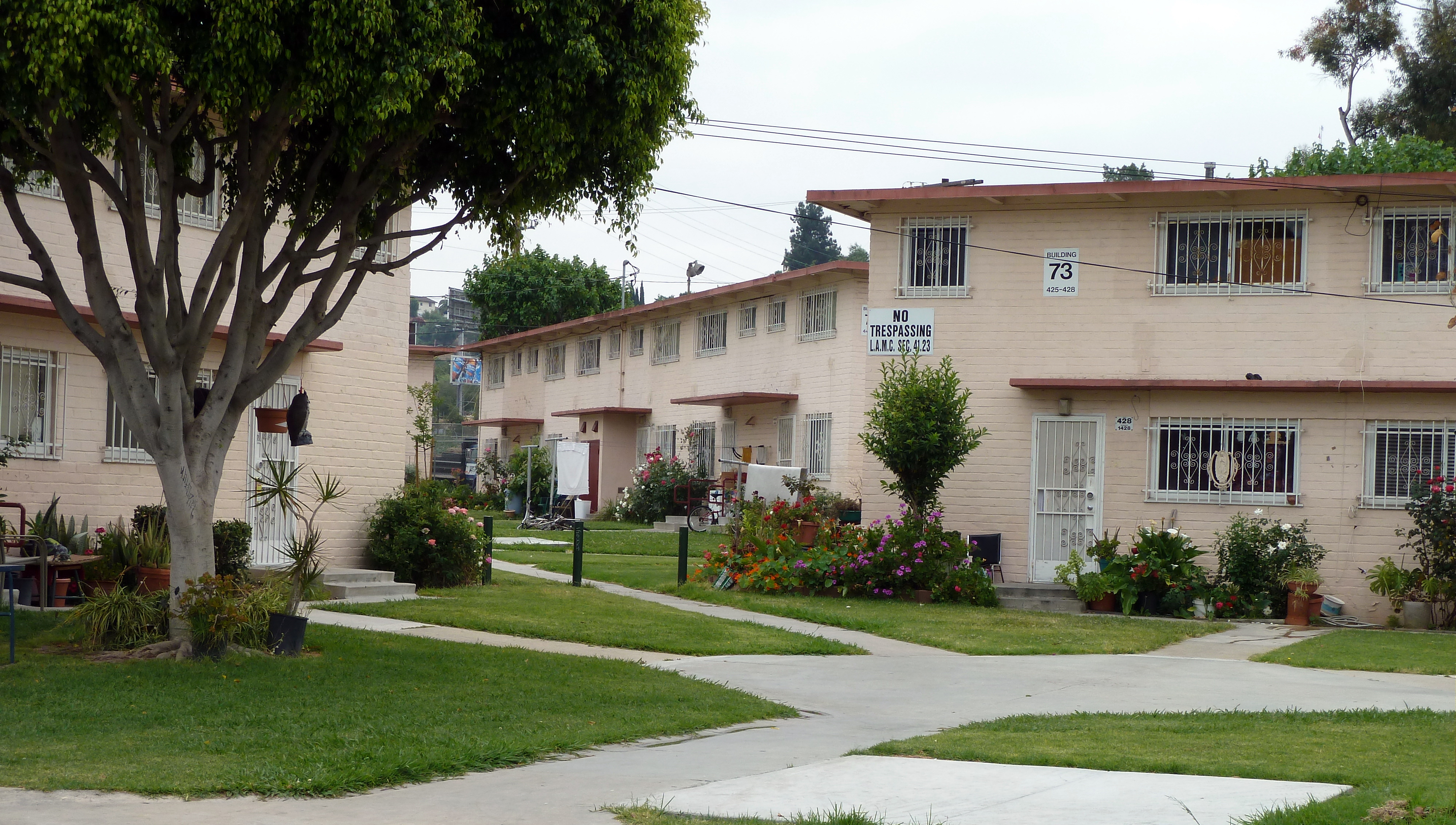
Ramona Gardens
When the Christian Science Monitor covered the opening of Ramona Gardens in 1941, it marveled at the conveniences available to tenants at rents ranging from $11 to $18 a month: modern kitchens, indoor plumbing, landscaped grounds. For families who had been living in overcrowded tenements in Boyle Heights, these concrete buildings were something close to a promise kept.
Building the Future
Groundbreaking at Ramona Gardens came on March 16, 1940. The project covered 32 acres of Boyle Heights, with 610 apartment units designed by a consortium called Housing Architects Associated that included Lloyd Wright — son of Frank Lloyd Wright. The federal government, through the United States Housing Authority, funded 90 percent of the $2 million planned cost. It was one of the New Deal's most ambitious housing initiatives in Los Angeles.
The development was dedicated on February 22, 1941 — George Washington's birthday, the kind of symbolic date that New Deal planners favored, gesturing toward national belonging for communities that America often treated as marginal. For the Mexican American families who moved in, Ramona Gardens offered something that Boyle Heights had rarely provided: stable housing at a price that working people could actually pay.
For decades the development functioned as its designers intended — dense, imperfect, but genuinely livable. Children grew up here, attended local schools, moved into the streets of Boyle Heights. A community formed in the particular way that communities form in housing projects: out of proximity, shared hardship, and the slow accumulation of shared history.
Walls That Speak
Between 1973 and 1977, something unusual happened at Ramona Gardens. Working with the Mechicano Arts Center, a group of artists transformed the development's exterior walls into one of Los Angeles's most significant collections of Chicano murals. The painters included Judithe Hernández, Carlos Almaraz, Willie Herrón, and Wayne Healy — artists who would go on to be recognized as central figures in the Chicano art movement.
The murals addressed what the residents of Ramona Gardens lived: Mexican history, Indigenous heritage, the Chicano civil rights movement, pride in a culture that mainstream Los Angeles had long rendered invisible. On the walls of a New Deal housing project, art became a form of testimony.
In 1982, something even more unexpected occurred: rival gang members who called Ramona Gardens home came together to paint the buildings. The act of collaborative creation did not dissolve the underlying tensions, but it documented a moment when people who defined themselves as enemies chose, briefly, to make something together instead.
Living with History
Ramona Gardens has also lived with the presence of gangs, particularly the Big Hazard crew, whose history in the development runs deep and whose connections to the Mexican Mafia have made the community's story complex. Like many urban public housing developments, Ramona Gardens has been simultaneously a site of creativity and solidarity and a place where poverty and systemic neglect have concentrated the conditions that produce violence.
The murals remain. Some have been restored; others have faded or been painted over and restored again. They stand as evidence that people who are given very little by the society around them still insist on beauty — that the walls of their homes deserve to say something worth reading.
Ramona Gardens is not a museum. People live here. The story of what they have made of these thirty-two acres, under difficult conditions and over eight decades, is still being written.