Ramona Street Architectural District
Pedro Joseph de Lemos bought the property at 520 Ramona Street in Palo Alto for one reason: to save a very old oak tree. A craftsman, graphic artist, and curator of the Stanford Museum, de Lemos was troubled by the larger-scale, linear development creeping along University Avenue in the 1920s. He believed that informal architecture, full of whimsy and integrated with nature, could be compatible with commercial business. In 1925, he designed the Gotham Shop around that venerable oak, with rustic benches, ceramic tiles, and stucco walls. The tree stood until the 1980s. The architectural vision it inspired still defines an entire block.
A Street Named for a Novel
Ramona Street takes its name from Helen Hunt Jackson's 1884 novel Ramona, a romanticized account of Mexican and Native American life in Southern California. The development of this particular block, between University Avenue and Hamilton Avenue, was an early and successful attempt to expand the commercial district laterally, away from the main drag. De Lemos set the tone. In 1938, he built another Spanish Colonial Revival commercial office building across the street at 533-539 Ramona, featuring a recessed arched entrance, an interior patio, wrought iron details, and more handmade tiles. The gentle archways, tile roofs of varying heights, and hidden courtyards that characterize the block today all trace their origin to de Lemos's conviction that a business district could feel like a village.
Clark, Weeks, and the Cardinal
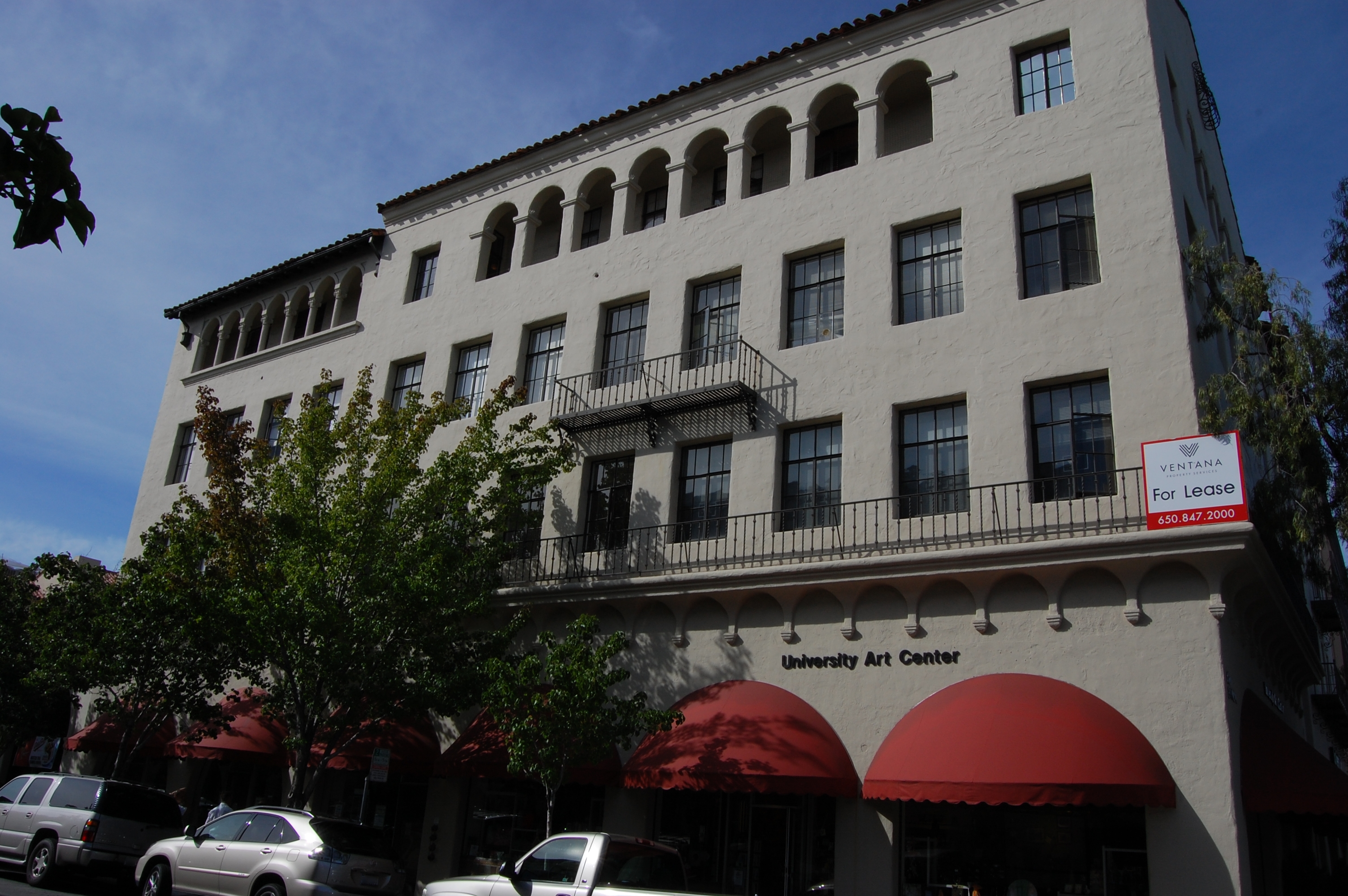
Other architects added their voices to the Spanish chorus that de Lemos had started. In 1928, noted local architect Birge Clark designed the multistory Medico-Dental Building at the corner of Hamilton and Ramona, which now houses the University Art Center on its ground floor. Across the street, architect W. H. Weeks designed the Cardinal Hotel, Palo Alto's first non-frame hotel. The Cardinal's debut was a social event: it became the scene of tea dances and balls, bringing a cosmopolitan energy to a town still finding its identity. The hotel also served a strategic purpose, intended to help establish Hamilton Avenue as a commercial street. Together, these buildings created a unified streetscape of Spanish Colonial and Early California styles, with wrought iron work, tile roofs, and the sense that you had wandered into a California pueblo rather than a business district.
Recognition and Renewal
The unified aspect of the 500 Ramona Street block was recognized in 1985 when it was designated a Historic District on the National Register of Historic Places. Since then, Plaza Ramona and other remodelings at the University Avenue end of the block have enhanced the Spanish theme rather than diluted it. The district remains a working commercial block, its courtyards occupied by restaurants, shops, and offices. Walking through on a warm evening, with light falling through wrought iron gates and the sound of conversation spilling from open doorways, you understand what de Lemos understood nearly a century ago: that architecture shaped by whimsy and respect for the natural world creates spaces people want to inhabit, regardless of whether the purpose is commerce or contemplation.
From the Air
Located at 37.45°N, 122.16°W in downtown Palo Alto, one block south of University Avenue. Palo Alto Airport (KPAO) is approximately 2 miles northeast. The district occupies a single commercial block and is not individually visible from altitude, but the downtown Palo Alto grid is identifiable by its proximity to the Stanford campus and the Caltrain corridor.