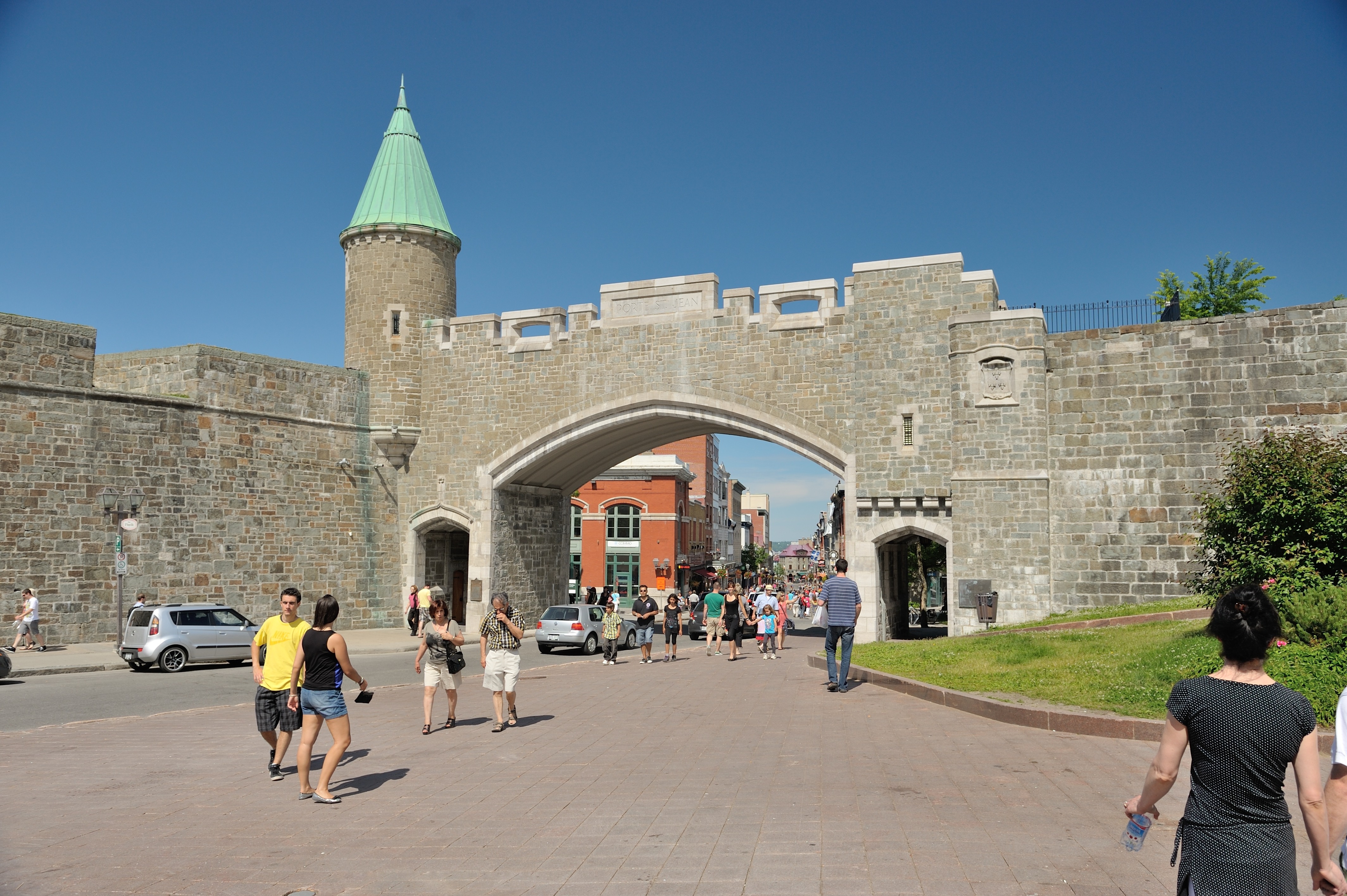
Ramparts of Quebec City: The Only Fortified Walls Left Standing in North America
In 1871, the British garrison packed up and left Quebec City. With the soldiers gone, city planners saw opportunity: tear down the old military gates, widen the roads, make room for modern commerce. Plans were drawn to demolish the Saint-Jean and Saint-Louis gates. Then Lord Dufferin, the Governor General, stepped in and stopped it. His intervention preserved what would become the only intact example of a fortified colonial settlement in North America north of Mexico. The ramparts that ring the western end of Old Quebec's Upper Town survive today because one man in the right position valued stone over convenience. UNESCO agreed in 1985, designating Old Quebec a World Heritage Site.
The First Walls
Fortification began almost as soon as Europeans arrived. When Samuel de Champlain established Quebec in 1608, the initial settlement -- the Habitation de Québec -- included a trading post, a residence, and a redoubt with elevated walls. Makeshift defenses were the norm for decades. The first real defensive walls went up after Port Royal in Acadia fell to the British in 1690, a shock that made Quebec's vulnerability unmistakable. Three years later, in 1693, an improved enceinte was constructed, designed by military engineer Gaspard-Joseph Chaussegros de Léry. He pushed the walls further west than the original perimeter to accommodate the Upper Town's growth. Every expansion of the city demanded an expansion of its defenses. The walls were not monuments; they were survival.
Besieged Three Times
The ramparts earned their keep. During the French and Indian War, the condition of the walls was partly what drove General Montcalm to march his troops outside the fortifications to meet the British on the Plains of Abraham in 1759 -- a gamble that cost France its North American empire. After the British took the city, they held out behind those same walls during the French siege of Quebec in 1760, when France tried and failed to retake the capital. Fifteen years later, during the American Revolutionary War, American forces besieged Quebec through the brutal winter of 1775-1776, but the walled city held. The ramparts withstood the Americans just as they had shaped the outcome of the French and British struggle. Three sieges across three wars, and the walls never fell to assault.
The British Rebuild
The American siege renewed British interest in fortifying Quebec properly. Through the 1820s and 1830s, the British expanded and improved the entire defensive network. A series of wood and earthworks formed along the redoubt and heights of Cap Diamond served as a temporary citadel while the permanent Citadelle of Quebec -- the massive star-shaped fortress -- was completed in the late 1830s. The ramparts atop Cap Diamant, a large promontory, encircled the western portions of the Upper Town; the other sides needed no walls because steep cliffs provided natural defense. The complete system, dating from 1608 to 1871, was designated as the Fortifications of Québec National Historic Site in 1948, encompassing the ramparts, the Citadelle, and the Lévis Forts across the river.
The Gates That Open and Close
The ramparts originally had three city gates during the mid-18th century. More were added in the 19th century, but demolition claimed two: Palace Gate and Hope Gate were torn down, leaving four gates standing. Each gate has its own story of destruction and resurrection. Saint-Jean Gate was first erected in 1693, rebuilt at its present location in 1770, demolished and rebuilt again in 1865, and reconstructed once more in 1939 to better match Kent Gate and Saint-Louis Gate. From 1770 to 1871, the gate doors were locked every night, disrupting trade for the merchants of Rue St-Jean. The doors were permanently removed in 1871 when the garrison left. Saint-Louis Gate's present structure dates to 1878, built to replace its predecessor with something more 'aesthetically pleasing.' Prescott Gate, named after Governor Robert Prescott, was rebuilt twice -- in 1871 and again in 1983. The gates that once locked a city in now welcome four seasons of tourists through.
Walking the Walls Today
The ramparts are walkable. Visitors trace the same circuit that sentries once patrolled, following the wall line from gate to gate along the western perimeter of the Upper Town. On one side, the steep drop to the Lower Town and the St. Lawrence River; on the other, the narrow streets and stone buildings of Old Quebec. The cliffs that protect the north, east, and south sides of the Upper Town explain why walls were only needed on the west -- nature did the fortifying everywhere else. Cap Diamant's promontory gave the original French settlers their strategic advantage, and it still gives visitors their best vantage point. The Citadelle anchors the southern end, an active military garrison of the Royal 22nd Regiment. The fortifications that span from 1608 to 1871 tell a continuous story of colonial ambition, imperial rivalry, and the stubborn persistence of a city that refused to let its walls come down even when no enemy remained to keep out.
From the Air
Located at 46.81°N, 71.21°W atop Cap Diamant, a prominent promontory above the St. Lawrence River. From altitude, the ramparts trace a clear line around the western edge of Old Quebec's Upper Town -- the wall line is distinctly visible separating the dense historic core from the more modern development beyond. The star-shaped Citadelle of Quebec anchors the southern end where the ramparts meet the cliff edge. The four surviving city gates (Saint-Jean, Saint-Louis, Kent, and Prescott) punctuate the wall line where major streets pass through. The Upper Town sits dramatically elevated above the Lower Town, with steep cliffs on the north, east, and south sides providing natural defense where no walls were needed. The Château Frontenac rises within the walls. Nearby airport: Jean Lesage International Airport (CYQB), approximately 15 km west. Best appreciated at 2,000-4,000 feet, where the full circuit of walls and the contrast between fortified old city and surrounding development are most apparent.