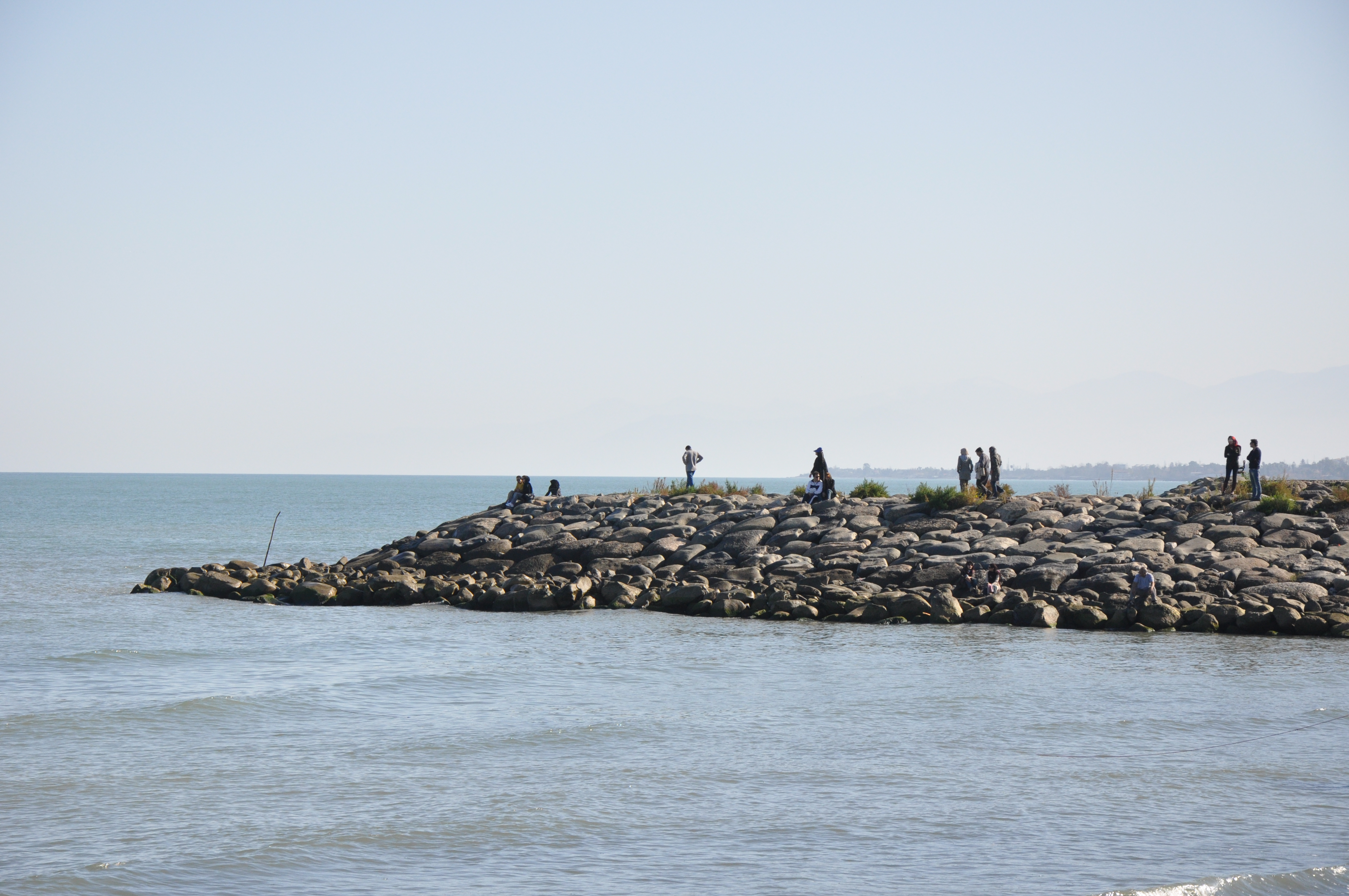
Ramsar, Iran
In one neighborhood of this small Iranian beach town, the bedroom walls glow. Not visibly, but measurably: Geiger counters pressed against the plaster in Talesh Mahalleh register radiation doses more than 80 times the global average. Ramsar, a resort city of 36,000 on the Caspian Sea coast, is simultaneously one of Iran's most popular tourist destinations and the most naturally radioactive inhabited place on the planet. It is also the city that lent its name to the Ramsar Convention, the international treaty that has protected wetlands across 160 countries since 1971. These facts coexist here without apparent contradiction, much like the city itself, which sits at the improbable junction of lush forest, radioactive hot springs, Qajar palaces, and Caspian surf.
Through the Tunnel
Driving from Tehran to Ramsar, you climb through the Alborz Mountains on roads that switchback through increasingly barren terrain. Then you reach a tunnel. On the far side, everything changes. The air thickens with humidity. Green appears -- dense, subtropical green, the kind that seems almost aggressive after the desiccated plateau. This is northern Iran's Caspian coast, where moisture from the world's largest inland body of water collides with mountain barriers and produces one of the cloudiest microclimates in the country. Ramsar receives only about 1,582 hours of annual sunshine, making it Iran's cloudiest city. For Iranians from the arid interior, this dampness is the attraction. The mist, the rain, the forests climbing the slopes behind the town -- all of it feels like a different country from the desert provinces a few hours south. Ramsar sits at the western edge of Mazandaran Province, bordered by the Caspian to the north and the Alborz rising steeply behind.
The Hot Earth
Beneath Ramsar's pleasant surface lies something extraordinary. Underground water percolates through uraniferous igneous rock, dissolving radium and carrying it upward through at least nine known hot springs. The radium-rich water has been used for centuries in local building materials, concentrating radioactivity in walls, floors, and foundations. In the Talesh Mahalleh district, about 2,000 residents receive an average annual radiation dose of 10 millisieverts -- ten times the internationally recommended limit for public exposure from artificial sources. One house measured an effective external radiation dose of 131 millisieverts per year, with an additional 72 millisieverts from radon gas. Scientists have studied these residents for decades, looking for evidence that the linear no-threshold model of radiation risk -- which predicts cancer rates rising proportionally with dose -- holds true at these levels. The results so far are ambiguous. Lung cancer rates appear slightly lower than expected, though other health effects, including chromosomal aberrations, have been documented. The population is too small for definitive conclusions, and monitoring continues.
The Treaty That Bears Its Name
In 1971, delegates from 18 nations gathered in Ramsar and signed an international treaty that would reshape global conservation. The Convention on Wetlands of International Importance -- universally known as the Ramsar Convention -- established a framework for protecting marshes, swamps, bogs, and other wetland ecosystems worldwide. Today, 172 countries are parties to the convention, and more than 2,500 wetland sites covering 2.5 million square kilometers carry the designation "Ramsar site." The treaty was a landmark: the first modern intergovernmental agreement focused on a specific type of ecosystem. Amendments followed in Paris in 1982 and Regina, Canada, in 1987. Signatories meet every three years, having held their first conference in Cagliari, Italy, in 1980. That a small Caspian beach resort became the namesake and birthplace of one of the twentieth century's most consequential environmental agreements remains one of those accidents of history that feels, in retrospect, fitting -- a place where mountain, forest, sea, and wetland converge.
Palaces and Pistachios
Ramsar was a village in western Mazandaran until Reza Shah's government transformed it during the first Pahlavi period into a city with tourist infrastructure. The Last Shah, Mohammad Reza Pahlavi, maintained a vacation palace here, now a museum. The Ramsar Hotel, built during this era of royal patronage, still operates. Twenty-seven kilometers south and 2,700 meters above sea level, the mountain village of Javaher Deh draws visitors into the high Alborz, connected to Ramsar by a road that winds through the Safarood forest park. Dalkhani Forest, nicknamed the "Corridor of Paradise," is a mountainous woodland nearby. A cable car complex opened in 2008 has become one of northern Iran's most visited attractions. The city's airport, first surveyed by German engineers in 1930 and operational since 1952, now handles private flights, weekly service to Tehran and Mashhad, and an international route to Muscat, Oman. Beneath the tourism infrastructure, Ramsar's Caspian coastline and fish markets preserve a simpler identity -- a working seaside town where the catch still matters.
A Place of Contradictions
Ramsar thrives on contrasts that would seem impossible elsewhere. Tourists flock to hot springs fed by the same geological processes that make bedroom walls radioactive. An international environmental treaty was born in a city that scientists have recommended partially evacuating. The cloudiest city in Iran is also one of its most popular vacation spots. Mazandarani culture, with its distinct language and customs, blends here with Gilaki influences from neighboring Gilan Province to the west. The city is twinned with Puerto Montt in Chile, Al Wakrah in Qatar, and Shiraz within Iran -- a roster as eclectic as Ramsar itself. Walking through the bazaar or along the Caspian promenade, you would never guess that the ground beneath your feet is doing something no other inhabited ground on Earth does quite so enthusiastically. That invisibility may be Ramsar's defining quality: the most remarkable things about this place are the ones you cannot see.
From the Air
Located at 36.92N, 50.65E on the southern coast of the Caspian Sea in Mazandaran Province, Iran. From altitude, Ramsar is visible as a coastal strip between the Caspian shoreline and the steep northern face of the Alborz Mountains. The dramatic terrain transition from dry plateau to lush forest is clearly visible. Ramsar International Airport (OINR) is located within the city. The mountain village of Javaher Deh is visible at 2,700 meters elevation to the south. The Caspian coastline stretches east toward Tonekabon and west toward Gilan Province. Best viewed in breaks between the frequent cloud cover that characterizes this stretch of coast.