Ramsgate Airport
For thirty pence at 1950s prices - seven shillings and sixpence - you could buy an eight-minute flight along the Kent coast in a De Havilland Dragon Rapide. Punters were rounded up off the kiosks at Ramsgate Harbour and the Margate seafront, bundled into a Morris J-type minibus or a Dormobile, driven inland to a flat 90-acre field, and put eight at a time into a biplane that took off, flew along the white chalk cliffs past Broadstairs and Margate, and put them down again before the sandwiches went cold. Ramsgate Airport ran from 1935 to 1968, with a war in the middle, and a clubhouse designed by an Art Deco architect that had a control tower built right into it.
The chain that started here
Ramsgate Airport opened in July 1935 on a 90-acre site that cost the council 26,000 pounds to develop. Hillman's Airways inaugurated services to Belgium, four flights a day - because Ostend Airport was not yet ready, they actually landed at Le Zoute, near Knokke. The airport was run by Ramsgate Airport Ltd, a private company with 5,000 pounds of capital and three directors: F Gwatkin, the racing driver Richard Seaman, and the polymath aviator Whitney Straight. It was the first of what would become twelve airports in Whitney Straight's Straight Corporation chain. The mayor of Ramsgate did the official opening, then climbed into a De Havilland Dragon flown by Neville Stack and was promptly flown to Belgium. The official terminal opening followed on 3 July 1937. Its clubhouse, designed by the Art Deco architect David Pleydell-Bouverie, had the control tower built into the middle of it - a small modernist landmark on a Kentish field.
Flying Fleas and Geoffrey de Havilland
1936 was the summer of the Mignet HM.14 "Flying Flea," a French home-built monoplane briefly grounded after a crash and then cleared after wind-tunnel modifications. Ramsgate hosted a Flea race on 3 August 1936 with a hundred-pound prize. Seven flew, plus an eighth flown by Henri Mignet himself, doing aerobatics with the inscription "Flying Flea flies in England. I thank the Air Ministry" painted on the fuselage. The following August, sixteen aircraft from three nations entered a Ramsgate air race. Paul Elwell won it in a Taylor Cub. Alex Henshaw came third in a Percival Mew Gull. Seventh place went to Geoffrey de Havilland Jr in a De Havilland T.K.2 - the man whose father had built the plane, the man who would die a decade later test-flying a jet for the same company. The airfield ran a holiday camp on site: tents, a clubhouse, free pleasure flights, a free flying lesson, all in for one summer fortnight.
When the bombs came
In 1940, with the Battle of Britain breaking overhead, Ramsgate was pressed into service as a satellite of RAF Manston - the famous fighter station four miles inland that took some of the heaviest German bombing of any RAF airfield. Manston was the closest fighter base to occupied France and a priority Luftwaffe target. During one of the many August raids on Manston, the Germans worked over Ramsgate too. They cratered the field. With the German shift away from airfields toward London, Ramsgate's value as a satellite diminished, and the field was deliberately obstructed to prevent enemy gliders from landing on it. Through the rest of the war it grew potatoes.
Pleasure flights and Tiger Moths
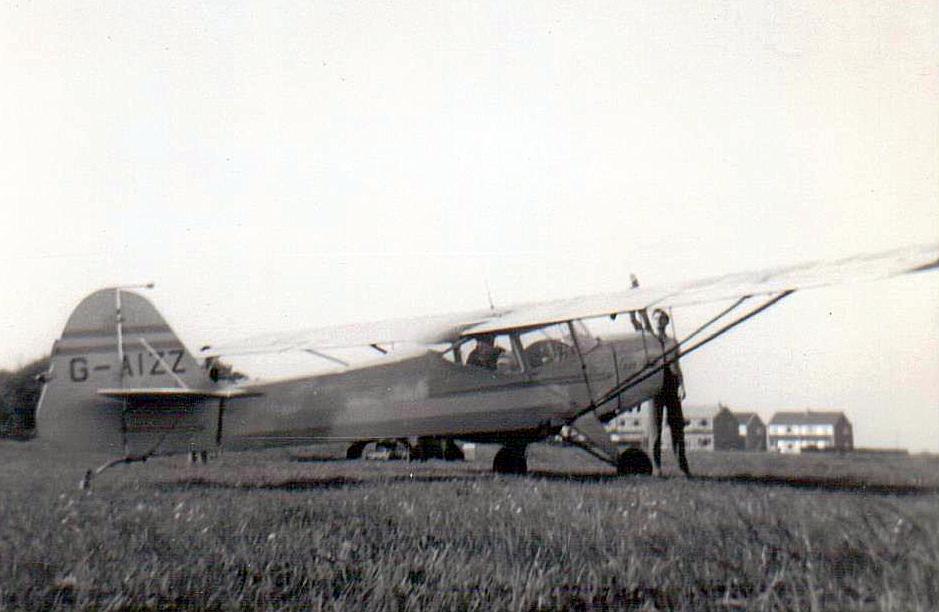
The airport reopened on 1 June 1952 as Ramsgate Municipal Airport, on a 21-year lease to Air Kruise (Kent) Ltd. The first aircraft to land was an Auster J/1 Autocrat registration G-AIZZ, owned by Hugh Kennard. Air Kruise traded as Trans-Channel Airways and carried 22,500 passengers in 1953. Then the strange middle decade began. Between 1954 and 1957 the airfield was a summer carnival of pleasure flights, eight passengers at a time in Dragon Rapides, often piloted by Ron Pullinger - whose wife ran the office, and who later died in 1967 in a DC-4 crash at Perpignan caused by carbon monoxide leaking into the cockpit. In the off-season the engineer Jim Bowyer assembled ex-RAF Tiger Moths for civilian conversion. The wing-rib jigs for the first Rollason-built Druine Turbulent were made in the Ramsgate hangar. Jock Maitland - later Commandant of Biggin Hill - flew his Percival Proctor here while his wife rounded up customers at the harbour. By 1962 Cormorant Aviation was running pleasure flights in a Piper Tri-Pacer often piloted by Paul Horsting, who later became Cathay Pacific's international operations manager and flew the record-breaking nonstop trans-polar inaugural from New York to Hong Kong in 1998.
An industrial estate, with aircraft-named streets
Ramsgate Airport closed for the last time in 1968. The land was sold. Today the site is housing and an industrial estate. Nothing remains of the airfield except the main hangar along Hopes Lane - steel-framed, originally clad in asbestos sheeting with sliding wooden Henderson doors at the front. The clubhouse with the built-in control tower is gone. The runways are buildings. The local council, with rare sense, named several of the new roads for aircraft: Anson Close, Blenheim Close, Hornet Close, Lysander Close, Vincent Close. If you walk those streets today you are walking on the field where Geoffrey de Havilland Jr came seventh in a 1937 air race, where Battle of Britain ground crew filled in craters at night, and where an eight-shilling flight to look at the white cliffs took off four times an hour on a Saturday in summer.
From the Air
Former airfield site at 51.35N, 1.41E, on the western edge of Ramsgate, Kent, now an industrial estate around Hopes Lane and the road network with aircraft-themed names. Nearest active airport is Manston (EGMH) about four miles north - the same RAF Manston that Ramsgate Airport served as satellite to in 1940. Lydd (EGMD) is about 25 miles south. The English Channel is two miles east; the French coast about 30 miles further on. From the air, look for the Royal Harbour at Ramsgate as the obvious reference point.