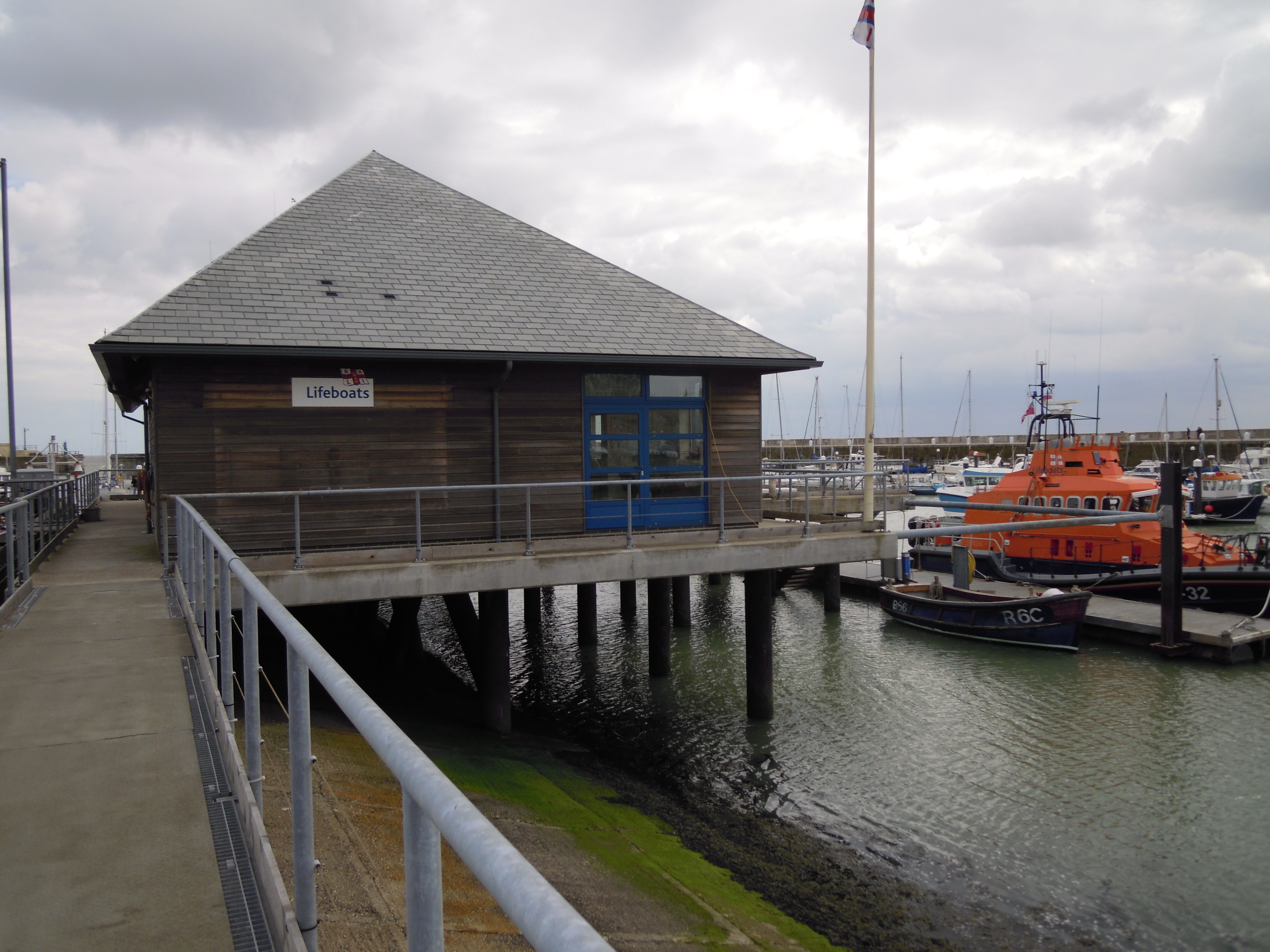
Ramsgate Lifeboat Station
In 1919, President Woodrow Wilson of the United States sent a gold watch and a pair of binoculars to the harbour wall at Ramsgate. The watch went to the coxswain. The binoculars went to the second coxswain. Gold medals went to the rest of the crew. The Royal National Lifeboat Institution was already nearly a century old by then, but the lifeboat station at Ramsgate had been older still - established in 1802, twenty-two years before any national lifeboat organisation existed in Britain, and one of the oldest continuously operating rescue stations in the British Isles. It is still there, on the Western Crosswall of the Royal Harbour, with the all-weather lifeboat Diamond Jubilee waiting alongside.
The mayor of Bradford pays for a boat
The Ramsgate Harbour Trustees put the town's first lifeboat - built by Henry Greathead, who effectively invented the British lifeboat - on the harbour wall in 1802. It served until 1824. A second was placed in 1851. Then in 1865, with the harbour newly under Board of Trade management, the RNLI agreed to fund a proper modern lifeboat. The money - 425 pounds - came from a fund raised in Bradford, Yorkshire, by Mayor Charles Semon and eleven other gentlemen. The lifeboat ordered from Forrestt of Limehouse, a 40-foot self-righting pulling-and-sailing design with twelve oars, was towed down the Thames to Kent in February 1866 by the Ramsgate steam tug Aid. They named her Bradford in honour of the donors. The Bradford committee, hurt that the boat could not be exhibited at home, asked for a scale model to display to their subscribers - which the RNLI promptly built and sent up north. Four successive Ramsgate lifeboats over the next forty years were also named Bradford, each replacing the last as designs improved.
1881: a crew that earned medals
In a single year - 1881 - thirteen Ramsgate crewmen were awarded the RNLI's Distinguished Service Medal. Thomas Friend, John Goldsmith, Stephen Goldsmith, Henry Meader, Robert Penney, Charles Vernon, William Wharrier, William Austen, Charles Knight, Edward Revell, George Woodward, Richard Yare, and the master Alfred Page all got medals that year. That kind of cluster - thirteen medals to one crew in twelve months - happens because the conditions and the casualties were both extraordinary. The Goodwin Sands, the notorious shoals south of Ramsgate, swallowed ships routinely in the 19th century. Ramsgate's lifeboat was the closest specialist rescue craft, and her crew lived inside an industrial-scale loss of life that the Victorians simply accepted as the price of maritime trade. Woodward, Knight, Yare - these are names you find carved on harbour-wall plaques up and down the Kent coast.
Dunkirk
Howard Primrose Cooper Knight, coxswain at Ramsgate, won the Distinguished Service Medal in 1940. The crew, collectively, received an inscribed silver plaque the same year. The reason is in those dates. In late May 1940, with the British Expeditionary Force trapped on the beaches of Dunkirk, the Admiralty requisitioned everything that could cross the Channel: yachts, fishing boats, paddle steamers, RNLI lifeboats. Ramsgate's Royal Harbour - the only Royal Harbour in Britain, with deep tidal water and a sheltered basin - became one of the principal embarkation points of the evacuation. Some 40,000 men were brought ashore at Ramsgate in nine days, off destroyers and motor launches and the famous Little Ships. The lifeboat went over to France too, working off the beaches under bombardment. By the time the operation ended, 338,000 Allied soldiers had been pulled home. Knight got his medal. His crew got their plaque. They never talked much about it afterwards.
Ron Cannon's hundred shouts
The Ramsgate roll of honours after Knight reads like a single name carved on the wall over and over: Ronald Nicholas Cannon. The Maud Smith Award in 1985, again in 1999. The Lady Swaythling Trophy. The James Michael Bower Endowment Fund Award. Framed letters of thanks in 1983 and 1984. Member of the Order of the British Empire in 2017, on retirement, in the Queen's Birthday Honours. Cannon served as coxswain/mechanic at Ramsgate for decades; his crew - Pegden, Cooper, Blay, Brown, Hurst, Mett, Stephens, Noble - went out with him on shouts that won them all letters of thanks. Lifeboat stations work like that. The medals are public, individual. The work is private, collective. Most rescues never make a single newspaper. The current Ramsgate boat, the 16-23 all-weather Diamond Jubilee, replaced its predecessor in 2023; the inshore boat Claire & David Delves has been on station since 2014. Both are paid for by gifts and legacies and the slow patient fundraising of millions of small donations.
The harbour they watch
Ramsgate Royal Harbour, where the lifeboat station sits, is one of the busiest small-craft harbours on the southeast coast. The Strait of Dover - the world's busiest shipping channel - lies just to the east. Cross-Channel ferries, container ships, tankers, fishing boats, leisure yachts, and migrant inflatables all share the same crowded water. RNLI Ramsgate works it all. The station has been continuously operating since 1851 - 175 years this year. Volunteers crew the boats. There are no salaries for the men who go out in the storms. The current lifeboat station building, on the harbour wall between the inner and outer pools, opened in 1998. From the air on a clear day, the orange hull at the wall is the first thing you see in the harbour: small, modern, ready, against a backdrop of chalk cliffs that have watched lifeboats go out from this place for the better part of two and a half centuries.
From the Air
Station at 51.33N, 1.42E, on the Western Crosswall of Ramsgate Royal Harbour, east Kent. The Royal Harbour - the only such in the UK - is the obvious feature from the air, with its inner and outer basins protected by stone piers. Nearest airfield Manston (EGMH) directly north; Lydd (EGMD) about 25 miles south. The Strait of Dover and its dense merchant traffic separation lanes lie immediately east. Goodwin Sands - long the main source of the lifeboat's work - mark themselves as a shallow patch about 6 miles southeast at low tide.