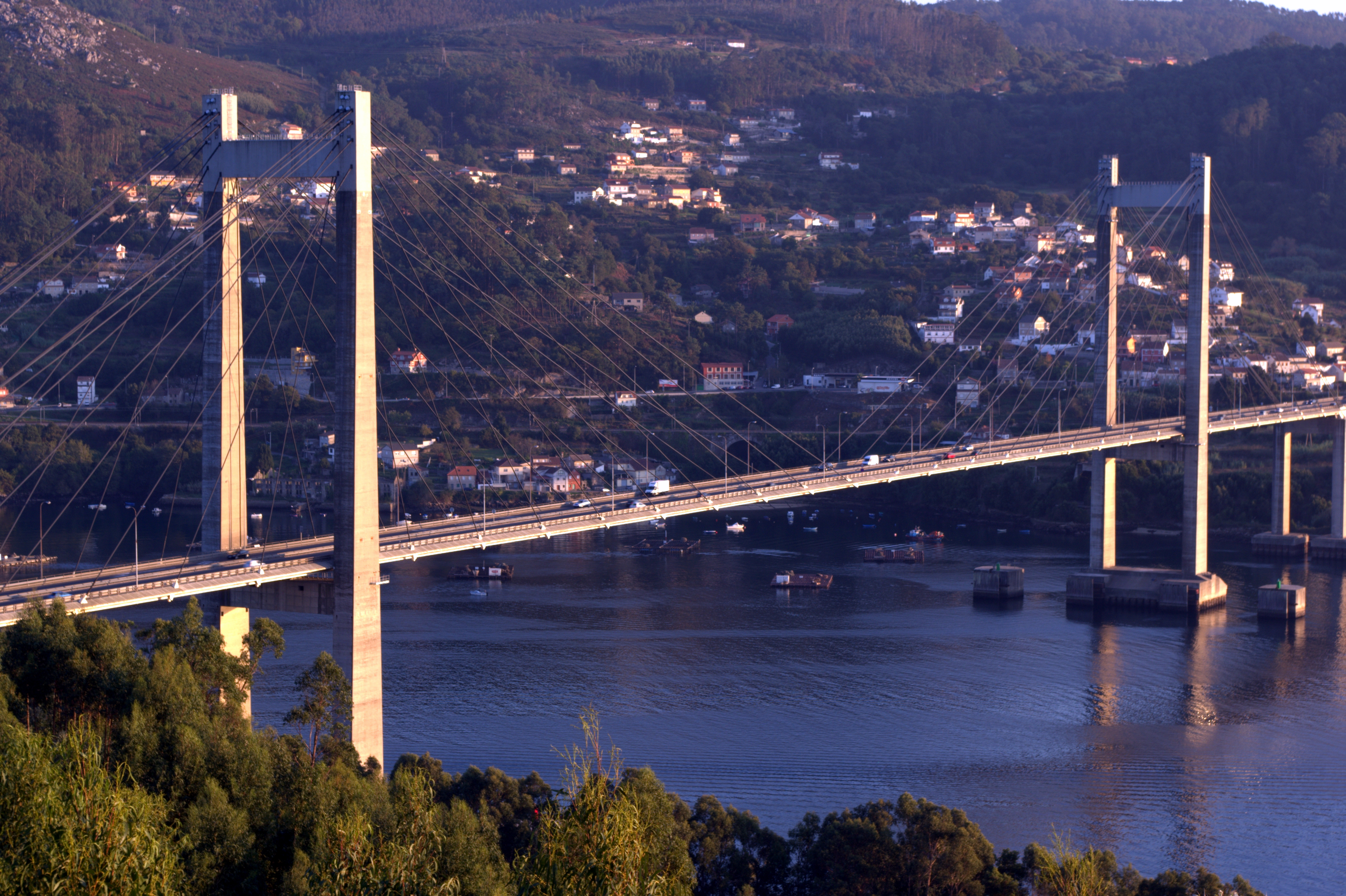
Rande Bridge
Somewhere beneath the cable stays of the Rande Bridge, the wrecks of 18th-century warships lie on the floor of Vigo Bay. The bridge crosses the Rande Strait, the same narrow passage where in October 1702 an Anglo-Dutch fleet broke through a fortified boom to destroy the entire Franco-Spanish treasure fleet in one of the most decisive naval actions of the War of the Spanish Succession. Today, instead of warships and chain booms, 50,000 vehicles cross this strait every day on a cable-stayed bridge that was, when it opened in 1981, the longest multi-lane cable-stayed span in the world.
An Italian Vision Over Galician Waters
The Rande Bridge was designed by Italian engineer Fabrizio de Miranda, along with Spanish engineer Florencio del Pozo, who oversaw its foundations, and Alfredo Passaro. Construction began in 1978, and the bridge opened in 1981, just over a year before Spain hosted the 1982 FIFA World Cup. It forms part of the AP-9 motorway, the highway spine of Galicia's Atlantic coast. The bridge stretches 1,604 meters in total length, with pillars reaching 148 meters high and a main span of 401 meters. While it was not the single longest cable-stayed span in the world at the time of its opening, it held the distinction of being the longest with more than two traffic lanes, a record that reflected the ambition of connecting Galicia's two major coastal cities more than its pursuit of engineering superlatives.
Linking Two Shores
The bridge connects the municipalities of Redondela on the eastern shore to Moana on the western side of Vigo Bay, binding together communities that had previously required a long detour inland or a ferry crossing. The city of Vigo lies 9 kilometers to the south, Pontevedra 18 kilometers to the north. For Galicia, a region whose geography is defined by deep rias, the fjord-like inlets that cut into the Atlantic coast, bridges are more than conveniences. They stitch together a landscape that water would otherwise divide. The Rande Bridge cost 3,658 million pesetas to build, and it was exclusively a toll bridge until 2006, when it transitioned to a shadow toll arrangement funded by the government rather than directly by drivers.
The Weight of Success
Since opening in 1981, more than 230 million vehicles have crossed the Rande Bridge. The current daily volume of approximately 50,000 vehicles pushes the bridge toward its capacity limits. Congestion studies began well before the situation became critical, and in February 2015 widening works commenced with an estimated investment of 107.9 million euros. The expansion reflects a pattern familiar to bridge engineers everywhere: a structure built for one era's traffic demands eventually becomes a bottleneck for the next. From the bridge's deck, the view stretches across one of Galicia's most dramatic landscapes. The ria opens westward toward the Atlantic and the Cies Islands, while the inner bay narrows into the strait where history was made three centuries before the first cable was strung.
From the Air
Located at 42.29N, 8.66W spanning the Rande Strait across Vigo Bay (Ria de Vigo), Galicia, northwest Spain. The cable-stayed bridge with its twin 148-meter pylons is a prominent visual landmark from the air, crossing the narrow strait where the bay constricts. Vigo is visible to the south, Pontevedra to the north. Nearest airport is LEVX (Vigo-Peinador) approximately 12 km south. The Cies Islands at the mouth of the ria are visible to the west. Best viewed from 2,000-4,000 ft AGL.