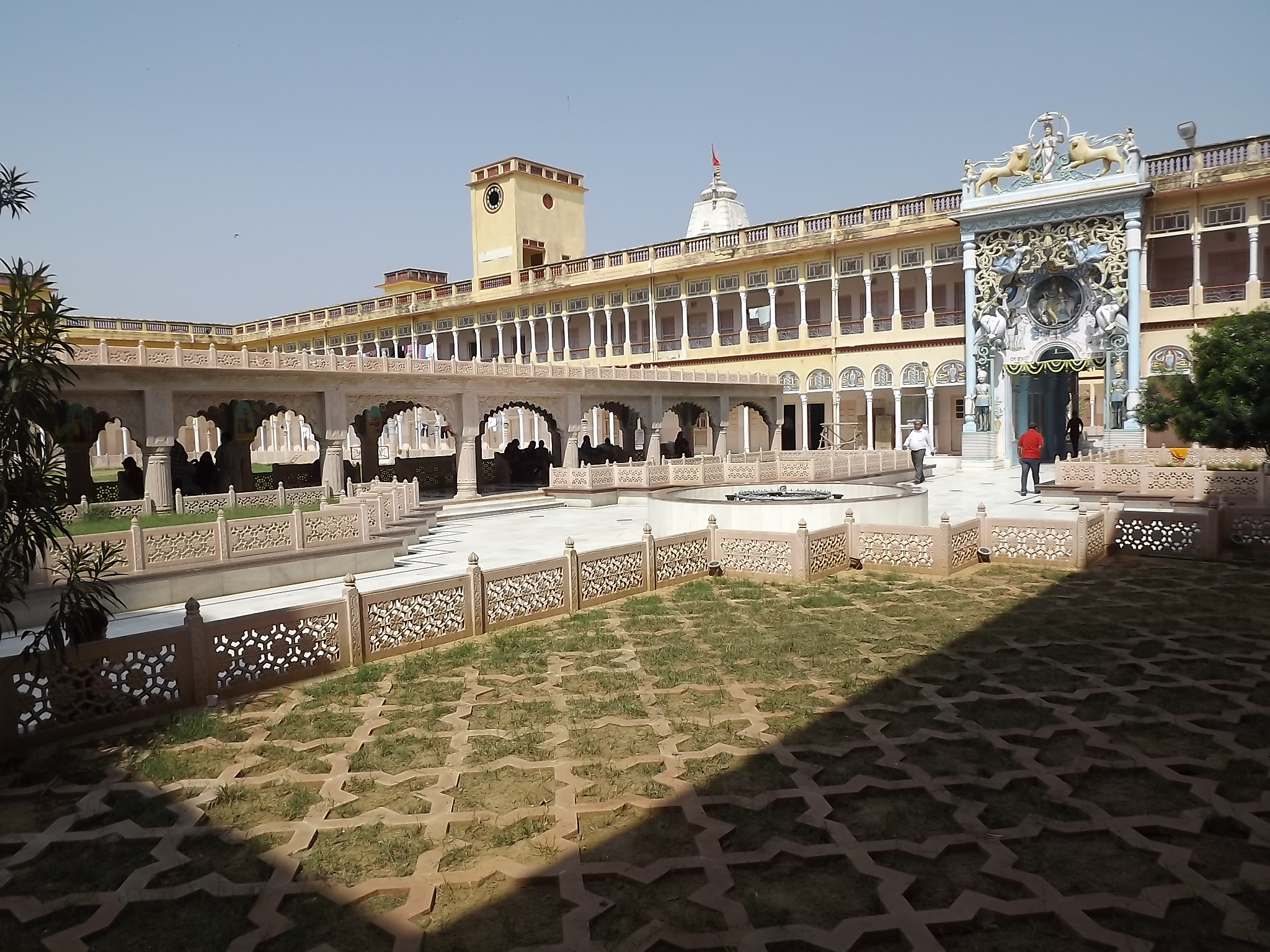
Rani Sati Temple
Somewhere between myth and history, a seventeen-year-old bride chose fire over widowhood. The story of Narayani Devi, known as Rani Sati, has been retold so many times across so many centuries that the details shift with each telling -- the date of her death ranges from 1295 to the 1600s, the identity of her husband's killer alternates between a king's son and a nawab, and the horse at the center of the dispute changes color depending on who is speaking. What does not change is the temple built where the horse finally stopped walking. In the dusty Shekhawati region of Rajasthan, the Rani Sati Temple in Jhunjhunu stands as India's largest shrine dedicated to a woman who committed sati, the practice of self-immolation on a husband's funeral pyre. Hundreds of devotees arrive daily. The temple complex sprawls across the landscape, its walls alive with murals and glass mosaics that narrate the very legend that made this ground sacred.
A Blessing Deferred
The temple's founding legend reaches back to the Mahabharata itself. When the young warrior Abhimanyu was killed on the battlefield through treachery, his wife Uttara wished to join him on the funeral pyre. But she was pregnant, and the elders -- along with Krishna, Abhimanyu's own maternal uncle -- forbade it. Harming an unborn child, they told her, was an unforgivable sin. Uttara relented, but she extracted a promise from Krishna: that in a future lifetime, she would again be married to Abhimanyu, and that if widowhood found her once more, she would be granted the chance to follow her husband into death. According to the tradition, Krishna granted this boon. The story thus frames what happened centuries later not as tragedy but as the fulfillment of a divine compact, a wish carried across lifetimes.
The Bride, the Horse, and the King's Son
In that later lifetime, the legend continues, Uttara was born as Narayani in the village of Dokwa in Rajasthan, and Abhimanyu as Tandhan Jalan in Hisar, Haryana. Both belonged to the Agarwal merchant community. They married young, and life was peaceful until Tandhan's horse attracted the wrong attention. The king of Hisar's son coveted the animal and, when refused, challenged Tandhan to a duel. Tandhan killed the prince but was himself slain by the enraged king. What followed defied expectation: Narayani did not retreat into grief. She fought the king and killed him. Then she turned to Ranaji, the horse's caretaker, and commanded him to prepare her husband's cremation pyre so she could join him in the flames. She blessed Ranaji, declaring that his name would be worshipped alongside hers forever. Other versions shift the antagonist to a nawab and the prize to a white mare, but the ending remains constant -- the horse carried the couple's ashes until it stopped, and a temple was built on that spot.
Mosaics and Morning Prayers
The temple complex that stands today in Jhunjhunu is far more than a single shrine. Within its walls sit temples dedicated to Hanuman, Sita, Ganesha, and Shiva, along with twelve smaller sati shrines. A towering statue of Lord Shiva rises from the center of the complex, ringed by green gardens that soften the arid Rajasthani landscape. Inside the main temple, every surface tells a story. Exquisite murals and glass mosaics cover the walls, tracing the full arc of Narayani's legend in vivid color. Devotees call her Dadiji -- grandmother -- an intimate term that speaks to the personal relationship worshippers feel with a figure who lived, by most accounts, somewhere between the 13th and 17th centuries. Twice daily, elaborate aarti ceremonies fill the temple with chanting and the scent of incense: the Mangala Aarti at dawn when the temple doors first open, and the Sandhya Aarti at sunset.
A Contested Legacy
The practice of sati was outlawed by the British colonial government in 1829 and remains illegal in modern India, where the Commission of Sati (Prevention) Act of 1987 criminalizes both the act and its glorification. The Rani Sati Temple thus occupies complicated ground -- it is simultaneously a living place of worship, a monument to a practice that caused immense suffering to women, and a site where the boundary between religious devotion and the glorification of self-immolation blurs. Scholars like Sakuntala Narasimhan and Anne Hardgrove have documented the ways in which the Rani Sati legend has been shaped and reshaped over the centuries, with the accounts of her life varying so widely that pinning down basic facts -- her era, the identity of her adversary, even the sequence of events -- proves impossible. What remains undeniable is the devotion itself. The annual festival on Bhadra Amavasya, the fifteenth day of the dark half of the Bhadra month in the Hindu calendar, draws crowds from across India to a temple that insists on remembering what the modern state has tried to consign to history.
From the Air
Located at 28.135N, 75.404E in Jhunjhunu, Rajasthan. The temple complex is visible as a large walled compound in the town center. Jhunjhunu sits in the Shekhawati region, a semi-arid landscape of painted havelis and small towns. Nearest major airport is Jaipur (VIJP), approximately 180 km to the southeast. The terrain is flat desert, and the town is identifiable by its cluster of colorful historic buildings.