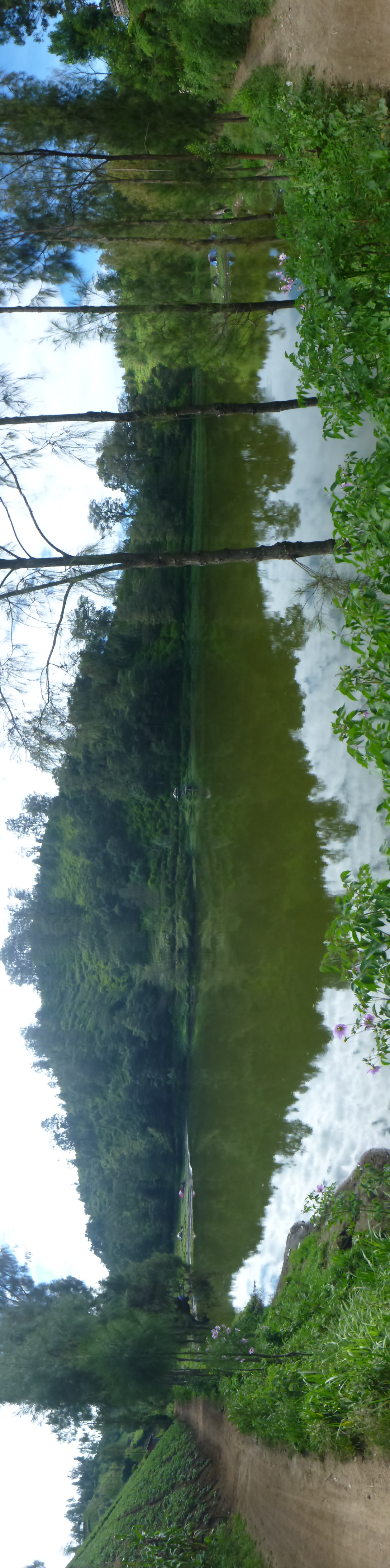
Ranu Pani: The Last Village Before the Summit
The porters of Ranu Pani inherit their profession the way other families inherit farmland. Fathers teach sons the weight a human back can carry up a volcano, the rhythm of steps on loose scree, the shortcuts through forest that shave an hour off the trek to Semeru's summit. In this village of roughly 2,000 people, perched at 2,100 meters above sea level in East Java's volcanic highlands, guiding climbers up the highest mountain on Java is not adventure tourism -- it is a family trade, passed down through generations, coordinated through a community of porters who know every switchback and water source between here and the 3,676-meter peak.
Descendants of an Empire
The villagers of Ranu Pani are Tenggerese -- one of the few Hindu communities on an island that is overwhelmingly Muslim. They trace their ancestry to the Majapahit Empire, the last great Hindu-Buddhist kingdom of Java, which reached its peak in the 14th century before collapsing under the spread of Islam. While most of Java converted, the Tenggerese retreated into the highlands around the Tengger caldera and the slopes of Semeru, preserving their faith and their rituals in the thin air above the lowland world. Each year, the village holds a clean village ceremony and the unan-unan ritual, led by traditional shamans, reaffirming ties to a spiritual tradition that predates the arrival of Islam on Java by centuries. It is a community defined as much by what it has held onto as by where it lives.
A Lake Losing Its Depth
The village takes its name from the volcanic lake at its center. Ranu Pani once covered a full hectare of surface area, but sedimentation has reduced it to an estimated 0.75 hectares -- and the shrinkage extends downward as well. In 1998, the lake's depth measured 12 meters. By 2013, the deepest point had dropped to just 7 meters. The causes are cumulative and intertwined: surrounding hillsides cleared for agriculture accelerate erosion, sending soil cascading into the water. Climbers and visitors leave trash that accumulates on the lakebed. Hikers have even burned garbage at the water's edge. The loss is not just ecological -- it is practical. Ranu Pani and its companion lake, Ranu Regulo, sit within the village boundaries, while Ranu Kumbolo lies a five-hour hike upslope. Together these lakes anchor the hydrology of the upper Semeru watershed. Since 2010, the Bromo Tengger Semeru National Park authority has partnered with the University of Brawijaya and the Japan International Cooperation Agency to try to reverse the damage, planting living fences along the lake's borders and working to reduce the flow of sediment and garbage into the water.
Gateway to Semeru
Every climber bound for Semeru's summit passes through Ranu Pani. There is no alternative -- the village is the legal starting point for the easiest route, and the registration post where park permits are checked sits at the trailhead. From here, the path climbs through montane forest to Ranu Kumbolo at 2,400 meters, then continues through open savanna and increasingly barren volcanic terrain toward the peak. The full trek covers roughly 18 kilometers one way and takes most hikers two days. Ranu Pani's porters make the difference between a grueling slog and a manageable expedition. They carry supplies, cook meals, navigate routes in poor visibility, and share the accumulated knowledge of families who have been walking these slopes for generations. All Semeru porters belong to a coordinated community, ensuring fair distribution of work and consistent safety standards on a mountain that demands respect.
Frost at the Equator
Ranu Pani occupies a climatic zone that surprises visitors expecting tropical heat. At 2,100 meters, the village sits in what the Koppen classification calls a subtropical highland climate. Average temperatures hover around 13 degrees Celsius year-round. During the dry season, from June to September, nighttime temperatures regularly plunge below freezing, and frost coats the fields and rooftops by dawn. Snow has been observed on rare occasions -- an almost surreal sight at 8 degrees south of the equator. The wet season, November through March, brings heavy rainfall that feeds the lakes and forests but turns trails to mud. It is this climate, inhospitable enough to discourage lowland settlers for centuries, that helped the Tenggerese preserve their isolation and their identity. The altitude that keeps the rest of Java at a distance is the same altitude that makes Ranu Pani the perfect staging ground for Semeru -- high enough to acclimatize, sheltered enough to rest, remote enough to feel like the edge of the inhabited world.
From the Air
Ranu Pani village sits at approximately 8.01S, 112.95E at an elevation of 2,100 meters (6,890 ft) on the northwestern slopes of Mount Semeru. The volcanic lake is small but may be visible in clear conditions as a dark patch within the village clearing. Mount Semeru (3,676 m) rises to the south-southeast, often with an active ash plume. The Tengger caldera with Mount Bromo and Batok lies to the north-northwest. Nearest airports: Abdul Rachman Saleh Airport (WARA/MLG) in Malang, approximately 55 km northwest; Juanda International (WARR/SUB) in Surabaya, about 120 km northwest. Terrain is rugged and mountainous with active volcanic hazards from Semeru. Best visibility in early morning; convective clouds build rapidly after midday. Maintain safe clearance above all volcanic peaks.