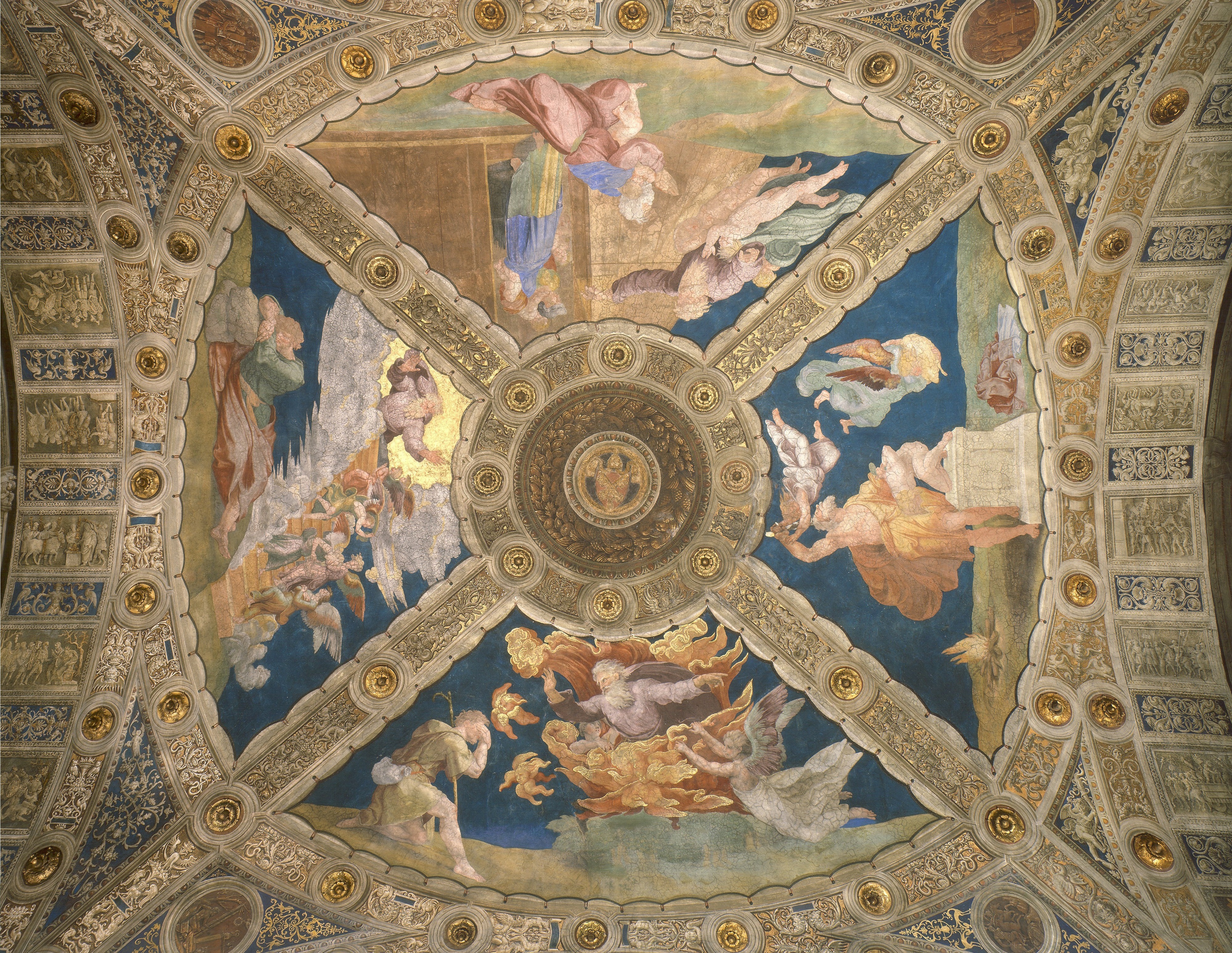
Raphael Rooms
Pope Julius II had a problem with the floor. Directly beneath his private apartments in the Apostolic Palace lay the Borgia Apartment, decorated by his hated predecessor and rival, Pope Alexander VI. Julius refused to live surrounded by Alexander's legacy. In 1508, he hired a young painter from Urbino, not yet 26 years old, to redecorate his rooms entirely. The painter was Raffaello Sanzio, known to the world as Raphael, and the four rooms he and his workshop transformed over the next twelve years became the defining achievement of the High Renaissance, rivaled only by Michelangelo's work in the Sistine Chapel one floor below.
The Philosopher's Wall
Raphael began in the Stanza della Segnatura, Julius II's private library and the chamber of the Apostolic Signatura, where the most important papal documents were signed and sealed. The room's theme was the harmony between Christian teaching and classical philosophy, and Raphael organized it around four disciplines: theology, philosophy, jurisprudence, and poetry. On one wall, the Disputation of the Holy Sacrament presents the Church spanning heaven and earth. Directly opposite, The School of Athens gathers the greatest philosophers of antiquity under a soaring barrel vault. Plato and Aristotle stride forward at the center, Plato pointing upward toward the realm of forms, Aristotle gesturing outward toward the observable world. Raphael populated the scene with recognizable faces: Michelangelo broods in the foreground as Heraclitus, Leonardo da Vinci stands serenely as Plato, and Raphael himself peers out from the crowd at the far right. It is perhaps the most famous fresco in the world after Michelangelo's ceiling.
Divine Intervention
The Stanza di Eliodoro, painted between 1511 and 1514, marked a dramatic shift in Raphael's approach. Where the Segnatura presented serene compositions of balanced figures, the Eliodoro demanded action. The room's theme was the heavenly protection of the Church, and Raphael responded with narrative force. In The Expulsion of Heliodorus from the Temple, angels on horseback charge at the intruder who tried to seize the Temple's treasure, their momentum threatening to burst from the wall. Julius II himself appears at the left, carried by the Swiss Guard, witnessing the scene as both patron and protagonist. In The Mass at Bolsena, Raphael depicted the 1263 miracle of a bleeding communion wafer with such psychological subtlety that the 13th-century witnesses and Julius's contemporary courtiers occupy the same space without confusion. The room's masterpiece of light is the Deliverance of Saint Peter, where natural moonlight, flickering torchlight, and radiant angel light compete across a single composition.
Popes in Every Painting
Renaissance patronage was never selfless. Julius II appears in fresco after fresco throughout the Stanze, sometimes as himself, sometimes wearing the face of a historical pope. When Julius died in 1513 with two rooms complete, his successor Leo X continued the program and promptly inserted himself into the work. In The Meeting of Leo the Great and Attila, Raphael had originally planned to give the pope Julius's features and place him in the background. Leo X encouraged the artist to bring the papal figure front and center with Leo's own portrait instead. The assistants who completed the Sala di Costantino after Raphael's death in 1520 continued the tradition, giving Pope Clement VII's face to Pope Sylvester in the paintings of Constantine's life. The Raphael Rooms are as much a gallery of papal vanity as they are of artistic genius, each pontiff determined to write himself into sacred history.
The Workshop After the Master
Raphael died on Good Friday, April 6, 1520, at the age of 37. Two of the four rooms were essentially complete; two were not. His assistants Giulio Romano, Gianfrancesco Penni, and Raffaellino del Colle carried the project forward. The Stanza dell'incendio del Borgo, prepared as a music room for Leo X, was based on Raphael's mature designs but executed by his workshop. Its centerpiece, the Fire in the Borgo, shows Pope Leo IV extinguishing a raging fire in Rome's Borgo district with the sign of the cross, and includes figures that reveal Raphael's late interest in muscular, dynamic forms influenced by Michelangelo. The final room, the Sala di Costantino, was painted entirely after Raphael's death and depicts the triumph of Christianity through scenes from Emperor Constantine's life. The frescoes are competent but lack the master's touch, and art historians have debated for centuries exactly where Raphael's hand ends and his students' begins.
Two Geniuses, One Palace
The Raphael Rooms and the Sistine Chapel ceiling were created simultaneously, a coincidence of genius that has no parallel in art history. While Michelangelo painted alone on his scaffolding below, Raphael led a workshop above, the two artists aware of each other's progress and driven to surpass each other. Raphael reportedly gained access to the unfinished Sistine ceiling and was so struck by Michelangelo's power that he added the brooding figure of Heraclitus to The School of Athens in tribute. Michelangelo, for his part, accused Raphael of stealing his ideas. The rivalry produced two of the greatest fresco cycles ever created, housed in the same building, separated by a single flight of stairs. Visitors today walk the route that connects them, moving from Raphael's luminous philosophy to Michelangelo's terrifying judgment, experiencing in the span of an afternoon what took two lifetimes to create.
From the Air
The Raphael Rooms (41.904N, 12.456E) are located within the Apostolic Palace in Vatican City, part of the Vatican Museums visitor route. The rooms are not individually visible from the air, but the Vatican Palace complex and St. Peter's dome are unmistakable landmarks. Rome Fiumicino Airport (LIRF) is 28km southwest; Ciampino (LIRA) is 16km southeast. Mediterranean climate.