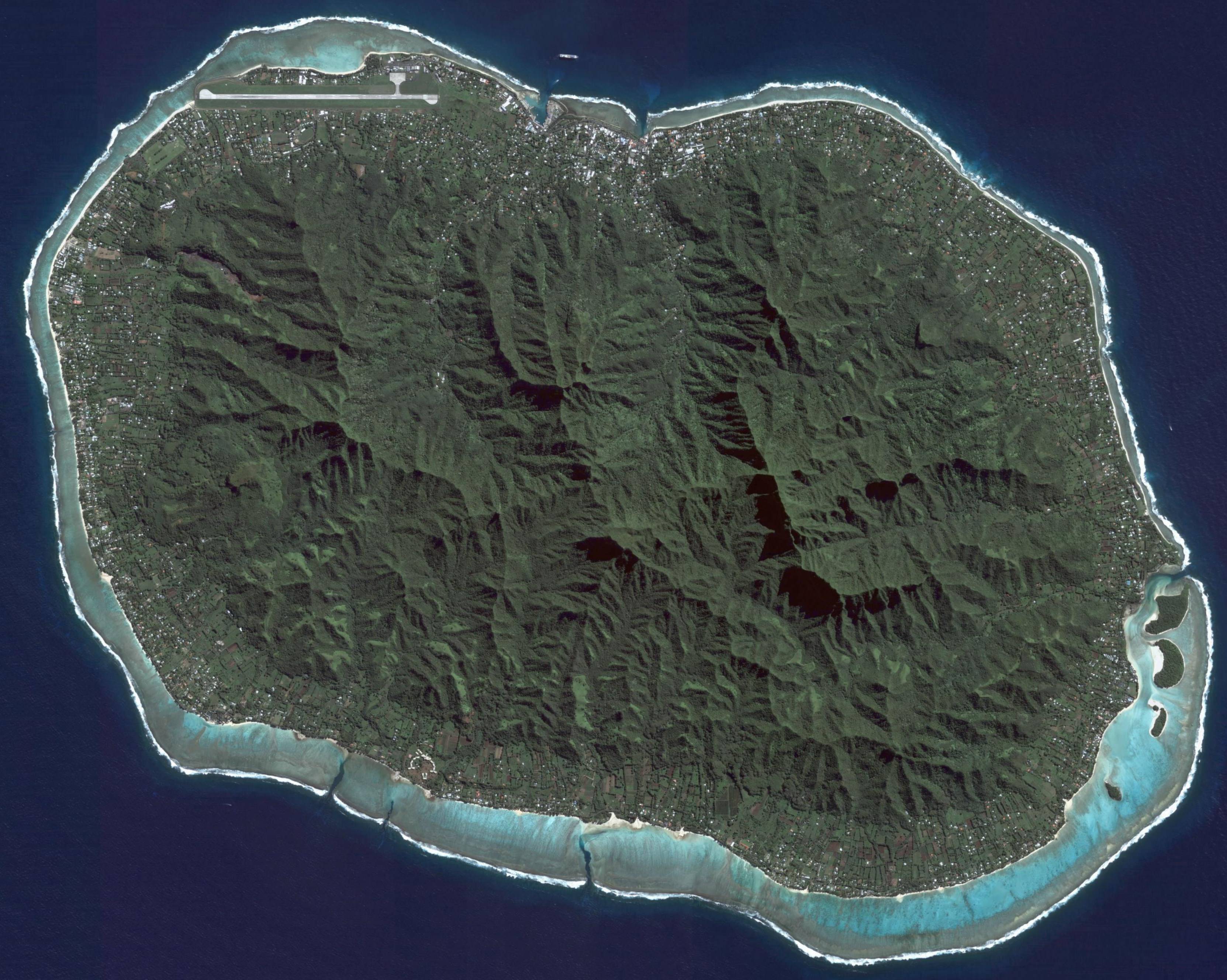
Rarotonga
The entire island is a single loop. Thirty-two kilometers of coastal road circling a volcanic core so steep and jungle-thick that nothing has ever been built in the interior. The clockwise bus leaves town on the hour. The counterclockwise bus leaves on the half hour. Whichever direction you choose, you'll be back where you started in fifty minutes - or you can get off anywhere and walk the beach between villages, wade the lagoon that wraps the island in a protective ring of turquoise, climb toward the Needle that punctures the clouds above. Rarotonga is the Cook Islands' main island, its capital, its gateway to everywhere else in the scattered archipelago. But it's also complete in itself: a self-contained tropical world where feral chickens crow at all hours, jet-blasted locals wave at incoming aircraft from the seawall, and the most urgent question of any day is whether to snorkel the marine reserve or hike to the waterfall.
The Volcanic Heart
Rarotonga is young by geological standards - just two million years since the volcano punched through the Pacific plate, and the cone has barely had time to erode. The interior rises sharply from the coastal strip, a wall of green ascending to knife-edge ridges and the spectacular spire of Te Rua Manga - the Needle - at 413 meters. The Cross-Island Track climbs through the jungle to its base, offering views of both coasts from a perch that feels like the world's rooftop.
The rock is ancient coral limestone around the coast, volcanic basalt in the peaks. Both are clothed in vegetation so lush it seems to breathe - hibiscus, frangipani, the massive leaves of taro, and the coconut palms that lean over every beach. Waterfalls tumble down the interior slopes when the rains come. Streams carve valleys that hikers follow upward, swimming in freshwater pools before the inevitable descent. The island was made for exploration, small enough to know completely, varied enough to never bore.
The Encircling Reef
What makes Rarotonga special isn't the mountain but the lagoon. A coral reef encircles the island like a protective wall, creating a calm inner harbor where the water glows in shades of impossible blue. At Muri Beach on the east coast, the lagoon stretches so far and stays so shallow that you can wade to the small motus offshore, palm-topped islets that exist solely to make postcards jealous.
The Aroa Lagoon on the southwest is a marine reserve, its waters thick with tropical fish that have never learned to fear humans. Snorkelers drift over giant clams, hover beside moray eels, watch schools of trevally move like single silver organisms through the crystal water. At Avaavaroa Passage in the south, sea turtles cruise the current, sharing the passage with eagle rays and reef sharks. The reef that creates this sanctuary also breaks the ocean swells - you can hear the distant thunder of waves crashing on the outer wall while floating in waters as calm as a swimming pool.
The Island Pace
Nothing in Rarotonga happens quickly. The buses run on 'island time' - roughly hourly, but the drivers prefer spots where they can pull off the road to chat. Push the stop button and you'll likely complete another lap of the island. Shops close early. Sundays are genuinely observed - the counterclockwise bus doesn't run at all. The speed limit is 50 kilometers per hour, and locals actually observe it, partly because the feral chickens that own every roadside have no road sense whatsoever.
This pace isn't laziness but philosophy. The Cook Islands are Polynesian to the core, and the Polynesian way is to live in relation - to family, to land, to sea, to the rhythms that existed before clocks. Saturday morning means the Punanga Nui Market in Avarua, where locals sell fresh fish, tropical fruits, and taro alongside tourists hunting black pearls. Island Night means feast and dancing at one of the resorts, the performers moving through dances that have been passed down for centuries. The rest is beach, snorkel, repeat - punctuated by coffee, by sunset drinks, by the kind of relaxation that takes a few days to remember how to do.
The Jet Blast Ritual
The runway at Rarotonga's airport runs parallel to the coast, separated from the beach by nothing but a low sea wall. When the Air New Zealand jets come in - particularly the larger aircraft from Auckland and Sydney - their approach takes them directly over the road where locals have gathered for a uniquely Rarotongan tradition: jet blasting.
Stand on the sea wall as the aircraft descends, and the roar builds to a physical presence, the plane passing overhead close enough to read markings, the downdraft pressing you toward the sand. It's loud, visceral, slightly terrifying, and absolutely free entertainment. The more adventurous head for the eastern end of the runway for takeoff blasts - exponentially more intense, definitely requiring earplugs, completely unforgettable. Nowhere else in the world does this happen so casually, so accessibly, so much a part of local life. The jets come and go. The locals wave. Another flight connects this tiny island to the wider world, and Rarotonga absorbs it without changing.
Gateway to the Outer Islands
Rarotonga is the largest of fifteen Cook Islands scattered across two million square kilometers of Pacific. It's also the jumping-off point for the others - Aitutaki with its stunning lagoon, the raised atoll of Atiu with its caves, remote Mangaia, the bird sanctuary of Suwarrow. Each island has its character, each its handful of visitors, each a different way of experiencing the vast Pacific isolation that was once the only reality here.
But Rarotonga itself is complete. You could spend a week here and never leave - hiking the cross-island track, snorkeling every beach, eating ika mata (raw fish in coconut cream) at different restaurants, watching the sunset paint the lagoon in colors that seem invented. The Needle will still be there tomorrow, the reef will still be full of fish, the bus will still loop the island as it has since roads were built. In a world that seems to speed up constantly, Rarotonga offers proof that slower is possible. The chickens crow. The palms sway. The lagoon glitters. Time, here, is measured in tides.
From the Air
Located at 21.23°S, 159.78°W, Rarotonga is a nearly circular volcanic island approximately 11km in diameter. Rarotonga International Airport (RAR) has a 2,300m paved runway on the island's north coast, roughly 2km west of the capital Avarua. The runway parallels the coast - notable for aircraft passing very low over the sea wall (popular local spectacle). From altitude, the island is distinctive: dark green volcanic core rising sharply to 658m (Te Manga), surrounded by a ring road, encircled by a reef creating turquoise lagoon. Muri Lagoon on the east coast is the main tourist area - visible as extended shallow water with small motus (islets). Avarua on the north coast is the only real town. The island is self-contained - one main road goes around it. Weather is tropical with distinct dry season (April-November) and wet season (December-March). Nearest significant airports: Aitutaki (AIT) 220km north; Auckland (AKL) 3,000km southwest. Air New Zealand provides the main international service.