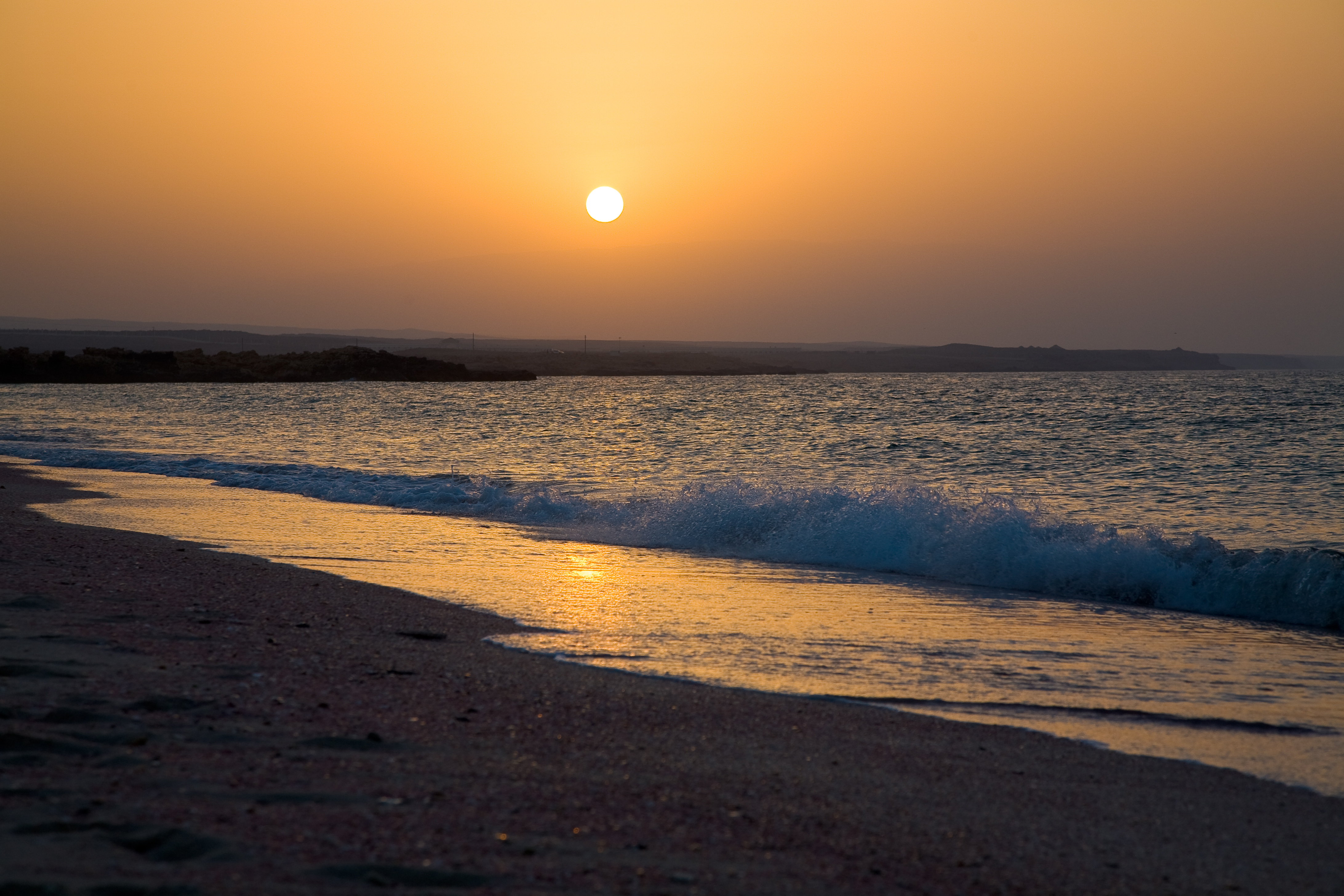
Ras al Hadd
Every night at Ras al Hadd, a ritual older than civilization repeats itself. Green sea turtles, some weighing 190 kilograms, drag themselves from the Gulf of Oman onto beaches at the easternmost point of the Arabian Peninsula. They excavate nests in the sand, deposit roughly a hundred eggs each, and return to the sea. Of those hundred eggs, statistically one hatchling will survive to adulthood. The turtles have been doing this for millions of years. The village that watches over them has been here for considerably less time, but the relationship between this headland and the sea defines both.
Where the Gulf Begins
Ras al Hadd occupies a strategic point at the entrance to the Gulf of Oman, where the Arabian Sea narrows into the strait that leads to the Persian Gulf. The Al-Hajar Mountains rise to the west, their eastern flanks descending into a coastline of rocky coves and sandy beaches. The village belongs to the Ash Sharqiyah district, a quiet settlement whose geography has always mattered more to empires and navies than its modest size would suggest. An airport was planned here, with construction beginning in 2011, but beyond laying a runway, nothing further materialized. The headland itself remains what it has always been: a geographical marker where waters meet and currents collide.
The Turtle Reserve
About sixty kilometers from Sur, the beaches at Ras al Hadd and nearby Ras al-Jinz host one of the world's most important populations of green sea turtles. Between six thousand and thirteen thousand turtles nest here annually. The Ras Al Jinz Turtle Reserve was designated a nature reserve on April 23, 1996. Visitors arrive at night, guided along dark paths to the beach where the turtles haul themselves ashore. The experience is deliberately low-key: minimal lighting, whispered instructions, no flash photography. What you witness is not a spectacle arranged for tourists but a biological imperative playing out on its own terms. Each female may return to lay eggs multiple times in a season, and each clutch contains roughly a hundred eggs buried in sand warmed by the Omani sun.
Watchers on the Point
Ras al Hadd's strategic position has attracted more than turtles. India maintains a listening post here, part of a broader network of intelligence installations that extend Indian military awareness into the western Indian Ocean. Berthing rights for the Indian Navy at Muscat's naval base complement the radar installation at Ras al Hadd, giving India electronic coverage of maritime traffic entering and leaving the Persian Gulf. The arrangement reflects the deep defense ties between Oman and India, built over decades of cooperation that predates the current geopolitical tensions in the region. The listening post operates quietly, its presence known but rarely discussed, monitoring the same waters where green turtles swim and tankers carry oil.
Edge of Arabia
Ras al Hadd feels like the edge of something. The land tapers to a point, the mountains recede, and the horizon opens in every direction. Fishermen launch boats into waters that have connected Arabia to India and East Africa for millennia. The lighthouse at the headland marks the transition from the Arabian Sea to the Gulf of Oman, a navigational boundary that matters to every ship captain approaching the Strait of Hormuz. At dawn, the light hits the water at an angle that turns the surface metallic, and you can see why the turtles return here year after year. Something about this place -- the temperature of the sand, the chemistry of the water, the geometry of the coastline -- registers as home in a brain the size of a walnut. They find their way back across thousands of miles of open ocean, and they have never been wrong.
From the Air
Coordinates: 22.52N, 59.77E, at the easternmost point of the Arabian Peninsula. Best viewed at 5,000-8,000 ft to see the headland's shape and the turtle nesting beaches. Ras al Hadd Airport (runway only, unfinished) is directly adjacent. Muscat International (OOMS) is approximately 250 km northwest. The lighthouse is a good visual reference. Clear conditions predominate.