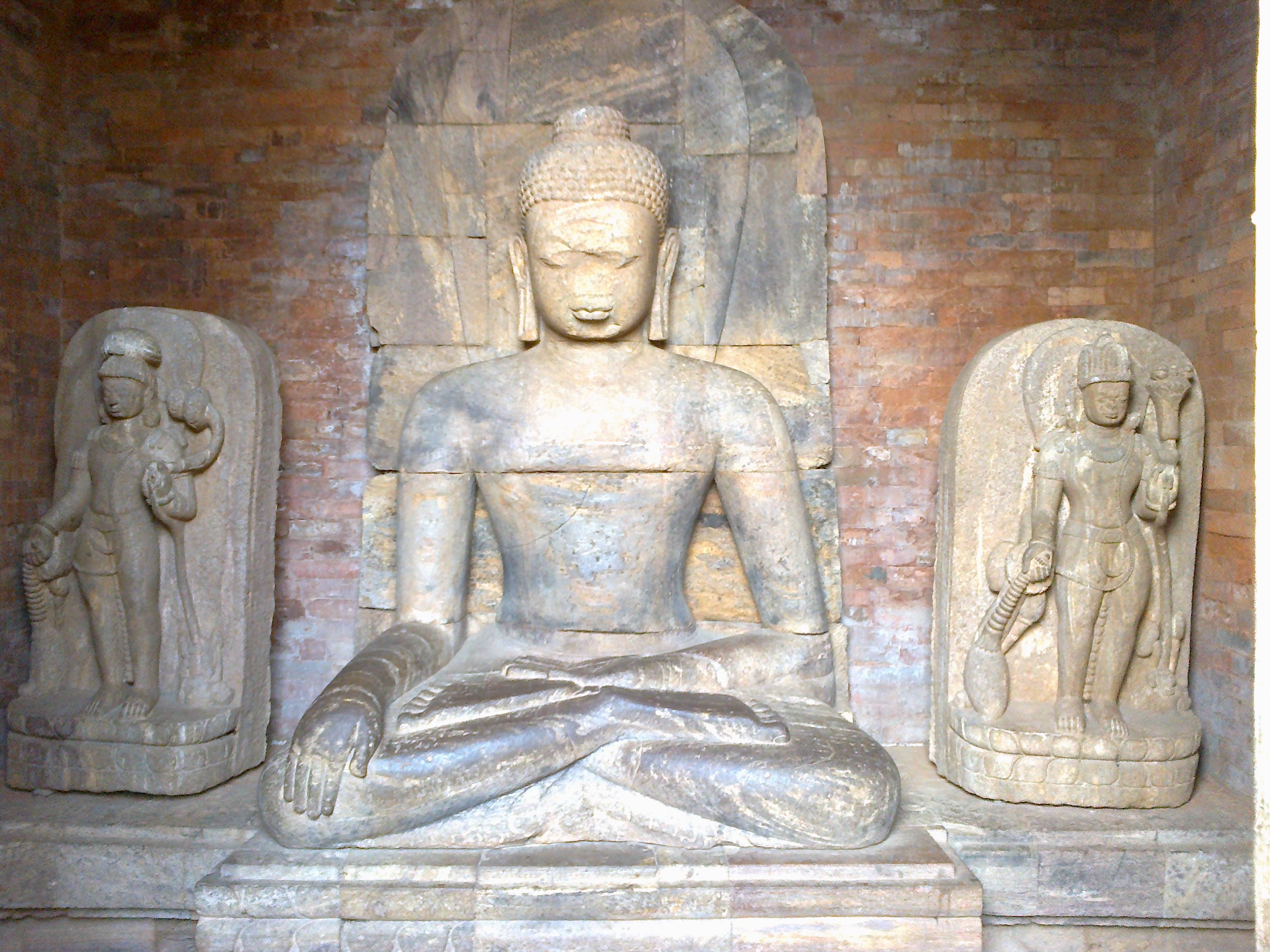
Ratnagiri, Odisha
The doorway stops you before anything else. Carved from blue-green chlorite, its innermost band rises in an intricate foliated arabesque, a thin vine stem undulating upward in a pattern so precise it seems grown rather than cut. The next zone features stylized lotus petals flattened into a design that scholars call "quite unique" in Indian art. And then the outer columns switch mid-composition from green chlorite to plum-colored khondalite, the bodies of playing putti straddling both stones as if the carvers refused to let geology interrupt their vision. This is the entrance to Monastery 1 at Ratnagiri -- called by the archaeologist Debala Mitra "the loveliest entrance to a structural monastery in the whole of India."
The Hill of Jewels
Ratnagiri means "hill of jewels" in Odia, and the name proved prophetic. Situated on a hill between the Brahmani and Birupa rivers in Jajpur district, this ruined mahavihara was once the major Buddhist monastery in Odisha. Construction began in the 5th century CE and continued through the 13th, with the peak period of artistic production falling between the 7th and 10th centuries. After perhaps the 16th century, the site ceased to function and fell into ruin, largely forgotten until major excavations by the Archaeological Survey of India in the 1960s revealed what lay beneath the overgrowth. Together with the nearby sites of Lalitgiri and Udayagiri, Ratnagiri forms what is known as the Diamond Triangle of Odishan Buddhism.
A Colossal Buddha Behind the Loveliest Door
Monastery 1 is the largest of three quadrangular monasteries at Ratnagiri, measuring 55 square meters overall with a 21-square-meter paved courtyard. It had at least two stories, though everything above the ground floor has collapsed. Twenty-four windowless cells line the ground floor, each large enough for multiple monks and fitted with wooden doors. Across the courtyard from that celebrated entrance sits the main shrine: a colossal seated Buddha, twelve feet high including its base, carved in chlorite in horizontal sections and flanked by standing figures of Padmapani and Vajrapani holding chamaras. The monastery was built in at least two major phases -- the first in the late 8th century, the second around the early 10th -- and scholars have noted that the later work, which includes some erotic scenes, represents a shift toward Tantric Buddhism.
Seven Hundred Small Stupas
The main stupa at Ratnagiri dates to the 9th century, built on the site's highest point with a square base measuring 47 feet on each side. It originally stood much taller than its current 17 feet. But what makes Ratnagiri exceptional is not the main stupa -- it is the more than 700 smaller stupas that surround it. Most stand less than a meter tall, carved from single pieces of stone, each bearing a seated deity figure in a niche and decorated with lotus petals and beaded tassels. Twenty-two different deities have been identified across the collection, and some unfinished examples reveal the production process: blanks with the deity niche left empty, waiting for a customer to choose. Scholars believe these miniature stupas served as memorials and reliquaries for dead monks and votive offerings from pilgrims. Nothing comparable exists at this scale at any other Indian Buddhist site.
Where Green Stone Meets Red
Ratnagiri's sculptors worked in two contrasting stones that give the site its distinctive visual character. Blue-green chlorite provided the material for fine carving -- doorways, Buddha images, decorative panels -- while the local khondalite, a garnet-bearing gneiss with plum-colored overtones, supplied structural elements and a warm counterpoint. The effect is striking: cool green figures emerging from warm reddish walls, a palette that the carvers exploited deliberately. Over two dozen colossal Buddha heads have been excavated, along with 27 bronze and brass figures. The earlier sculptures continue the classic Gupta style, while later works reflect the transition to Tantric Buddhism that paralleled developments at Nalanda in Bihar. A total of 1,386 clay seals bearing the legend Sri Ratnagiri Mahavihariya Aryabikshu Sanghasya confirmed the monastery's historical name.
Builders Without Borders
One detail about Ratnagiri challenges modern assumptions about religious separation in ancient India. Analysis of the sculpture demonstrates that some individual carvers worked at both Ratnagiri and the Baitala Deula, a Hindu temple in Bhubaneswar. River goddesses borrowed from the Hindu pantheon -- Yamuna in "sisterly camaraderie" with companions, Gaja-Lakshmi guarding the entrance -- appear throughout the Buddhist complex. Figures of Pancika, the Hindu Kubera, and his consort Hariti represent material and spiritual wealth at more than one level. This "lack of sectarian specialization" among builders and carvers was common across India, a reminder that the boundaries between religious traditions were far more porous in practice than they appear in textbooks.
From the Air
Ratnagiri is located at 20.64N, 86.34E on a hilltop between the Brahmani and Birupa rivers in Jajpur district, Odisha. From altitude, the site is part of the Diamond Triangle with Lalitgiri (20.59N, 86.25E) and Udayagiri (20.64N, 86.27E) visible nearby. Biju Patnaik International Airport (VEBS) in Bhubaneswar is approximately 100 km southwest. The site is about 70 km from Cuttack. The river system and hilltop positions of the three sites are distinguishable from lower altitudes in clear conditions.