Ravello
Richard Wagner arrived in Ravello in 1880, climbed through the gardens of Villa Rufolo, and declared that he had found Klingsor's enchanted garden — the setting he had been struggling to imagine for the second act of his opera Parsifal. The gardens still overlook the same view that stopped Wagner mid-sentence: a sheer drop to the coastline below, the Tyrrhenian Sea spreading to the horizon, and a silence broken only by wind and birdsong. Ravello sits 350 meters above the Amalfi Coast, high enough to feel removed from the bustle of the shore towns, close enough to see them laid out beneath you like a relief map.
Two Villas, Two Infinities
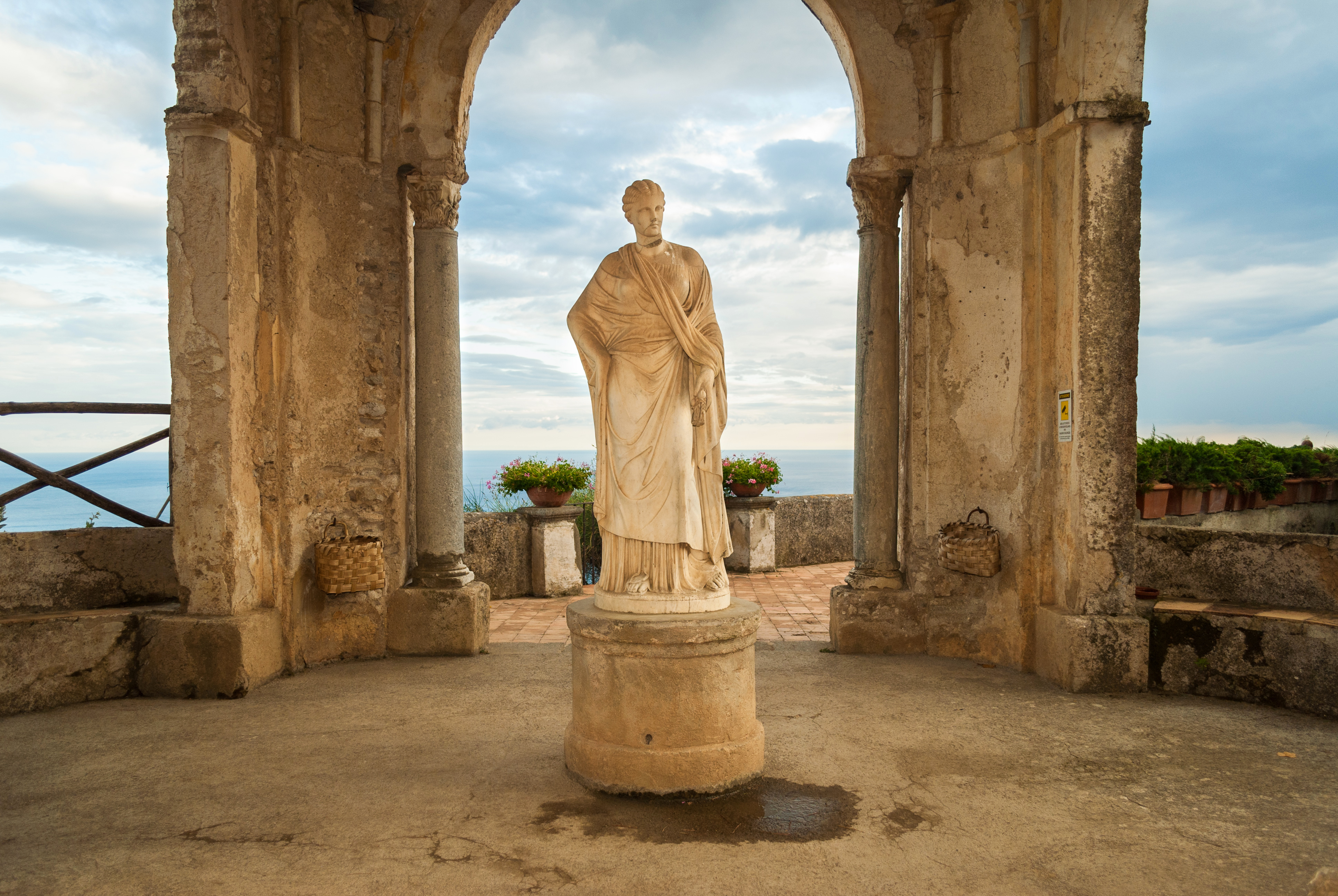
Ravello's identity rests on two gardens, each offering a different version of the sublime. Villa Rufolo, in the center of town beside the Piazza Duomo, dates to the 13th century and was built by the wealthy Rufolo family during Amalfi's era as a maritime republic. Its layered terraces, Moorish arches, and overlapping garden rooms are the setting that inspired Wagner, and today the villa's main terrace serves as the stage for the Ravello Festival's summer concerts, with the sea and sky as a backdrop that no theater could replicate. Villa Cimbrone, a short walk along a narrow lane lined with wisteria, culminates in the Terrace of Infinity — a marble-balustrade belvedere lined with 18th-century busts, perched at the edge of a cliff with nothing between you and the Mediterranean but 300 meters of air. Gore Vidal, who kept a home in Ravello for decades, called it the most beautiful view in the world.
A Festival Born from Admiration
The Ravello Festival began in 1953, founded explicitly in homage to Wagner's visit 73 years earlier. What started as a chamber music series on the Villa Rufolo terrace has grown into a major summer arts program spanning orchestral concerts, ballet, film screenings, and visual art installations that run from June through September. The festival's signature image — a symphony orchestra performing on a stage cantilevered over the cliff edge, with the audience seated in the open air and the coast glowing below — has become one of Italy's most recognized cultural scenes. But the festival has expanded well beyond Wagner. Contemporary composers, jazz ensembles, and world music acts now share the program, and the spirit has shifted from reverence for a single genius to a broader celebration of what happens when art meets an extraordinary landscape.
Wine from the Vertical Hillside
Below Ravello's streets, vineyards cling to terraces so steep that harvesting by machine is impossible. The grapes that survive this terrain produce white wines of distinctive mineral character — a product of volcanic soils, sea air, and punishing sun exposure. Two local DOC wines stand out: Vigna San Lorenzo, from the Episcopio winery housed inside the Hotel Palumbo, and Selva delle Monache, from the Ettore Sammarco estate. Both wineries are located within the town itself, which means tasting local wine in Ravello involves walking a few hundred meters from the Piazza Duomo rather than driving to some distant countryside estate. The vineyards are part of the view — those green terraces stepping down the hillside are not decorative landscaping but working agricultural land, producing wine from slopes where a single misstep means a tumble into the lemon groves below.
The Quiet Above the Coast
What distinguishes Ravello from its famous neighbors — Positano, Amalfi, Sorrento — is altitude and its consequences. Cars cannot enter the town center; there is one parking lot near the main square, and after that, everything happens on foot. The town is small enough to walk end-to-end in fifteen minutes, and its population is a fraction of the coastal cities below. SITA buses connect Ravello to Amalfi, the main transit hub on the coast, and from Amalfi ferries scatter to Positano, Salerno, Sorrento, and Naples. But the ride up from the coast — a series of switchbacks climbing through chestnut forests — creates a psychological boundary. Ravello feels apart. The cafes around Piazza Duomo serve espresso to a quieter crowd, the boutiques sell handmade ceramics rather than mass-market souvenirs, and by evening the town empties of day-trippers, leaving behind the guests of its small hotels and the sound of rehearsal drifting from the Villa Rufolo stage.
From the Air
Ravello sits at 40.650°N, 14.617°E, perched in the hills above the Amalfi Coast at approximately 350 meters elevation. From 3,000-5,000 feet AGL, it is visible as a small cluster of buildings set back from the coastline on a ridge above the town of Amalfi. The distinctive terraced gardens of Villa Rufolo and Villa Cimbrone extend to the cliff edge. The coast road below follows the narrow shelf between mountains and sea. The nearest airport is Salerno Costa d'Amalfi (LIRI), approximately 10 nautical miles to the southeast, with Naples International (LIRN) about 30 nautical miles to the northwest. Mountain turbulence and updrafts from the heated cliff faces are common, especially in afternoon thermal conditions.