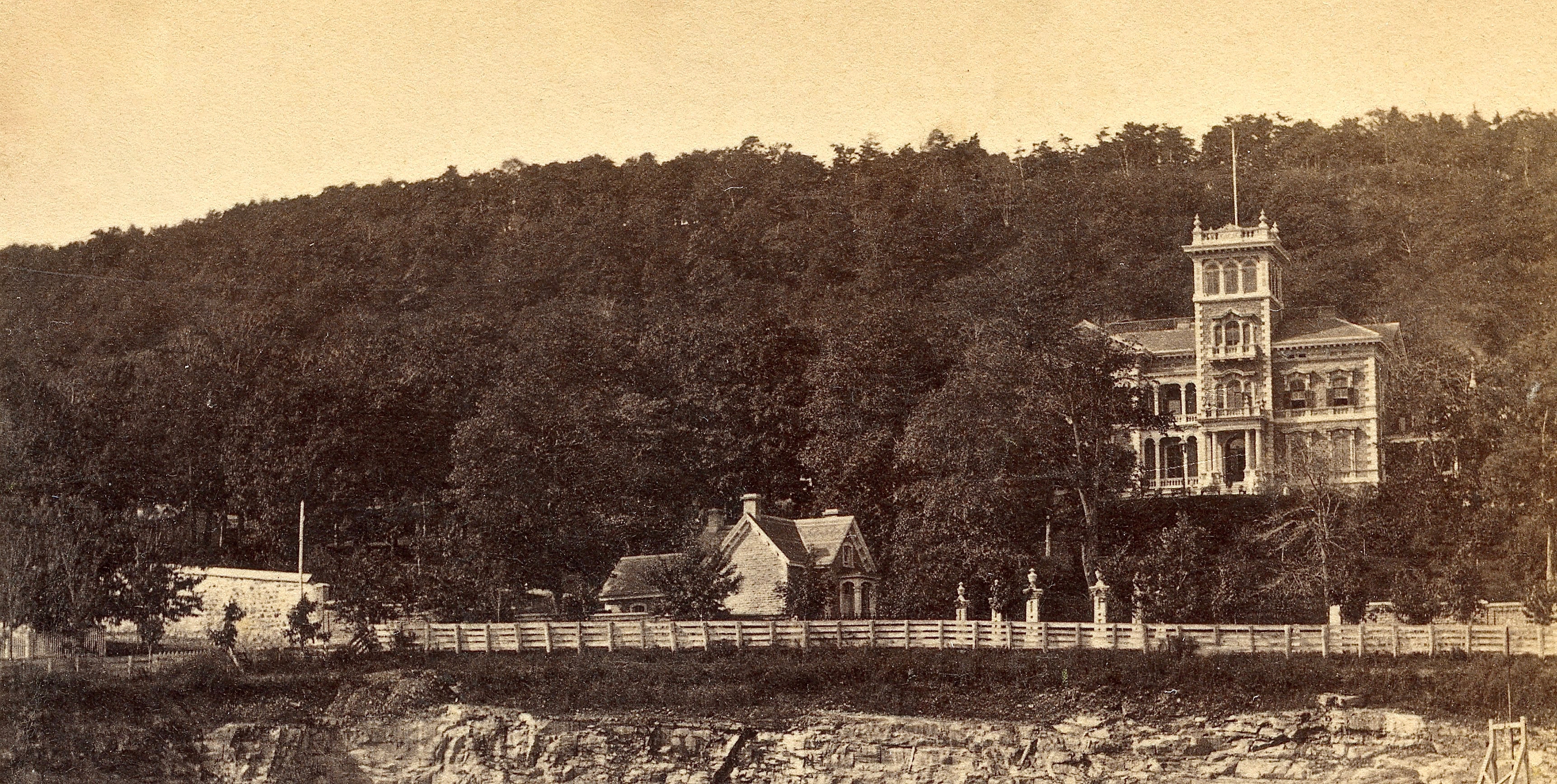
Ravenscrag, Montreal
Above the portico of the mansion, carved in stone, a dog's head gazes outward beneath a single Latin word: Spero. Hope. The motto of the Allan family has presided over this spot on Mount Royal's southeastern slope since the 1860s, watching the house below transform from the grandest private residence in Montreal into a hospital for the mind, and now into something not yet decided. Ravenscrag is a 34-room Italianate villa in the Golden Square Mile, built between 1861 and 1863 for Sir Hugh Allan, the shipping magnate who was then the richest man in Canada. Its story tracks the arc of Montreal itself -- from colonial ambition through gilded excess to institutional reinvention -- all within the walls of a single building perched above the city.
A Fur Trader's Ghost and a Shipping King's Dream
The land beneath Ravenscrag carries its own history. It was once part of the vast estate of Simon McTavish, the wealthy fur trader whose property stretched from the mountaintop down to Saint Catherine Street. In 1803, McTavish began building a chateau to honor his wife, Marie-Marguerite Chaboillez. He died in 1804 before it was finished, and construction stopped forever. Decades of subdivision followed. On November 23, 1853, Hugh Allan purchased a lot on the southeast slope of Mount Royal at auction from David Torrance. Allan was already wealthy from his shipping empire, and he wanted a home that reflected his position. He hired architect Victor Roy of the firm William Spier & Son to design an Italianate villa inspired by Osborne House, the British royal summer residence built for Queen Victoria and Prince Albert on the Isle of Wight. The result was a house with 34 rooms -- not counting servants' quarters -- perched high above the noise and prying eyes of the city, with commanding views down to the Saint Lawrence River.
Frescoes, Ballrooms, and a Governor General's Approval
Hugh Allan spared nothing on the interior. He hired the Italian painter Giuseppe Guidicini to execute decorative frescoes in the living room and library. He commissioned a Carrara marble fireplace mantel from Montreal sculptors Jules Souquere and Gervais Buffle. The Montreal Foundry and City Works forged the wrought iron gates. By 1865, Allan had added a billiard room, an anteroom, a full ballroom, and a greenhouse to the already enormous house. The most lavish evening in Ravenscrag's history came on November 21, 1872, when Hugh Allan hosted 300 guests for a ball honoring the Earl of Dufferin, then Governor General of Canada. The ballroom ceiling was painted with gold-background portrait medallions. The walls were hung with gilt cornices and heavy curtains. The sumptuousness of the evening was likely not unrelated to Allan's ambitions regarding the construction of a transcontinental railway -- ambitions that would later engulf him in the Pacific Scandal. Three years earlier, in November 1869, he had thrown a party for Prince Arthur of the United Kingdom, at which observers noted that "such a display of rich clothes has never been seen in Montreal."
From Drawing Rooms to Psychiatric Wards
Hugh Allan died on December 27, 1882. All flags in Montreal were lowered to half-mast, and many businesses closed. His will left the house and all its furniture to his son, Hugh Montagu Allan, who continued the family tradition of hospitality. Montagu received Prince Fushimi Hiroyasu, brother of the Emperor of Japan, in 1907 -- a visit that earned him the Order of the Rising Sun. But by 1938, the Allans had moved to an apartment on Sherbrooke Street. When World War II broke out in 1939, they offered Ravenscrag to the Canadian government as a convalescent home. The government did not know what to do with it, so in 1940 the couple donated it to the Royal Victoria Hospital instead. On November 18 and 19, 1940, the residence's furniture went to auction: hunting trophies, life-size candelabra supported by caryatids, hallway carpets, elephants carved in ivory and ebony. The hospital transformed the mansion into Canada's first psychiatric department in 1943, under the directorship of Dr. Donald Ewen Cameron, a professor at McGill University. The balconies and terraces were destroyed. The greenhouse was removed. Ravenscrag became the Allan Memorial Institute.
Between Two Lives
The Allan Memorial Institute operated within Ravenscrag's walls for decades, eventually joining the McGill University Health Centre in 1997. A new wing of Queenston limestone, inaugurated in 1953, expanded capacity to 250 beds. An annex added in 1986 brought another twenty. But when the Royal Victoria Hospital moved to a new site in April 2015, Ravenscrag's future became uncertain once again. In 2019, the City of Montreal published an official heritage statement recognizing the "exceptional quality" of the villa's architecture and the "formidable library furniture" still inside. The richly carved rosettes on the original ballroom ceilings, now concealed above a suspended ceiling installed decades ago, were singled out for artistic value. In 2023, the MUHC transferred the property to the Societe quebecoise des infrastructures to support McGill University's proposed "New Vic" pavilion. The estate is now part of the Mount Royal Heritage Site, protected by provincial decree since 2005. The dog's head still watches from the pediment. Spero. Hope -- for whatever Ravenscrag becomes next.
From the Air
Ravenscrag sits at 45.51N, 73.58W on the southeast slope of Mount Royal, in Montreal's Golden Square Mile district. From the air, the Italianate villa and its stable complex are visible among the trees below the Royal Victoria Hospital buildings on the mountainside. Best viewed from 2,000-3,000 feet AGL on an approach from the south or east, with the mountain as a backdrop. Montreal/Pierre Elliott Trudeau International Airport (CYUL) lies approximately 13 nm to the west. Montreal/Saint-Hubert Airport (CYHU) is roughly 10 nm to the southeast. Mount Royal's cross and the downtown skyline provide strong visual reference points.