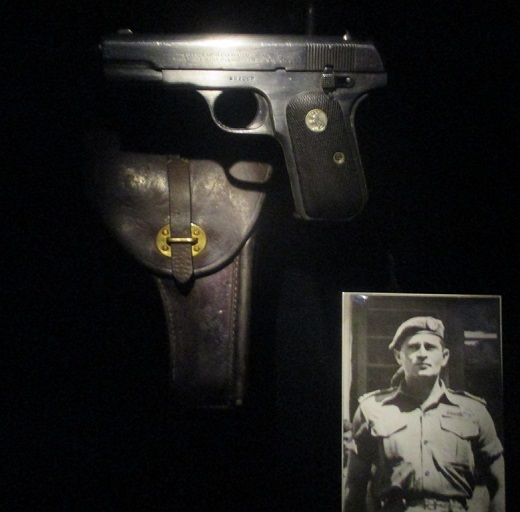
Raymond Westerling
Between December 1946 and February 1947, on the Indonesian island of Sulawesi, soldiers under the command of a Dutch officer named Raymond Westerling rounded up villagers at dawn, separated the men from the women and children, and executed those they decided were guerrillas or sympathisers. The killings happened in village after village across the southern peninsula. Indonesian historians put the death toll at around 40,000 over the whole campaign; a Dutch government investigation later acknowledged figures in the low thousands, including roughly 3,500 killed directly by Westerling's unit. The dead were teachers and farmers, fishermen and rice growers, children and old men. They had names that the Dutch records did not bother to keep. The man who ordered the killings lived another forty years after the war and was never put on trial.
South Sulawesi, 1946 to 1947
The killings happened in a colony that no longer wanted to be a colony. Indonesia had declared independence on 17 August 1945, two days after Japan's surrender, and the Netherlands - newly liberated itself from German occupation - refused to accept it. The Dutch military returned to a country in armed revolt. In southern Sulawesi, an island in the eastern half of the archipelago, the resistance against the returning Dutch was strong, and Dutch commanders authorised a counter-insurgency campaign by the Depot Speciale Troepen, the Special Forces Depot, under Westerling. The method became known as the Westerling method. His units would surround a village before dawn, march everyone to a central place, and identify supposed insurgents on the basis of denunciations or the commander's judgement. Those identified were shot in front of the rest, sometimes one by one, sometimes in batches. The intent was to terrorise the wider population into giving up the independence fighters.
The People of South Sulawesi
The Indonesian victims of these months were Bugis, Makassarese, Mandar, and Toraja people, communities that had lived along the southern peninsula of Sulawesi for centuries before any European had set foot in their islands. They were rice farmers and fishermen, weavers and traders, with their own kingdoms and languages and elaborate funeral traditions that the Dutch records never noticed. They were not anonymous casualties of an operation. They were a population that had decided their country should belong to them, and the Dutch state's response was to send a unit that killed in a way designed to be remembered. Indonesia today commemorates 11 December as a day of remembrance for the victims of what they call the South Sulawesi massacres. The Dutch government formally apologised in 2013 for executions carried out by Dutch troops in Indonesia during this period, and in 2022 the prime minister acknowledged systematic and excessive violence by the Dutch military across the entire Indonesian war.
Who Westerling Was
Raymond Pierre Paul Westerling was born on 31 August 1919 in Istanbul, then still being called Constantinople by many Europeans, to a Dutch father and a Greek mother. He grew up speaking Turkish, Greek, French, and English - but not Dutch - and only first visited the Netherlands in 1940, just as the German army was overrunning it. He volunteered for the Royal Netherlands East Indies Army in 1941, trained in Britain under commando instructors during the war, and was deployed to the East Indies after Japan's defeat. He was 27 years old when the South Sulawesi operations began. He was 28 when they ended. Witnesses later described a man who was calm during the killings, who often carried them out personally, and who seemed to believe entirely in his own methods. He was relieved of command in November 1948, not for the killings themselves but because his political loyalties had grown suspect.
The Coup Attempt and Escape
In January 1950, with the Netherlands having formally transferred sovereignty to Indonesia the previous month, Westerling tried to overturn the new state by force. He gathered a few hundred former colonial soldiers under a militia he called the APRA - Legion of the Just Ruler - and on 23 January 1950 his column attacked the city of Bandung, killing dozens of Indonesian soldiers. The wider coup plan, which included a strike on Jakarta to murder members of the new Indonesian cabinet, collapsed within days. Westerling fled. With the help of his wife and Dutch intelligence contacts, he escaped Indonesia disguised as a Dutch sergeant aboard a flight out of Tanjung Priok, landed in Singapore, was briefly detained by the British, and reached Belgium in mid-1951 before secretly entering the Netherlands in April 1952. The new Indonesian government demanded his extradition. The Netherlands refused.
The Investigation That Never Quite Happened
In the Netherlands, Westerling lived openly. He ran a bookshop in Amsterdam. He sang opera, taking the stage name Paul Vanger. He gave interviews. A 1969 Dutch television documentary - De Excessennota - brought the South Sulawesi killings back into national consciousness and forced a government investigation; the resulting Excessennota report admitted that excesses had occurred but stopped short of prosecutions. A 1954 internal Dutch military investigation, the Van Rij and Stam report, had already found Westerling's actions criminal, but its conclusions were suppressed at the time. He died on 26 November 1987 in Purmerend, just north of Amsterdam, at the age of 68. He had outlived almost everyone who could have testified against him.
What Remains
What remains is the work of remembering, which the Indonesians have done with more rigour than the Dutch. Indonesian historians, journalists, and descendants of victims have spent decades reconstructing what happened in those months in their own villages. Dutch researchers, especially in the past twenty years, have begun to catch up. The 2022 Beyond the Pale research project, funded by the Dutch government, concluded that systematic, structural violence by Dutch forces in Indonesia was not the exception but a chronic part of the colonial war. Westerling is not a unique figure in that history. He is the most notorious, but he was not alone, and the system that produced him - a colonial state that refused to accept its own end - was responsible for far more than one officer's actions. The villages in South Sulawesi where the killings happened are still there. They still hold the names of the dead.
From the Air
Coordinates 52.346 N, 4.939 E - the location is in the northern part of Amsterdam, near where Westerling lived in his later years and close to Purmerend where he died in 1987. The Dutch landscape here is urban-edge: low residential streets, canals, the Noordhollandsch Kanaal cutting north. Best viewed at 2,000 to 4,000 ft AGL. Closest airport: Amsterdam Schiphol (EHAM), 12 km south-west. Lelystad (EHLE) lies 35 km east. This story's geographic anchor is Dutch, but the events it commemorates happened more than 12,000 km away in South Sulawesi, Indonesia.