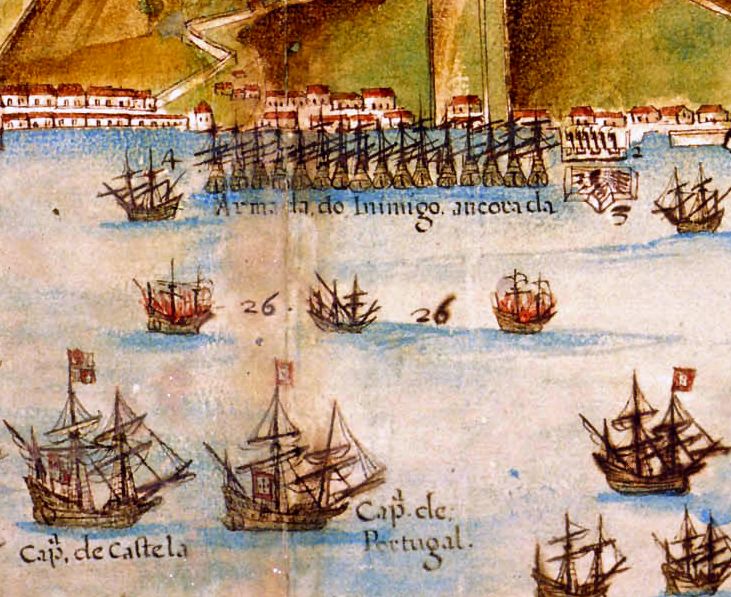
Recapture of Bahia
In August 1624, messengers reached Madrid with news that shook the Spanish court: a Dutch fleet had sailed up to Salvador, the capital of Portuguese Brazil, and taken the city in a single afternoon. Philip IV, who ruled both Spain and Portugal under the Iberian Union, ordered a response at a scale the Atlantic had rarely seen. By January of the following year, fifty-two warships carrying twelve thousand Spanish, Portuguese, and Italian soldiers were putting to sea from Lisbon and Cádiz, bound for the Bay of All Saints. The campaign that followed was brief, brutal, and decisive - and it reveals something about how fragile empires could be in the seventeenth century, and how much blood it cost to hold them together.
The Dutch Gamble
On December 22, 1623, a Dutch fleet of thirty-five ships under Admiral Jacob Willekens and Vice Admiral Piet Heyn slipped out of the Texel anchorage carrying 6,500 men. Most of the ships belonged to the West India Company, a joint-stock venture founded two years earlier to break the Iberian monopoly on Atlantic trade. A storm scattered them in the North Atlantic, but they regrouped at Cape Verde and pressed on. Willekens's target, revealed to the fleet only in African waters, was Salvador - the sugar-producing heart of Portuguese America and a natural base for attacking Iberian trade with the East Indies. Spanish spies in the Netherlands had warned Madrid the attack was coming. The Count-Duke of Olivares, Philip's chief minister, did not believe them.
The Fall of Salvador, 1624
When Willekens's fleet appeared off Salvador on May 8, 1624, the Portuguese governor Diogo de Mendonça Furtado had little time to organize a defense. He recruited three thousand men in haste, most of them unwilling peasant levies and enslaved Africans, many of whom resented Spanish rule over Portugal. The city's fortifications were hurriedly extended with moats and ramparts. None of it was enough against a professional Dutch landing force. Within a day the city had fallen. The Dutch commander Johan van Dorth organized the occupation, drawing more enslaved people into the defense with promises of freedom and land - promises that turned out to be more instrumental than principled. Dorth was killed in a skirmish outside the walls. His successor Albert Schoutens died in another ambush, replaced by his brother Willem. Portuguese guerrilla bands in the surrounding forest made the occupation miserable and contained.
The Iberian Fleet
Philip IV put Don Fadrique Álvarez de Toledo y Mendoza in command of a joint expedition. The Portuguese fleet left Lisbon on November 22, 1624 under Manuel de Menezes, with Francisco de Almeida as second-in-command - twenty-two ships and about four thousand men. The Spanish fleet sailed from Cádiz on January 14, 1625 after storms delayed its departure: thirty-eight ships, including twenty-one galleons drawn from the armadas of Castile, Biscay, Gibraltar, and Cuatro Villas, carrying eight thousand sailors and soldiers. The soldiers were organized into three tercios - two Spanish and one Italian, commanded by Pedro Osorio, Juan de Orellana, and Carlo Andrea Caracciolo, Marquis of Torrecuso. A council of war at Cape Verde on February 11 set the course for Brazil. The combined fleet lost a Portuguese ship and 140 men to shoals off Maio Island. On March 29, 1625, it entered the Bay of All Saints.
The Siege
Toledo anchored the fleet in a huge crescent, blocking the Dutch ships inside the harbor. At dawn on the second day, four thousand Iberian soldiers landed at Santo António beach with four days' rations and linked up with the Portuguese guerrillas already in the hills. The Dutch garrison - about 2,000 Dutch, English, French, and German soldiers plus roughly 800 African auxiliaries - was forced inside the city walls. The eighteen Dutch ships crowded beneath the protection of shore batteries. Siege work followed. Iberian artillery fired down on the Dutch positions from the occupied Carmen and San Benito quarters, and pioneers dug saps toward the ramparts. During one Dutch sortie, the Spanish maestro de campo Pedro Osorio died along with seventy-one officers and soldiers; sixty-four more were wounded. Juan de Orellana drowned. The Dutch surrendered after several weeks, and the prisoners were shipped home on German merchantmen - the officers to face trial for losing the city. The Dutch did not return to Brazil in force until 1630, when they seized Pernambuco instead. The men who fought on both sides at Salvador - Spaniards, Italians, Portuguese, Dutchmen, Englishmen, Germans, and the Africans pulled into the war on all sides - left names in ships' rolls and rarely much else. Their bones are somewhere under the streets and the bay.
From the Air
The 1625 siege took place at Salvador, Bahia, at approximately 12.97°S, 38.50°W. The fleet's anchorage extended across the narrow mouth of the Baía de Todos os Santos - a natural amphitheater roughly 50 km across. Santo António beach, where the Iberian landing force came ashore, lies on the Atlantic side of the peninsula, north of the colonial city. Nearest modern airport is Salvador Bahia Airport (ICAO: SBSV, IATA: SSA), about 28 km north of the historic city center. From 6,000-8,000 feet the bay's shape and the defensive role of the bluff-top Cidade Alta become obvious; the same crescent of water that sheltered seventeenth-century fleets still hosts the working port below Pelourinho. Trade winds from the east-southeast are reliable year-round.