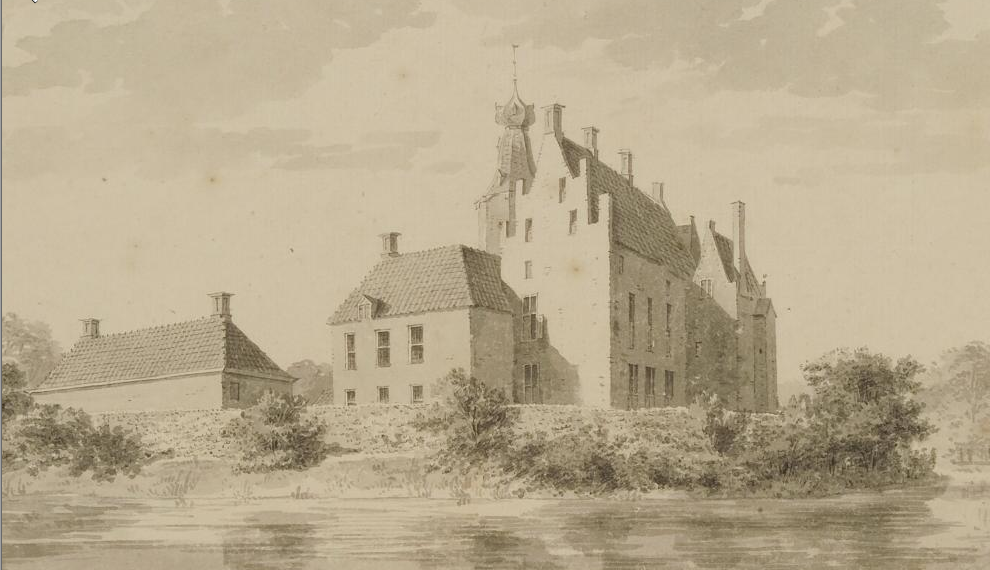
Rechteren Castle
In 1591, Prince Maurice of Orange sent word to the owners of Rechteren Castle with an unusual request: take it apart. Not the whole castle, just the fortifications. The ring wall came down, the main moat was drained, and the stronghold on its island in a side-branch of the Overijsselse Vecht was deliberately weakened. The point was to deny Spanish troops a position they might otherwise seize. It worked. Rechteren survived the Eighty Years War by ceasing, for a while, to be a fortress. More than four centuries later it is still here, still on its island, still in the hands of the family that gave it their name, and still the only medieval castle in the entire province of Overijssel.
Layers of Ownership
Rechteren first appears in the written record in 1190, when the counts of Bentheim held it as a frontier outpost on the wet margins of the IJssel lowlands. In 1315 it passed to Herman van Voorst, and from him through a cascade of medieval inheritances into the van Heeckeren family. The line eventually split, producing two branches: the van Voorst and the van Rechteren. The counts of Rechteren inherited the castle that bore their name, and they have not let go. The estate remains private property of the family today and is not open to the public. The continuity is the rare thing here. Most European castles cycled through dozens of owners and were sold off, ruined, or absorbed into the state. Rechteren stayed where it began.
Built, Unbuilt, Rebuilt
The walls and rooflines visible today are not what stood here in the Middle Ages. After the dismantling of 1591, the castle was rebuilt for residence rather than defense. The 18th century brought two new wings flanking the main building. Then in 1896 came a thorough Neo-Gothic makeover of the main block and the central tower, in keeping with the Victorian taste for medieval drama. By the 1950s that drama had fallen out of fashion. The Neo-Gothic flourishes were stripped away and the 18th-century silhouette restored. The result is a castle that looks older than its visible surfaces, which is to say it looks the way its owners decided in the postwar years that it should look.
Refuge in War
Rechteren's longest service to people outside the family came during the Second World War. As the Allies bombed and the Germans evacuated coastal towns, the castle opened its doors to roughly sixty refugees displaced from Katwijk, Noordwijk, and Scheveningen on the North Sea coast. For the duration of the war the moated island in Overijssel became a temporary home for families who had lost theirs. The story is told in a single sentence in the standard accounts, but it represents the kind of quiet decency that rarely gets monuments. When the war ended the refugees went home, and Rechteren returned to being what it had been for centuries: a private house, occupied by the same family, set apart by water.
What the Photographs Show
Because the castle is closed to visitors, what is known of the interior comes mostly from two photographic surveys, taken in 1908 and again in 1991. The vestibule is hung with family portraits going back generations. There is a white salon in the rococo style, all curves and pale ornament. The dining room is decorated with scenes from Greek mythology painted by Herman ten Oever. The central hall holds more portraits and the heraldry of the Rechteren line. For those flying or driving past, the visible signature is the moated island itself and the entrance bridge crossing the water to the gate, an arrangement that has hardly changed in shape since the 1700s.
From the Air
Rechteren Castle sits at 52.498N, 6.289E, on a small island in a side-branch of the Overijsselse Vecht just east of Dalfsen, in the eastern Netherlands. From the air, look for the meander of the Vecht and the rectangular moated island a few kilometers west of the river's main channel. The castle's red roofs and surrounding parkland stand out against the surrounding farmland. The town of Zwolle is about 15 km to the west, Groningen Airport Eelde (EHGG) lies further north, Schiphol (EHAM) about 130 km west. Best viewed from low altitude in clear conditions; the moat is most legible when the sun is low enough to throw shadows.