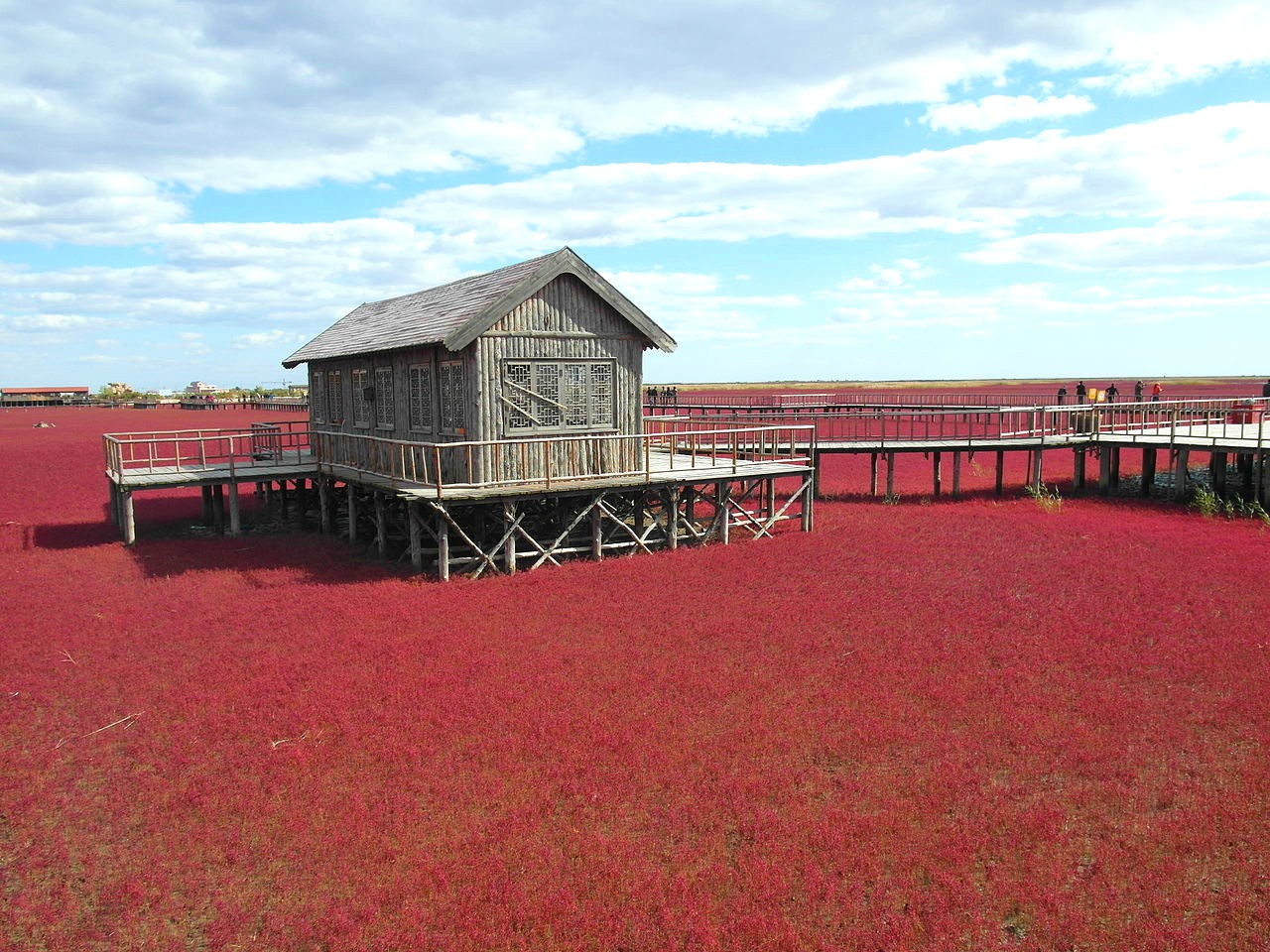
Red Beach (Panjin)
There are no white sands here, no turquoise surf. The beach at Panjin is red -- a deep, saturated crimson that stretches to the horizon, as if someone had spilled an ocean of paint across the tidal flats of the Bohai Sea. The color comes from a single plant: Suaeda salsa, a salt-tolerant species that thrives in the highly alkaline soil of the Liao River delta and turns from pale pink in spring to deep scarlet by autumn.
The Color of Survival
Suaeda salsa belongs to the family Chenopodiaceae, and its talent is surviving where almost nothing else can. The soil of the Liao River delta is so alkaline that conventional plants cannot take root. Suaeda thrives in this hostile chemistry, colonizing the tidal flats in vast, unbroken carpets. Its growth cycle begins in April, when the young plants show a pale, tentative red. As summer progresses and the plants mature, the color deepens and intensifies, reaching its most dramatic saturation in September and October. From the air, the effect is extraordinary: a landscape that appears to be bleeding, a wetland turned into abstract art by the simple fact of one plant's biochemistry.
Asia's Largest Reed Marsh
Red Beach does not exist in isolation. It sits within the Panjin Shuangtaizi River mouth state-level nature protection area, a sprawling wetland complex that preserves one of the most ecologically intact coastal environments in China. Promoted to state-level protection in 1988, the reserve has applied to join the UNESCO International Man and Biosphere network. More than 260 species of birds and 399 species of wild animals inhabit the wetland. Adjacent to the Suaeda flats lies the largest reed marsh in Asia, a vast expanse of Phragmites reeds that are harvested for papermaking -- an industrial use that coexists, somewhat improbably, with the reserve's conservation mission.
Cranes and Gulls
The wetland's most celebrated residents are its birds. The red-crowned crane, Grus japonensis -- one of the rarest and most culturally significant birds in East Asia -- breeds here, its white-and-black plumage a stark contrast to the red landscape beneath. The reserve is also the largest known breeding ground for the endangered black-mouth gull, a species whose survival depends on exactly this kind of undisturbed coastal wetland. The juxtaposition is striking: an industrial province in northeast China, a coastline that has been exploited for resources since antiquity, and yet here, in the alkaline tidal flats where conventional agriculture cannot gain a foothold, nature has created one of the most biodiverse habitats in the country.
Reading the Landscape from Above
Red Beach rewards aerial observation like few other landscapes. The color change is vivid enough to register from cruising altitude -- a rust-red expanse that stands out dramatically against the grey-green of surrounding wetlands and the murky waters of the Bohai. The boundary between red Suaeda and green reeds creates geometric patterns shaped by tidal channels and drainage, a natural mosaic that shifts with the seasons. In spring, the palette is muted pinks and greens. By late summer, the red overwhelms everything. And in winter, when the Suaeda dies back and the frost arrives, the landscape returns to brown and grey, waiting for April to bring the color back.
From the Air
Located at 40.90N, 121.82E in Dawa County, Panjin, Liaoning. The red coloration of Suaeda salsa is visible from altitude, especially in September-October. Look for the dramatic color contrast between the red tidal flats and the surrounding green reed marshes near the Liao River delta. Nearest airport is Yingkou Lanqi (ZYYK) to the south; Shenyang Taoxian (ZYTX) to the northeast.