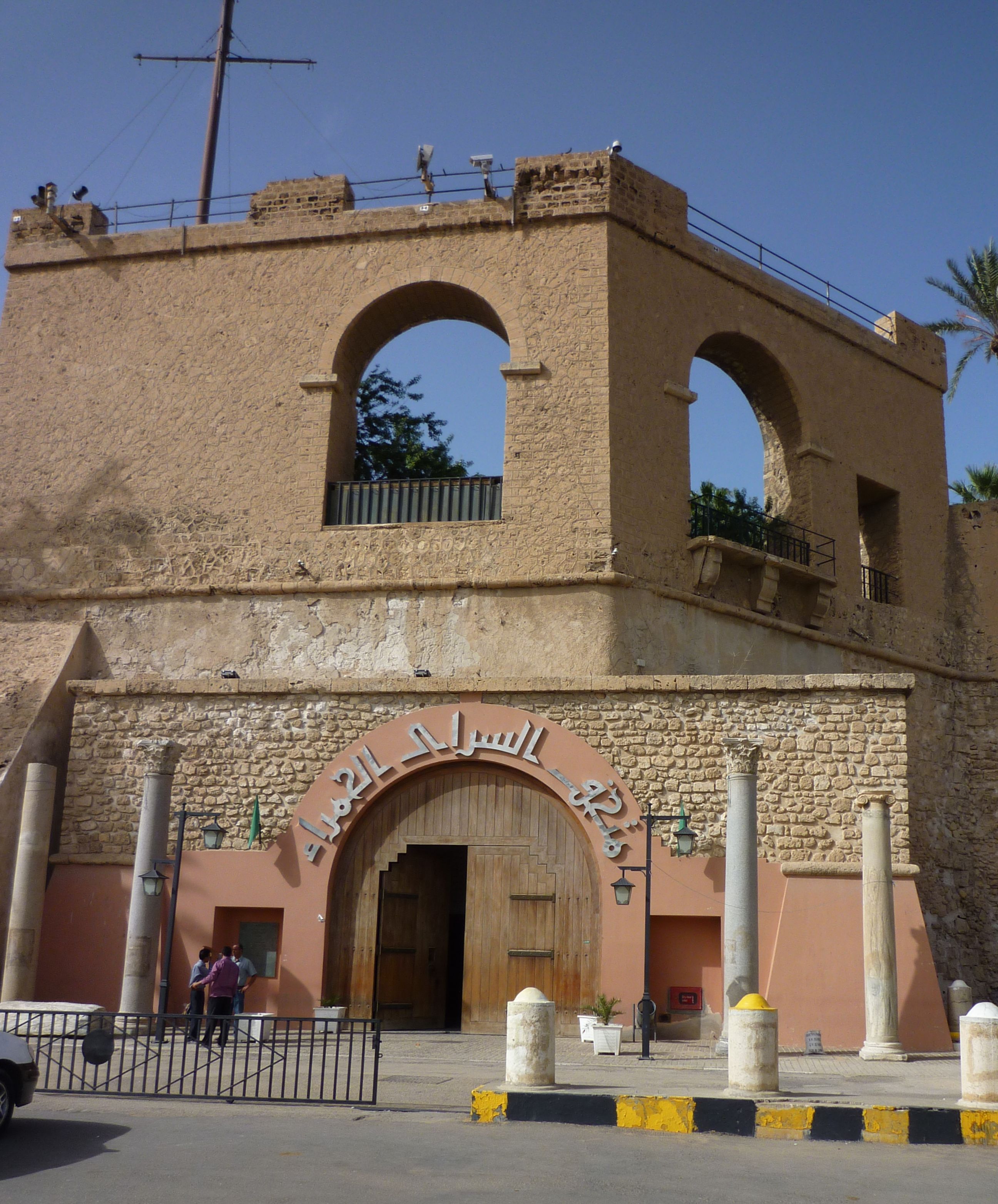
Red Castle Museum
In 2011, as rebels advanced through Tripoli, museum staff at the Red Castle faced a decision that curators should never have to make. The most valuable artifacts, pieces spanning 5,000 years of Libyan history, were quietly moved to an undisclosed location. Items linked to Muammar Gaddafi were placed in storage rather than left to the mob. When rebels entered the building, they damaged some Gaddafi-era objects but the ancient collections survived intact. Then the doors closed. For fourteen years, the Red Castle Museum, one of the most important archaeological collections in North Africa, sat in silence above the medina.
The Fortress on the Promontory
The Red Castle of Tripoli, known in Arabic as As-Saraya al-Hamra, has dominated the skyline above the old city for centuries. Perched on a promontory overlooking the Mediterranean, the fortified complex sits adjacent to the medina district called Ghadema, with an entrance on As-Saha al-Khadrah, better known as Martyrs' Square. The building's name comes from the color of its walls, a deep red that catches the North African sun and makes the castle visible from considerable distance, both by land and sea. The structure has been modified repeatedly over the centuries, each occupying power adding its own layers, but the basic position, a fortification commanding both the harbor and the old city, has remained constant since the site was first used for defense.
From Colonial Project to National Collection
The museum began in 1919, when Italy's colonial administration converted a section of the castle to house archaeological artifacts that had been scattered across Libya since prehistoric times. What started as a colonial project to catalogue and display the country's heritage grew steadily. Architect Armando Brasini renovated the building in the early 1920s, designing the distinctive arches that define its interior spaces today. In the 1930s, Florestano Di Fausto redesigned the surrounding square, connecting the castle more formally to the city around it. When the British took Libya during World War II, the museum expanded to fill the entire castle complex, and in 1948, it was renamed The Libyan Museum. The collection was designed with UNESCO consultation to span the full arc of Libya's human story, from prehistoric cave art through Phoenician and Greek settlement, Roman grandeur, Islamic civilization, and the independence revolution of 1953.
Five Thousand Years in Five Wings
The museum's design separates its collections into distinct wings and floors, each dedicated to a different era or theme. Prehistoric artifacts establish that human habitation in Libya stretches back millennia. Greek and Roman antiquities from sites like Leptis Magna and Sabratha fill the classical galleries with mosaics, sculpture, and architectural fragments. Islamic-era collections document the centuries when Tripolitania was part of the broader Arab and Ottoman worlds. The breadth of the collection reflects Libya's position at the crossroads of Mediterranean civilizations: Phoenicians, Greeks, Romans, Byzantines, Arabs, Ottomans, and European colonial powers all left physical evidence of their presence, and the Red Castle gathered that evidence under one roof. When the museum reopened in 1988 as the Assaraya Alhamra Museum, it featured facilities that were considered state-of-the-art for the era.
Reopening After the Silence
In December 2025, the doors opened again. Reuters, The Guardian, and the Smithsonian Magazine covered the event, each noting that the reopening carried weight beyond the cultural. Libya remained politically divided, with competing governments and armed factions still contesting authority. A national museum, a place designed to hold a country's shared past, offered an implicit argument for shared identity. Initial access was limited to school groups, a deliberate choice that prioritized young Libyans who had grown up knowing the Red Castle only as a closed building. For students born after 2011, the museum's reopening was not a return to something familiar. It was a first encounter with what their country had collected over five millennia and then locked away while it fought over its future.
From the Air
Located at 32.90N, 13.18E on a promontory above Tripoli's old medina. The Red Castle complex is one of the most visually distinctive structures in the city, identifiable by its red walls and elevated position overlooking the Mediterranean. Nearest major airport is Mitiga International Airport (HLLM), about 8 km east. From 2,000-3,000 ft, the castle's position above Martyrs' Square and the medina is clearly visible. The Roman Arch of Marcus Aurelius is nearby at street level.