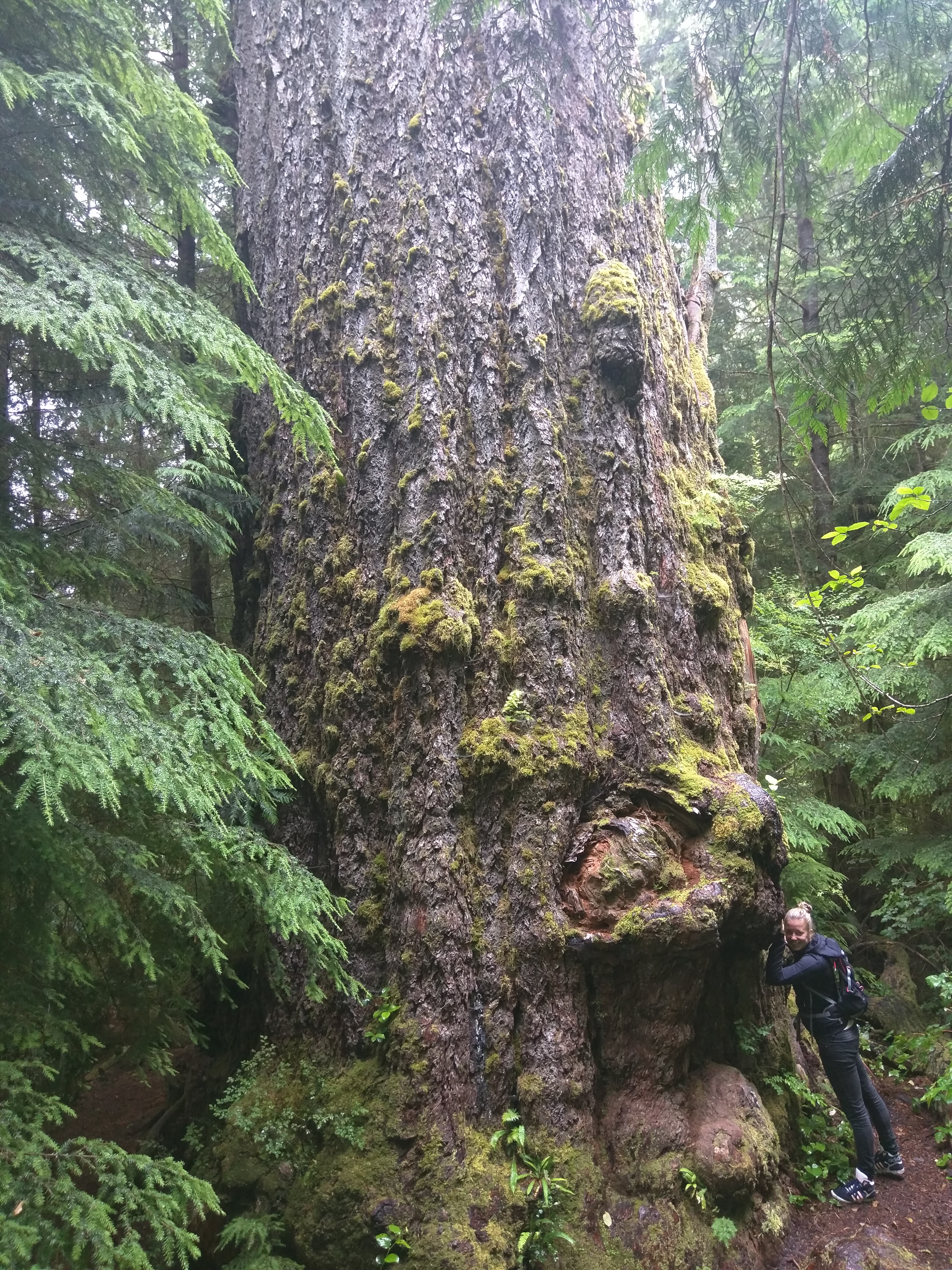
Red Creek Fir
Somewhere in its long life, the Red Creek Fir lost its top. The broken crown tells a story of lightning or wind or simply the weight of centuries, and it means that this tree -- the largest known Douglas-fir in Canada, possibly the largest on Earth by volume -- was once notably taller than it stands today. Even diminished, the numbers are staggering. The Red Creek Fir holds the highest tree score of any known tree in Canada, a composite measure of height, circumference, and crown spread that places it above every other measured specimen in the country. It grows in the San Juan Valley of Vancouver Island, British Columbia, surrounded by a forest that has no formal government protection.
A Champion Without a Shield
Despite its superlative status, the Red Creek Fir exists in a legal gray zone. The Ancient Forest Alliance has campaigned repeatedly for formal governmental protection, but the tree's only official designation is as a public recreation site -- a status that brings visitors but not the legal force to prevent logging in its vicinity. A proposal to extend Pacific Rim National Park down the west coast of Vancouver Island to include the tree has gone nowhere. Heritage BC has listed it, but listing alone carries no binding protection. Both proposals remain unsuccessful, leaving Canada's largest Douglas-fir in a position that conservation advocates find almost absurd: celebrated by guidebooks, filmed by drones, visited by hikers, and legally vulnerable to the same industry that has already stripped most of the old-growth from surrounding valleys.
The Science of Being Biggest
What makes a tree the "largest" depends on how you measure. The Red Creek Fir's claim rests on volume -- the total amount of wood contained in its trunk and branches -- which places it at or near the top of every Douglas-fir ranking worldwide. Some trees may be taller; others may have wider trunks at a specific height. But the Red Creek Fir's combination of girth, height, and crown mass gives it an overall score that no other known Douglas-fir in Canada can match. The broken top complicates the picture. Drone footage from 2014 revealed the jagged remnant of what was clearly once a much taller leader, suggesting the tree may have been significantly larger in its prime. Douglas-firs can live over a thousand years, and this specimen's age, while not precisely determined, places it among the oldest of its species on Vancouver Island.
A Valley of Giants
The San Juan Valley where the Red Creek Fir grows is part of a corridor of exceptional trees on southern Vancouver Island. The nearby San Juan Spruce, Big Lonely Doug, and Harris Creek Sitka Spruce all occupy the same general region, a testament to the growing conditions that this rain-soaked, mild-climate valley provides. These trees are not relics of a vanished forest so much as survivors of an ongoing one -- the old-growth that once covered most of the island, reduced by more than a century of industrial logging to scattered groves and individual champions. The Red Creek Fir stands as both a biological marvel and an uncomfortable question: if the largest known specimen of Canada's most iconic conifer cannot secure formal protection, what does that say about the country's commitment to preserving the forests that remain?
From the Air
Located at 48.58N, 124.22W in the San Juan Valley of southern Vancouver Island. The tree is not individually visible from cruising altitude, but the San Juan Valley is identifiable as a forested river corridor. Nearest airports: CYYJ (Victoria International, ~100 km SE). The tree is reached by logging roads from Port Renfrew. Best context from 3,000-5,000 ft AGL where the patchwork of clear-cuts and remaining old-growth is visible.