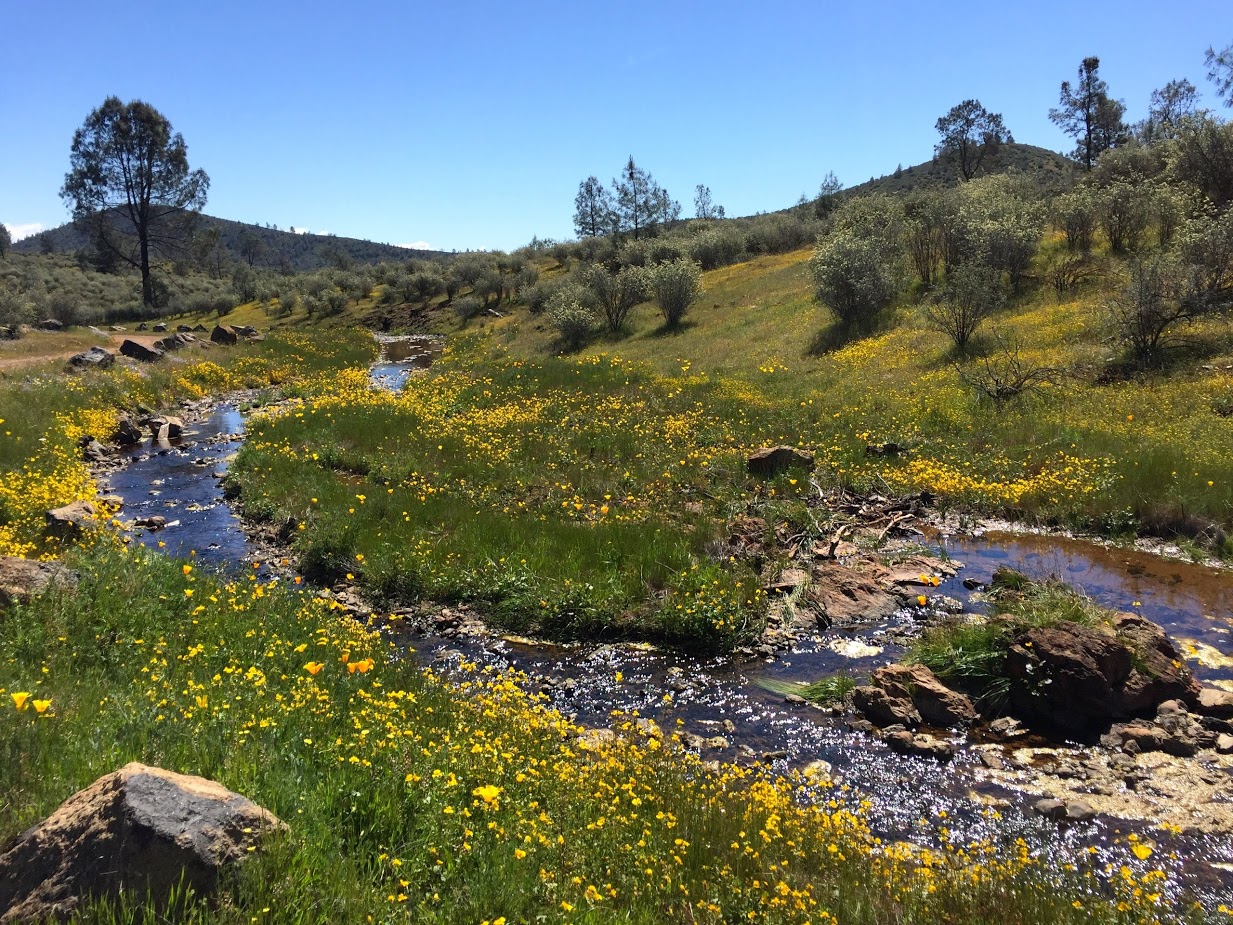
The Serpentine Islands
Most soil sustains life. Serpentine soil poisons it. Heavy in magnesium, chromium, and nickel, low in calcium and the nutrients that ordinary plants need, serpentine kills almost everything that tries to grow in it. Almost everything. In the Red Hills of Tuolumne County, a handful of species have not only adapted to this toxic ground but have come to depend on it, evolving in isolation the way finches did on the Galapagos. California verbena grows here and nowhere else on the planet. The Rawhide Hill onion colonizes south-facing slopes too barren for competitors. Each spring, wildflowers that have no business surviving in such hostile soil erupt across these rust-colored hills in displays vivid enough to draw botanists, students, and tourists from across the state.
Stone from the Mantle
The geology of the Red Hills reads like a cross-section of the Earth itself. The bedrock is dunite, a dense rock composed of dark green olivine and minor chromite that originated in the planet's upper mantle. It reached the surface along the Bear Mountain fault, a northwest-trending thrust fault with over 10,000 feet of vertical displacement - a fracture so deep it once penetrated the crust entirely. As this mantle material was thrust upward, water and pressure transformed it into serpentine, creating one of the largest exposures of serpentine rock in the entire Sierra Nevada metamorphic belt. The Tuolumne ultramafic complex, as geologists call it, sits within Upper Jurassic volcanic formations that were deformed during the Nevada orogeny and later intruded by plutons associated with the Sierra Nevada batholith. Dark brown diorite dikes, some exceeding a mile in length, cut through the dunite in swarms across the southeastern portion of the area.
An Ecology of Refusal
Serpentine soil repels most vegetation, and that rejection is precisely what makes the Red Hills botanically extraordinary. Where invasive Mediterranean annual grasses have overwhelmed native perennials across the California foothills, the Red Hills remain a stronghold for indigenous species. Native California oniongrass, big squirreltail grass, and pine bluegrass dominate the ground cover - grasses that have been pushed out of nearly identical elevations elsewhere. Foothill pine is virtually the only tree species, growing in sparse, scattered stands above dense buckbrush chaparral. Five plant species on the public lands here are classified as sensitive by the Bureau of Land Management. Layne's butterweed is federally listed as threatened. California verbena is a strict endemic, confined to short stream reaches kept moist by year-round groundwater seepage. Congdon's lomatium is known only from the Red Hills and the nearby Peoria Valley. The serpentine acts as a fortress wall, keeping out the aggressive exotic species that would otherwise displace these rarities.
The Fish with the Chisel Lip
The Red Hills have no perennial streams, but spring-fed pools persist through the dry California summers in the intermittent drainages of Six Bit Gulch and Poor Man's Gulch. In these warm, shallow pools lives the Red Hills roach, a distinctive population of California roach that ichthyologists at UC Davis and the California Department of Fish and Game have found possesses unique morphological characteristics. Most notable is a chisel-shaped lip the fish uses to scrape algae off submerged rocks - an adaptation not found in other roach populations. During the dry season, the roach survive in shrinking pools, waiting for spring rains to expand their range upstream for spawning. They share these drainages with the foothill yellow-legged frog and the western pond turtle, both rare species. In winter, as many as twenty bald eagles roost in stands of foothill pines along the shores of nearby Don Pedro Reservoir, adding another layer of ecological significance to a landscape already dense with it.
Gold in the Gulches
Before the Red Hills were recognized as an ecological treasure, they were mined. During the 1850s Gold Rush, Chinese laborers worked the placer deposits in Six Bit Gulch with a thoroughness that became legendary among miners. They panned and sluiced gold that had washed down from deposits to the north, extracting wealth from a landscape that offered little else. Hydraulic mining followed, then dragline dredging in the 1930s and 1940s. Six Bit Gulch and Poor Man's Gulch together produced over $100,000 worth of gold. The scars of that extraction are still visible - disturbed soils, altered drainages - but the serpentine has proven resilient. The same toxicity that discourages most plant life also discourages development, and in 1991 the Bureau of Land Management designated the entire Red Hills Management Area as an Area of Critical Environmental Concern, protecting the rare plants, the roach, and the eagles from the only real threat the serpentine cannot repel: us.
From the Air
The Red Hills are located at approximately 37.84N, 120.46W in Tuolumne County, California, between Jamestown and Chinese Camp in the Sierra Nevada foothills. The distinctive rust-red coloring of the serpentine soils is visible from altitude, contrasting with the green of surrounding vegetation. Best viewed at 3,000-5,000 feet AGL. Columbia Airport (O22) is approximately 8 nm northeast. Don Pedro Reservoir is visible to the south and east. The area lies just west of State Route 49 in Gold Country.