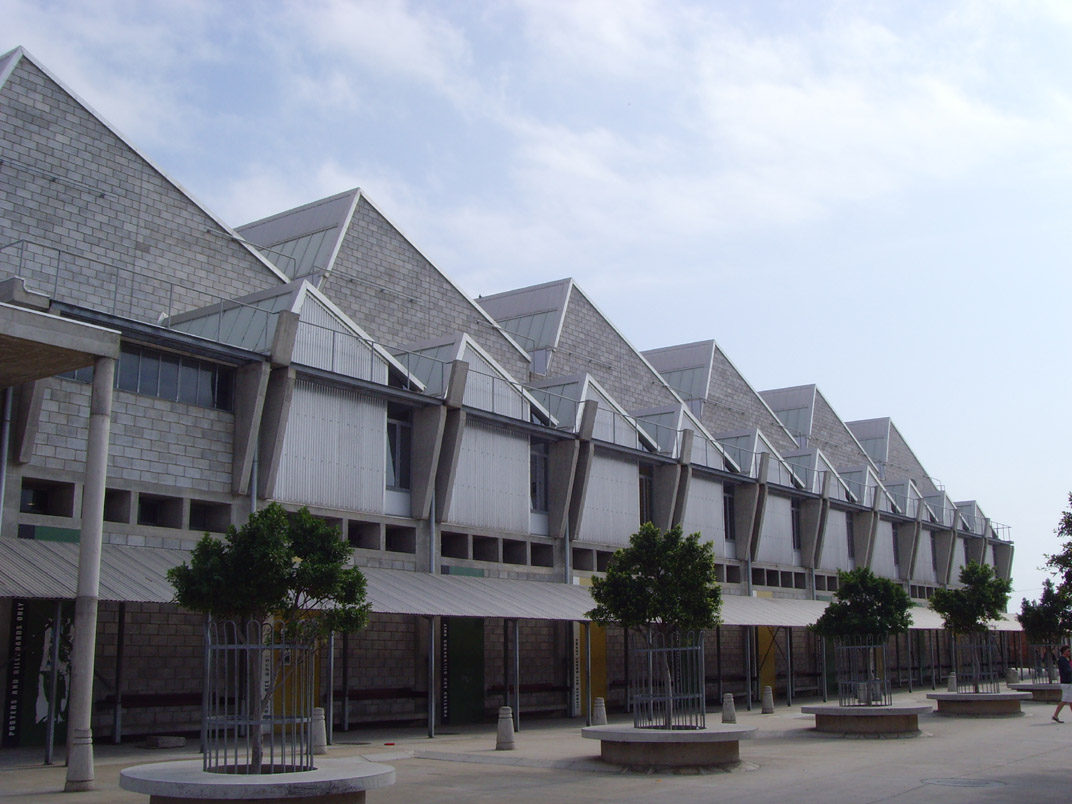
Red Location Museum
Twelve corrugated iron boxes rise from the streets of New Brighton like dignified monuments to the material the community knows best. The Red Location Museum, opened on 10 November 2006 in one of the oldest townships in Gqeberha (Port Elizabeth), was designed to look like the informal settlement surrounding it. That was the point. Architect Jo Noero of Noero Wolff Architects understood that a gleaming glass tower would have been an insult in a neighborhood where people live in structures made of the same rusted metal. Instead, he built something that belongs, twelve boxes measuring 6 by 6 by 12 meters each, inspired by the wooden crates migrant workers once used to store their most treasured possessions when labor contracts separated them from their families in rural areas.
From Concentration Camp to Community
The name Red Location refers to the rusted corrugated iron buildings that gave the area its distinctive color. The site carries heavy history. During the Second Boer War, it housed a British concentration camp. When the camp's residents were moved in 1900, the site became one of the earliest urban settlements designated for Black South Africans, part of the systematic racial segregation that would eventually crystallize into the formal apartheid system. For over a century, the people of Red Location built a community on ground that had been shaped by dispossession and control. They raised families, organized politically, worshipped, and resisted. The museum exists to honor that resilience, documenting the anti-apartheid struggle through the stories of local heroes whose courage helped bring the system down.
The World's Most Outstanding Building
The architectural world recognized what Noero Wolff achieved. In 2005, the museum won the World Leadership Award for Public Architecture in London. The Royal Institute of British Architects gave it their International Award in 2006, alongside the Dedallo Minosse Presidents Award from Italy. In 2010, RIBA named it the Most Outstanding Building Outside the EU, awarding it the prestigious Lubetkin Prize. The Icon Building of the Year Award followed in 2012. Inside, the museum houses an auditorium, a library, an art gallery, and a memorial space honoring liberation heroes including Raymond Mhlaba and Govan Mbeki, both of whom were imprisoned on Robben Island alongside Nelson Mandela. Plans to create an adjoining tomb for Mhlaba and Mbeki were never completed after the heroes' families declined to have the bodies exhumed.
A Museum Held Hostage by Broken Promises
In October 2013, the Red Location Museum closed. It has remained closed since. The shutdown was not an administrative decision but an act of protest by the community the museum was built to celebrate. Residents of Red Location demanded that the government fix their homes, 288 of which had been declared structurally unsound due to shoddy construction. An agreement was reached to demolish and correctly rebuild the houses. The work was not done. During the protests, windows were broken, wiring and air-conditioners were stolen, and one of the museum's security guards was fatally shot in front of the building in December 2013. Repair costs for the building were estimated at R12 million. The closure illuminates a painful irony: an internationally celebrated monument to the struggle for dignity and justice sits shuttered because the community surrounding it still lacks basic dignified housing. The museum's story is not finished. Whether it ends in restoration or continued decay will say as much about South Africa's present as its exhibits say about the past.
From the Air
The Red Location Museum sits at 33.90S, 25.61E in the New Brighton township, north of central Gqeberha (Port Elizabeth). From altitude, New Brighton is visible as a dense settlement area north of the city center. The museum's corrugated iron structure blends with the surrounding informal settlement and is not easily distinguishable from the air. Nearest airport: Port Elizabeth (FAPE), approximately 10 km south-southeast. A fly-over at 2,000-3,000 ft AGL provides context for the relationship between the township and the wider city.