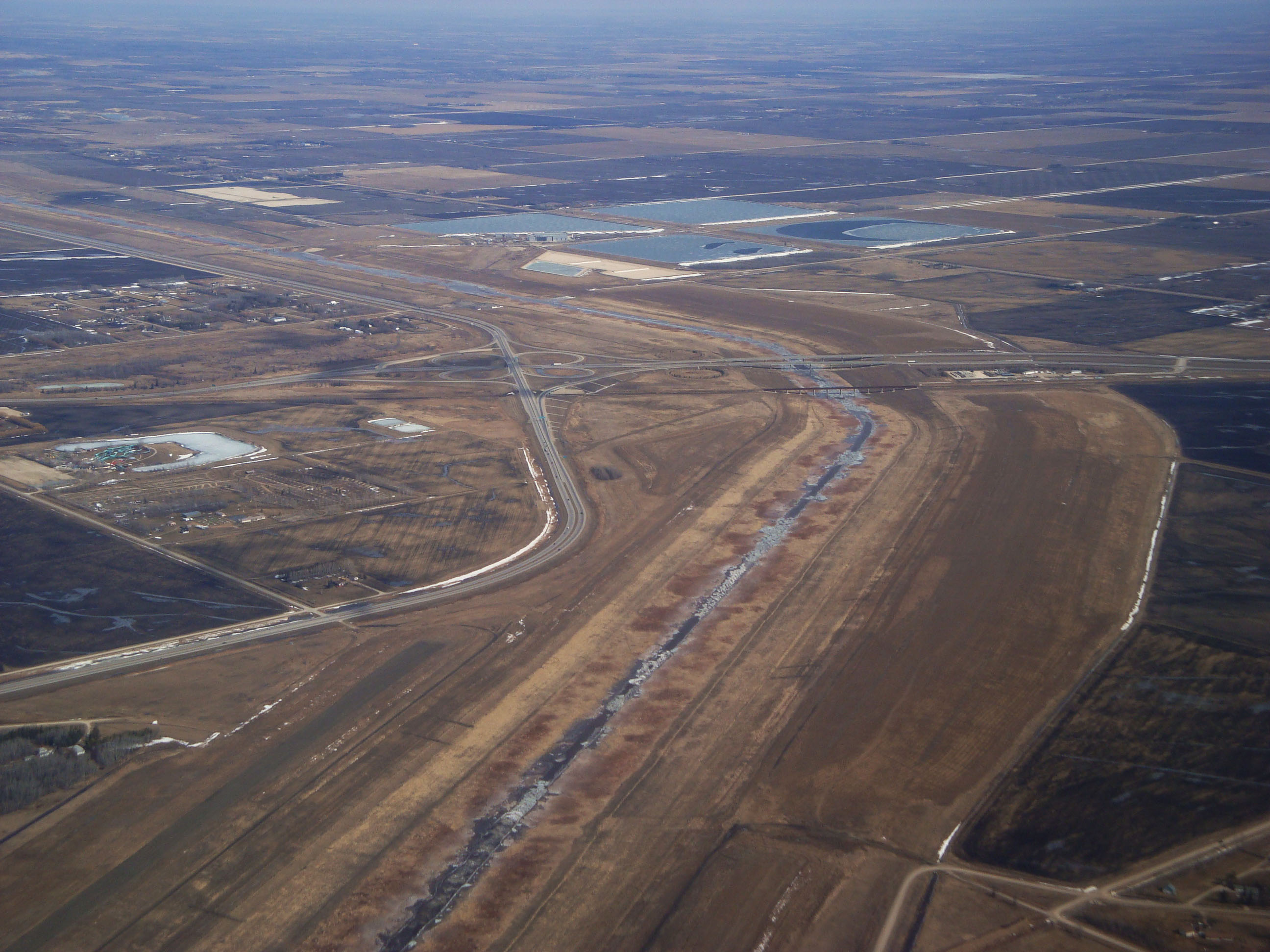
Red River Floodway
They called it "Duff's Folly." Critics compared it to the pyramids of Egypt -- in terms of usefulness. When Premier Duff Roblin proposed digging a massive channel to divert Red River floodwaters around Winnipeg in the late 1950s, opponents said the province could not afford it, that it was a monumental waste of money for a city of 900,000 people whose entire annual provincial revenue barely exceeded the project's cost. Construction began on November 27, 1962, and by the time it finished in March 1968, workers had excavated more earth than was moved for the Suez Canal. The total price tag: $63 million, delivered on time and under budget. The derisive nickname "Duff's Ditch" stuck, but over the decades, as flood after flood threatened Winnipeg and the floodway held, the name transformed from insult to tribute.
Digging a River That Wasn't There
The Red River Floodway is an artificial channel that runs east of Winnipeg, diverting floodwater from the Red River around the city and discharging it back into the river below the dam at Lockport. At the time of construction, it was the second largest earth-moving project in the world, exceeded only by the Panama Canal. Premier Roblin championed the project after the catastrophic 1950 Red River flood displaced over 100,000 people from their homes. He secured a commitment from Prime Minister John Diefenbaker's federal government to cover up to 60 percent of the construction costs. From south to north, the floodway passes through the southeastern edge of Winnipeg and the rural municipalities of Ritchot, Springfield, East St. Paul, and St. Clements. In 2000, it was designated a National Historic Site of Canada, recognized as an outstanding engineering achievement.
How the Gates Actually Work
The floodway's control structure is commonly misunderstood. The term "floodway gates" suggests barriers across the diversion channel, but the gates are actually on the Red River itself, at the point where it enters the city. When river flows exceed what Winnipeg's channel can safely handle, the gates rise from the riverbed, restricting the volume entering the city. The backed-up water then flows into the adjacent floodway entrance, carrying the excess safely around Winnipeg. Even with the floodway operating, the river within the city carries higher-than-normal flows, and local mitigation measures like sandbags may still be needed. The system also includes dikes along the river through the city and the West Dike, which extends southwest from the floodway inlet to near the village of Brunkild. That western dike proved to be the system's weak point: in 1997, it had to be urgently extended by 42 kilometres to prevent floodwater from flanking the entire defence.
The Night They Broke the Rules
The 1997 Red River flood was a hundred-year event that nearly overwhelmed Winnipeg. The floodway had been designed to handle a certain flow capacity, and the 1997 flood exceeded it. On the night of April 30, provincial authorities broke the floodway's legislated operational rules, raising water levels beyond the designed limit to prevent catastrophic inundation within the city, at the cost of additional flooding upstream. Winnipeg Mayor Susan Thompson announced that the design limit had been reached, interpreting it as the flood's peak. Sandbag operations halted. National reporters left town. But the water kept rising for three more days, peaking between May 3 and May 4. The near-disaster made the case for expansion undeniable. Every limitation the 1997 flood had exposed would eventually be addressed.
Wider, Not Deeper
In 2003, Manitoba announced plans to expand the floodway. Engineers chose to widen the channel rather than deepen it because of the underground aquifers beneath the floodway that supply drinking water to rural communities. Digging deeper risked contaminating those aquifers or causing pressure blowouts where groundwater would burst to the surface. The expansion project was completed in late 2010 at a cost exceeding $665 million. The upgraded floodway can now handle flows estimated at a one-in-700-year flood event -- more than double the average flow rate of Niagara Falls. The expanded system protects over 140,000 homes and more than 8,000 businesses, preventing an estimated $12 billion in potential economic damage. What opponents once derided as a ruinous folly has become the single most important piece of infrastructure keeping Winnipeg dry.
From the Air
Located at 50.09N, 96.93W, the Red River Floodway is a prominent linear feature visible from altitude east of Winnipeg. The channel runs roughly north-south and is crossed by the Trans-Canada Highway and Canadian National Railway bridges, with the Perimeter Highway also visible. The inlet control structure on the Red River is a notable landmark from the air. Nearest major airport is Winnipeg James Armstrong Richardson International Airport (CYWG) approximately 20 km to the west-southwest. At 5,000-8,000 feet AGL, the entire length of the floodway channel is visible as a wide, straight cut through the flat Manitoba prairie.