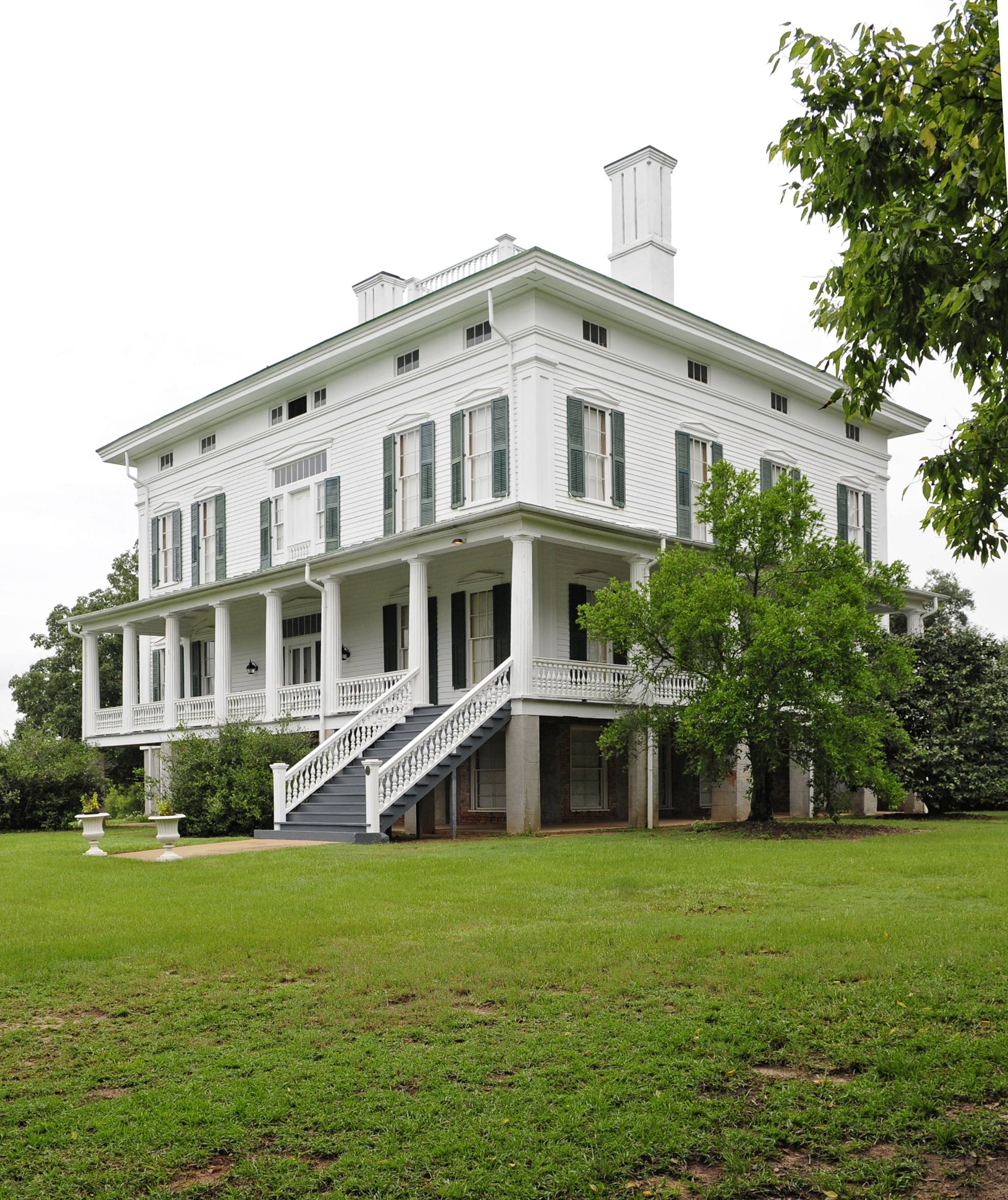
Redcliffe Plantation: Cotton King's Mansion, Enslaved People's Story
James Henry Hammond coined a phrase that defined an era. Standing in the United States Senate in 1858, the South Carolina governor-turned-senator declared, "Cotton is King," daring the North to wage war against the economic engine that enriched the entire nation. A year earlier, he had begun building the house that would embody that conviction. Redcliffe, a Greek Revival mansion on a bluff near Beech Island in Aiken County, rose on land worked by enslaved people whose labor made Hammond one of the wealthiest planters in the antebellum South. Today the house and its grounds survive as a state historic site, telling a story far more complicated than its elegant columns suggest -- a story of political ambition, human bondage, generational inheritance, and the long arc from plantation to public park.
The Man Who Built Redcliffe
James Henry Hammond was a man of towering ambition and deep contradictions. Born in 1807, he rose from modest origins to become a congressman, governor of South Carolina, and finally a United States senator. He accumulated four plantations along the Savannah River, encompassing more than 14,000 acres of prime cotton-growing land. During his lifetime, he enslaved some 300 men, women, and children. Hammond chose the name Redcliffe for the red clay bluffs overlooking the property, and commissioned Belgian-born landscape architect Baron Louis Berckmans to design both the house and grounds. Berckmans created a refined Greek Revival structure surrounded by magnolias, oaks, and formal gardens. Construction began in 1857 and the house was completed in 1859, just two years before the Civil War would test Hammond's assertion that King Cotton was invincible.
Lives in the Shadows of the Columns
The story of Redcliffe cannot be told through the main house alone. Between 20 and 50 enslaved people lived on the property at any given time, working as house servants, cooks, laundresses, gardeners, and field laborers. Two circa-1857 slave cabins still stand on the grounds, among the most intact surviving examples of enslaved people's dwellings in South Carolina. These small wooden structures sit within sight of the grand mansion, a physical reminder of the human cost embedded in every graceful column and polished floor. Today the site interprets African American history year-round through guided tours, special exhibits, and educational programs, giving voice to the people whose forced labor built and sustained the plantation for decades.
Three Generations Under One Roof
After Hammond's death in 1864, Redcliffe passed to his descendants, who maintained the property through Reconstruction, the collapse of the cotton economy, and two world wars. The house accumulated layers of family possessions -- furniture, books, artwork, personal papers -- spanning nearly a century of continuous occupation. Hammond's great-grandson, John Shaw Billings, became one of the most influential editors in American journalism, serving as managing editor of Time, Life, and Fortune magazines. Despite his career in New York, Billings retained Redcliffe as a family seat. In 1973, he made the decision that preserved the property for posterity: he donated the entire estate, with its collections intact, to the people of South Carolina. That same year, Redcliffe was added to the National Register of Historic Places.
A Living Classroom
The South Carolina State Park Service opened Redcliffe to the public two years after the Billings donation, and the site has operated as a historic site and public park ever since. What makes Redcliffe unusual among plantation museums is its completeness. The main house retains its original furnishings and family collections, offering a rare unbroken view of planter-class life from the antebellum period through the twentieth century. The surviving slave cabins provide an equally rare window into the living conditions of enslaved people. Visitors walk between these two worlds in a matter of steps. The juxtaposition is the point: Redcliffe does not sanitize or simplify. It holds the whole complicated truth of the plantation South in one place, from the senator's library to the cabins out back, asking visitors to see both and understand what connected them.
From the Air
Located at 33.42N, 81.88W near Beech Island in Aiken County, South Carolina, along the Savannah River corridor. The plantation grounds appear as a wooded estate surrounded by rural agricultural land. From the air, the Greek Revival mansion with its distinctive columned facade is visible in a clearing amid mature hardwoods. The Savannah River lies approximately 3 miles to the southwest, marking the South Carolina-Georgia border. Nearest airports include Aiken Municipal Airport (KAIK) about 18 miles to the southeast and Augusta Regional Airport (KAGS) roughly 12 miles to the southwest. Best viewed at 1,500-2,500 feet AGL in clear conditions.