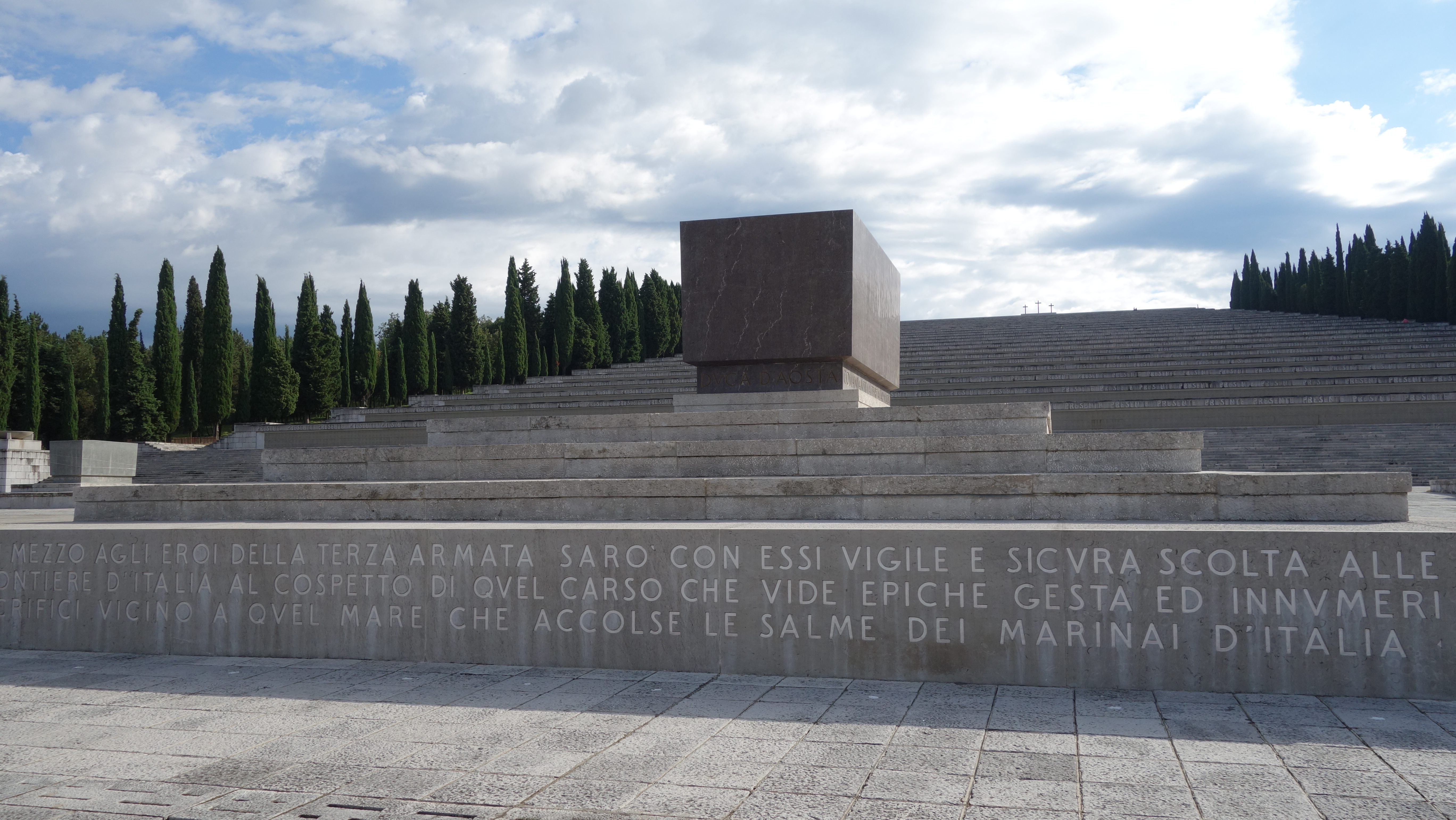
Redipuglia War Memorial
The word repeats across twenty-two terraces of stone, carved above the names of the dead: Presente. Present. It is the Italian military roll call for the fallen, an answer given on behalf of those who can no longer speak. At Redipuglia, on the rocky Karst Plateau near Fogliano Redipuglia in northeastern Italy, this single word is inscribed thousands of times, once for each of the 39,857 identified soldiers whose remains rest in the stepped platforms of the largest war memorial in Italy. Above the last terrace, two mass graves hold another 60,330 unknown soldiers. The total: 100,187 dead from the twelve battles fought along the Isonzo front between 1915 and 1917.
Blood on the Karst
The memorial stands on Monte Sei Busi, one of the countless rocky hills of the Karst Plateau whose possession was fought over with terrible intensity during the early battles of the Isonzo. Italian forces attacked Monte Sei Busi in the First and Second Battles of the Isonzo, finally capturing it during the Fourth. The hill opposite, the Colle di Sant'Elia, served as the war cemetery of the Italian Third Army, which fought in this sector from 1915 to 1917. That cemetery held over 30,000 fallen soldiers before their remains were transferred to the new memorial. The landscape itself was the enemy as much as the opposing army. The Karst's limestone terrain, riddled with sinkholes and devoid of cover, turned every advance into an exercise in exposure. Soldiers fought not only against artillery and machine guns but against the rock beneath their feet, which shattered into lethal fragments under shellfire.
A Monument Built on Ambiguity
The shrine was designed by architect Giovanni Greppi and built between 1935 and 1938. It was inaugurated on September 18, 1938, in the presence of Benito Mussolini and over 50,000 veterans who had fought on the Isonzo front. The timing and the patron complicate the memorial's meaning. Fascist Italy built Redipuglia not only to honor the dead but to appropriate their sacrifice for its own nationalist narrative. The cemetery once bore reliefs of the fasces, the ancient Roman symbol adopted by the regime. Yet the dead in the terraces preceded Fascism, and their suffering belonged to a war that predated Mussolini's rise to power. At the base of the memorial, six sepulchres hold the remains of Prince Emanuele Filiberto, Duke of Aosta, who commanded the Third Army and asked to be buried among his men when he died in 1931, along with five generals killed in action.
The Ones Who Were Not Soldiers
Among the 100,187 interred at Redipuglia, most were Army soldiers. But the memorial also holds 56 members of the Guardia di Finanza, Italy's fiscal police who served in combat roles, and 72 sailors, the crews of the submarines Medusa and Jalea, sunk in the Adriatic in 1915 and salvaged decades later in the 1950s. Only one woman rests at Redipuglia: Margherita Kaiser Parodi Orlando, a volunteer nurse who died in 1918 while caring for soldiers sick with Spanish flu. Her tomb carries the same inscription as the others: Presente. Leading up to the monument, the Via Eroica is flanked by 38 bronze plaques bearing the names of locations on the Karst where the fighting was bloodiest, each name a compressed history of slaughter on rocky ground.
Remembrance Without End
Every November 4, the President of the Italian Senate presides over a commemoration at Redipuglia, marking the anniversary of Italy's armistice with Austria-Hungary in 1918. The hill opposite the memorial, the Colle di Sant'Elia, has been transformed into a park of remembrance, with memorial stones dedicated to branches of the Italian armed forces, displays of Italian and Austro-Hungarian artillery, and everyday objects of the common soldier: mess kits, wire cutters, the small tools of survival in the trenches. A museum between Monte Sei Busi and the Colle di Sant'Elia houses war relics and panels documenting the history of the Third Army. From the air, the memorial's geometric form is unmistakable: a massive staircase of white stone climbing the hillside, a monument so large it registers as a landscape feature, as though the mountain itself were organized into ranks and files of the dead.
From the Air
The Redipuglia War Memorial sits at 45.852°N, 13.490°E on the Karst Plateau in Friuli-Venezia Giulia, northeastern Italy. From 3,000-5,000 feet AGL, the memorial is strikingly visible as a white stepped structure climbing the hillside of Monte Sei Busi. The Colle di Sant'Elia memorial park is on the adjacent hill. Trieste-Friuli Venezia Giulia Airport (LIPQ/TRS) is approximately 25 km to the east. The flat coastal plain transitions to the rocky Karst terrain in this area. The Adriatic Sea is visible to the south. Best viewed in clear conditions when the white stone contrasts sharply with the green landscape.