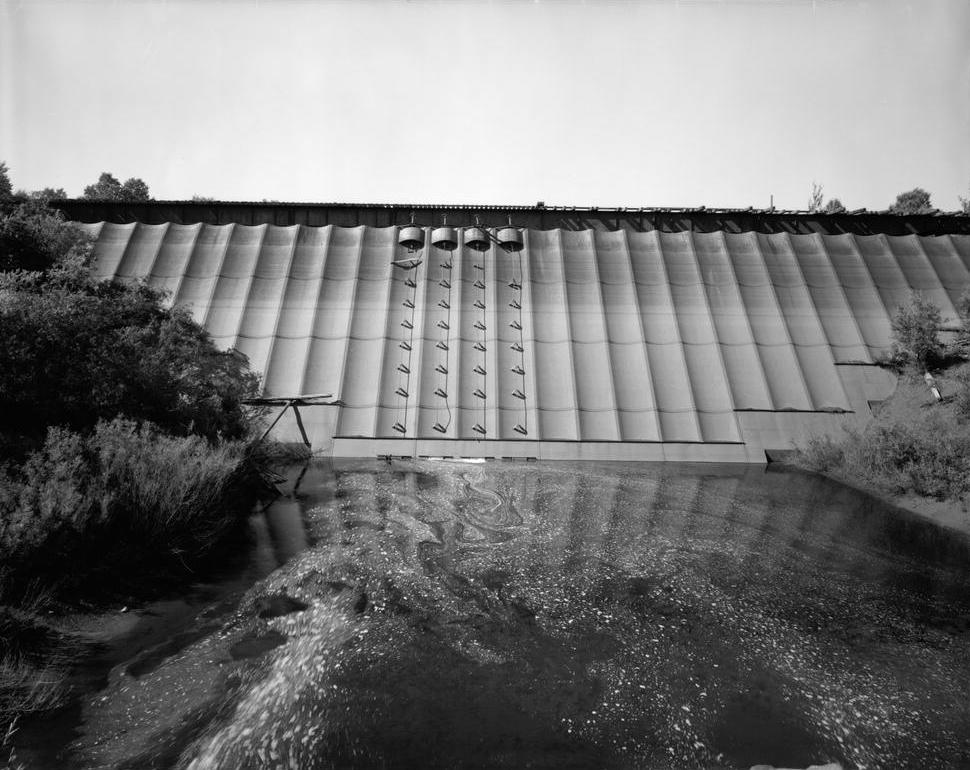
Redridge Steel Dam
Most dams are made of earth, concrete, or stone. The dam across the Salmon Trout River at Redridge, Michigan, is made of steel - thin plates angled against the water, held up by a lattice of girders, looking more like a bridge tipped on its side than anything meant to hold back a river. Completed in 1901, it was one of only three steel dams ever constructed in the United States. The first, the Ashfork-Bainbridge Steel Dam in Arizona, went up in 1898. The last, the Hauser Lake Dam in Montana, failed catastrophically in 1908, roughly fourteen months after its completion in early 1907. The Redridge dam is the survivor - battered, perforated with deliberate holes, its reservoir half-drained, but still standing in the rugged backcountry of Houghton County more than 120 years after the Wisconsin Bridge and Iron Company bolted it together.
Built for Copper, Not for Posterity
The dam exists because of stamp mills. In the 1890s, the Atlantic Mining Company needed water - enormous quantities of it - to power the stamp mills that crushed copper-bearing rock along the Lake Superior shore. In 1894, the company built a timber crib dam across the Salmon Trout River to create a reservoir. But the Atlantic stamp mill kept growing, and the Baltic Mining Company built its own mill nearby. The wooden dam could not supply enough water for both. In 1901, engineer J. F. Jackson designed a steel replacement, and the Wisconsin Bridge and Iron Company erected it over the submerged remains of the old timber dam. The new structure stood 74 feet high at its center and stretched 1,006 feet across the valley. A system of spillways, sluices, and pipes carried water downhill to the mills. The Atlantic and Baltic mines shared access through a common board of directors, an unusual arrangement that reflected how intertwined these mining operations had become.
The Engineering Gamble
Steel dams represented a brief moment of industrial optimism. The concept was elegant: thin steel plates face the water, angled so the water's own weight pushes them into the supporting framework rather than against it. This transfers force to the ground as compression, avoiding the bending stresses that would buckle a vertical wall. Engineers of the era believed steel dams could be built faster and more cheaply than masonry. They were partly right - the Redridge dam went up quickly. But the experiment did not spread. Only two other steel dams were attempted in the country, and one of them, the Hauser Lake Dam, failed within a year. The material posed challenges that concrete and earth did not: corrosion, fatigue, the difficulty of repair. The window for steel dam construction opened in the 1890s and closed within a decade. Redridge stands as one of the last artifacts of that brief, audacious experiment.
Easter Morning, 1941
The mines closed, and the dam's purpose died with them. No one maintained the structure. On Easter morning of 1941, the spillway behind the dam gave way, sending a flood downstream. The steel portion itself survived largely intact - a testament to Jackson's design - but with no mining operations to justify repairs, the owners simply opened the spillway valves and let the reservoir drain. The water level dropped, and the decades-old timber crib dam, submerged since 1901, emerged like a ghost from the shrinking lake. Overtopping incidents continued. In 1979, the Copper Range Company, successor to the original Atlantic Mining Company, had large holes cut directly through the steel plates so the dam could never again hold a full reservoir. The deliberate wounds did their job. Water now flows freely through the structure, and the reservoir sits at a fraction of its original level.
A Dam Too Historic to Fix, Too Dangerous to Ignore
Ownership passed to Stanton Township in 1992, the same year the dam was listed on the National Register of Historic Places. It had already been designated a Michigan Historic Civil Engineering Landmark in 1985. But historic status did not solve the structural dilemma. Michigan's Department of Environmental Quality classified the dam as a "significant hazard," and by 2001 the township was forced to consider repair options. Proposals ranged from $311,000 for basic stabilization to over a million dollars for full restoration. Stanton Township could afford none of them. A compromise was found in 2004: the upper 13 feet of the old wooden dam were removed to lower the water level and relieve pressure on both structures. A more permanent fix has never materialized. A study by Michigan Technological University students concluded both dams are likely safe for the foreseeable future, and the site has become a pilgrimage for students of industrial archaeology, drawn to one of the most unusual engineering relics in the American landscape.
From the Air
Located at 47.149N, 88.764W on the Salmon Trout River in Redridge, Houghton County, Michigan. Houghton County Memorial Airport (KCMX) near Hancock is approximately 15 miles to the northeast, with a 6,500-foot paved runway. The dam site is in rugged, forested terrain south of the Keweenaw Peninsula. From altitude, look for the Salmon Trout River valley running generally north toward Lake Superior - the dam creates a visible break in the drainage pattern. The reservoir behind the dam, though diminished, may be visible as a widening of the river course. The community of Freda sits to the north along the lakeshore, and the town of Atlantic Mine is a few miles northeast. Road access is limited; the site is somewhat remote even by Upper Peninsula standards. Expect lake-effect weather patterns and reduced visibility during fall and winter months.