Redstone Arsenal
In 1949, the U.S. Army nearly sold this land. Huntsville Arsenal had been declared excess, the first step toward demilitarization, and the Office of the Assistant Secretary directed it be advertised for sale by July 1. The sale never happened, because the Army realized it needed the sprawling grounds along the Tennessee River for a new mission: rockets. Within a year, 130 German scientists arrived from Fort Bliss, Wernher von Braun among them, and what had been a chemical weapons factory began its transformation into the birthplace of the American space program. Today, Redstone Arsenal hosts over 75 tenant agencies, employs 36,000 to 40,000 people daily, and houses NASA's largest field center, the Marshall Space Flight Center, where the Saturn V rockets that carried humans to the moon were designed.
Poison Gas and Ammunition
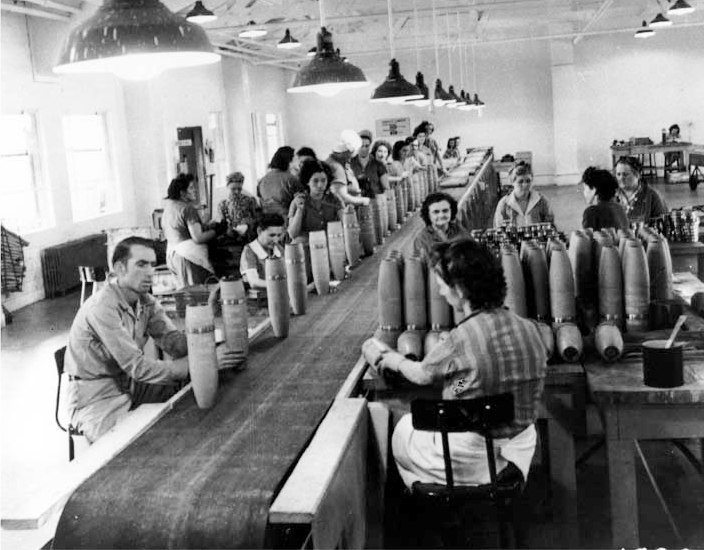
The story begins with chemistry, not rocketry. Established in 1941 as part of the World War II mobilization, the installation displaced over 550 families, including more than 300 tenant farmers and sharecroppers who had worked some of Madison County's richest agricultural land. The War Department razed nearly every building. Three separate entities occupied the site: Huntsville Arsenal and Huntsville Depot for the Chemical Warfare Service, and the Redstone Ordnance Plant for the Army Ordnance Department. The name Redstone came from the region's distinctive red rocks and iron-rich soil. During the war, the facilities produced phosgene, Lewisite, and mustard gas, along with carbonyl iron powder for radar tuning, tear gas, and incendiary devices. More than 27 million items of chemical munitions were produced and 45.2 million ammunition shells loaded. The arsenal earned the Army-Navy 'E' Award four times.
Paperclip and the Rocket Men
The Cold War gave Redstone its second life. German rocket scientists brought to the United States under Operation Paperclip arrived at the arsenal in April 1950, transferring from Fort Bliss with 130 German contract employees, 120 civil servants, and 500 military personnel. Von Braun served as technical director of the Ordnance Guided Missile Center. The team began with V-2 rocket derivatives, testing many of their designs at White Sands Missile Range, with flights between the two facilities becoming routine. When the Korean War erupted in June 1950, the center received orders to develop a surface-to-surface ballistic missile, a project that evolved through several iterations into the PGM-11 Redstone rocket. By 1958, the arsenal employed 20,000 workers. The Army Ballistic Missile Agency, commanded by Major General John Medaris with von Braun as its chief engineer, oversaw a program that would soon reach beyond the atmosphere.
From Arsenal to Launchpad
In 1956, the Army was relieved of most ballistic missile responsibilities in favor of the Air Force, and the German design team was spun off into the newly created NASA. The Cold War had moved to space. Marshall Space Flight Center, NASA's largest field center, was established on arsenal grounds, where von Braun's team designed the Saturn rocket family that would carry astronauts to the moon in the 1960s and later developed propulsion systems for the Space Shuttle. The arsenal itself remained a hub for Army missile programs, standing up the U.S. Army Missile Command in 1962 and pioneering anti-ballistic missile defense through the Nike-X program, which incorporated phased-array radars and high-velocity interceptors. That lineage continues today in the Missile Defense Agency and the U.S. Army Space and Missile Defense Command, both headquartered at Redstone.
Layers Deeper Than Rockets
Beneath the missile test stands and NASA laboratories lie far older stories. The arsenal has catalogued 651 prehistoric archaeological sites, at least 22 with components dating to the Paleo-Indian period, between 9200 and 8000 BC. The Redstone Point, a distinctive handhewn projectile point, was first identified here and named for the arsenal. Before the Army arrived, small farming communities like Spring Hill, Pond Beat, Mullins Flat, and Union Hill dotted the rolling terrain, supporting their own stores, mills, churches, and schools despite having no electricity, plumbing, or telephones. Forty-six historic cemeteries, including those of enslaved people, plantation families, and early twentieth-century farming communities, are maintained on the installation. The land remembers what was displaced so that rockets could rise.
From the Air
Located at 34.684N, 86.654W adjacent to Huntsville, Alabama, along the Tennessee River within the Wheeler National Wildlife Refuge. The arsenal covers a large area with visible test stands, industrial facilities, and NASA's Marshall Space Flight Center campus. Redstone Army Airfield (KHUA) is on-site. Huntsville International Airport (KHSV) lies approximately 8nm west. The Tennessee River forms the southern boundary, with extensive wetland areas visible. Caution: restricted airspace surrounds the arsenal - check current NOTAMs and TFRs. Best observed from altitude respecting restricted areas. The adjacent Cummings Research Park and Huntsville urban area are visible to the east.