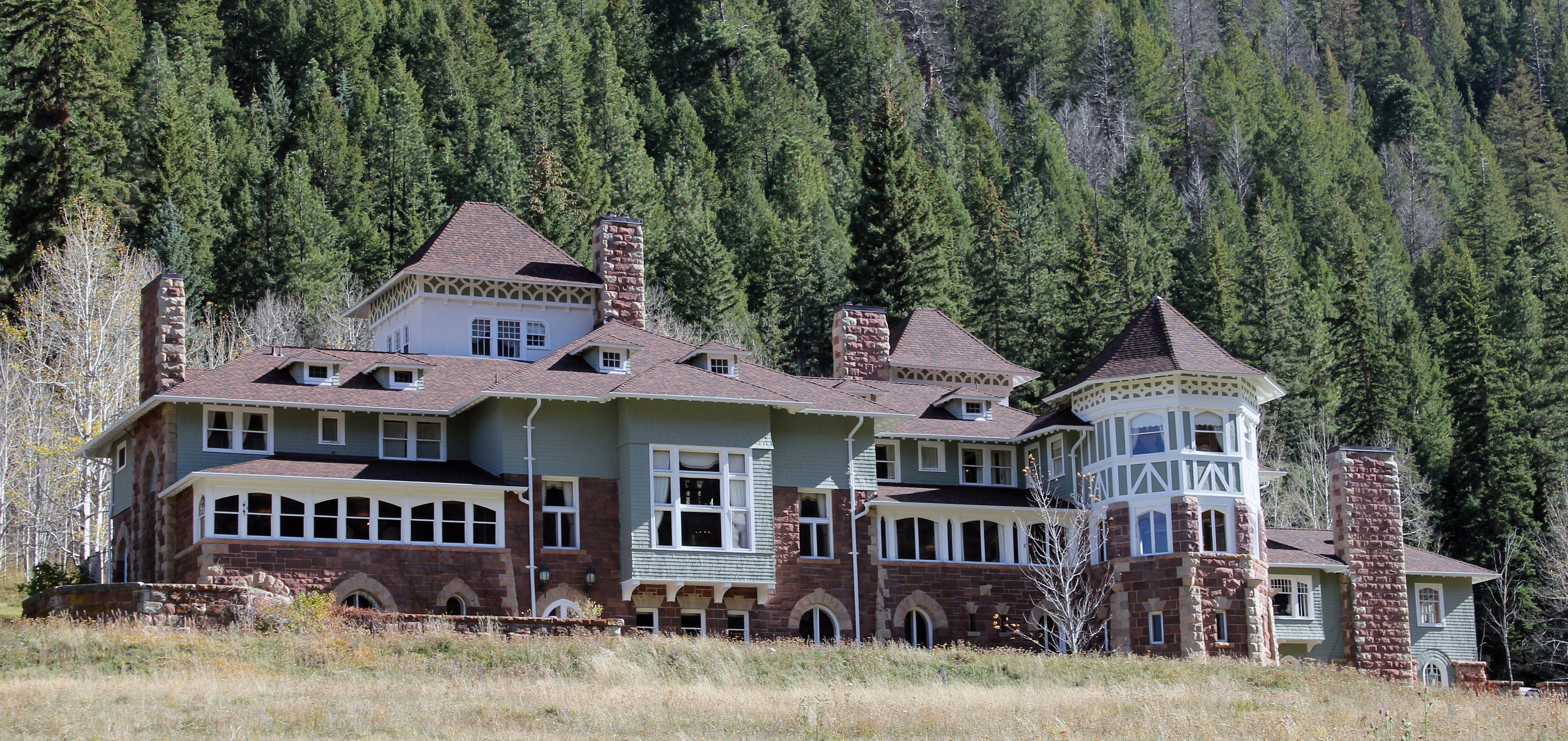
Redstone Castle
A special window was built into the ceiling of the entrance hall so that Alma Osgood could peer down and see how her female visitors were dressed before she appeared to receive them. That detail -- vain, ingenious, and perfectly preserved -- captures everything about Redstone Castle. Built in the early 1900s by John C. Osgood, founder of the Colorado Fuel and Iron Company and at the time one of the wealthiest men in the country, this timber-frame mansion sits on high ground above the Crystal River in a narrow Colorado valley between Redstone and Aspen. It was the grandest home in a planned company town that Osgood designed to be better than the squalid mining camps typical of the era. His workers lived in cottages with electricity and running water, luxuries in the late 1800s. And at the south end of Redstone Boulevard, Osgood entertained Theodore Roosevelt, John D. Rockefeller, and King Leopold of Belgium.
A Coal Baron's Vision
John C. Osgood did not stumble into the Crystal River valley. During his surveys, he discovered that the valley's coal was of exceptional quality -- low in ash, with few impurities. Coal that pure could be used directly or converted into coke for steelmaking. But to exploit the resource, the valley needed infrastructure. Various schemes to build toll roads and railroads launched over the next decade, but financing proved elusive. In 1892, Osgood's company merged with its rival, the Colorado Coal and Iron Company, to form Colorado Fuel and Iron, the largest such concern in the West. The Panic of 1893 devastated Colorado mining towns, including nearby Aspen, when the federal government stopped buying silver. It took years before banks would lend enough to extend the railroad down the valley. Just across the Crystal River from the castle stood the coke ovens that processed coal mined higher in the mountains and loaded onto the rail line.
Tiffany Glass and Tudor Arches
Osgood had architect Theodore Boal design the mansion using elements of the Tudor Revival style mixed with Swiss Chalet forms. Originally intended as a hunting lodge for Osgood and his Swedish-born wife Alma, who were avid outdoor sportspeople, the building grew into something far grander. The lush interior features European antique furniture and work by Gustav Stickley and Louis Comfort Tiffany. Its design was supposedly based on the ancestral home of Alma's family. The estate was fenced off with access controlled by two gates. The northern gatehouse featured a rusticated sandstone foundation, Tudor arches, overhanging eaves, gabled dormer windows, and half-timber detailing. Large wrought iron gates stood in a stone arch with Osgood's crest carved into the center and a bell. The castle sits at the east end of a cleared area sloping up from the river, its west elevation visible from Highway 133. On either side of the narrow valley, steep mountain slopes rise into White River National Forest, with the eastern slopes part of the Maroon Bells-Snowmass Wilderness.
Rise, Fall, and Fall Again
Redstone's prosperity lasted barely a decade. Osgood lost control of Colorado Fuel and Iron, and he spent less time at the castle. He returned in the late 1920s to die there. His wife Alma tried to convert the mansion into a resort, but the Great Depression made that economically unviable. Later owners managed to run it as a hotel into the 1990s, keeping the property alive if not thriving. Then came a twist worthy of a novel. A subsequent owner who attempted to refurbish the castle was indicted in a financial fraud scheme. The Internal Revenue Service seized the property and sold it in what became the agency's first-ever online auction of seized real property. The castle was sold again in 2016, and after a renovation, owners Steve and April Carver opened a ten-room boutique hotel in November 2018. The property is also open for daily public tours.
Hollywood and History
In 1971, Redstone Castle was added to the National Register of Historic Places, the first property in Pitkin County to receive that designation. It later became a contributing property to the Redstone Historic District. The 2006 Christopher Nolan film The Prestige used the castle as a filming location, its Tudor Revival exterior and ornate interiors providing a convincing stand-in for a Gilded Age mansion. The castle remains one of the most striking buildings in Colorado's mountain valleys. Its story tracks the entire arc of the American West: Indigenous land became coal country, coal country became a company town, the company town became a Gilded Age retreat, the retreat became a ruin, the ruin became a fraud scene, and the fraud scene became a boutique hotel. Through it all, Alma's peeping window still looks down on the entrance hall, waiting for the next visitor to arrive.
From the Air
Redstone Castle is located at 39.17N, 107.24W in Pitkin County, Colorado, approximately one mile south of the town of Redstone along the Crystal River and State Highway 133. The castle sits on high ground above the river and is visible from the air on the west elevation. The narrow valley runs between steep mountain slopes rising into White River National Forest, with the Maroon Bells-Snowmass Wilderness to the east between Redstone and Aspen. Nearest airports: Aspen-Pitkin County Airport (KASE) about 25 miles east, and Glenwood Springs Municipal Airport (KGWS) to the northwest. The valley orientation and surrounding terrain create channeled winds. Recommended viewing altitude: 10,000+ feet MSL for terrain clearance in this narrow valley setting.