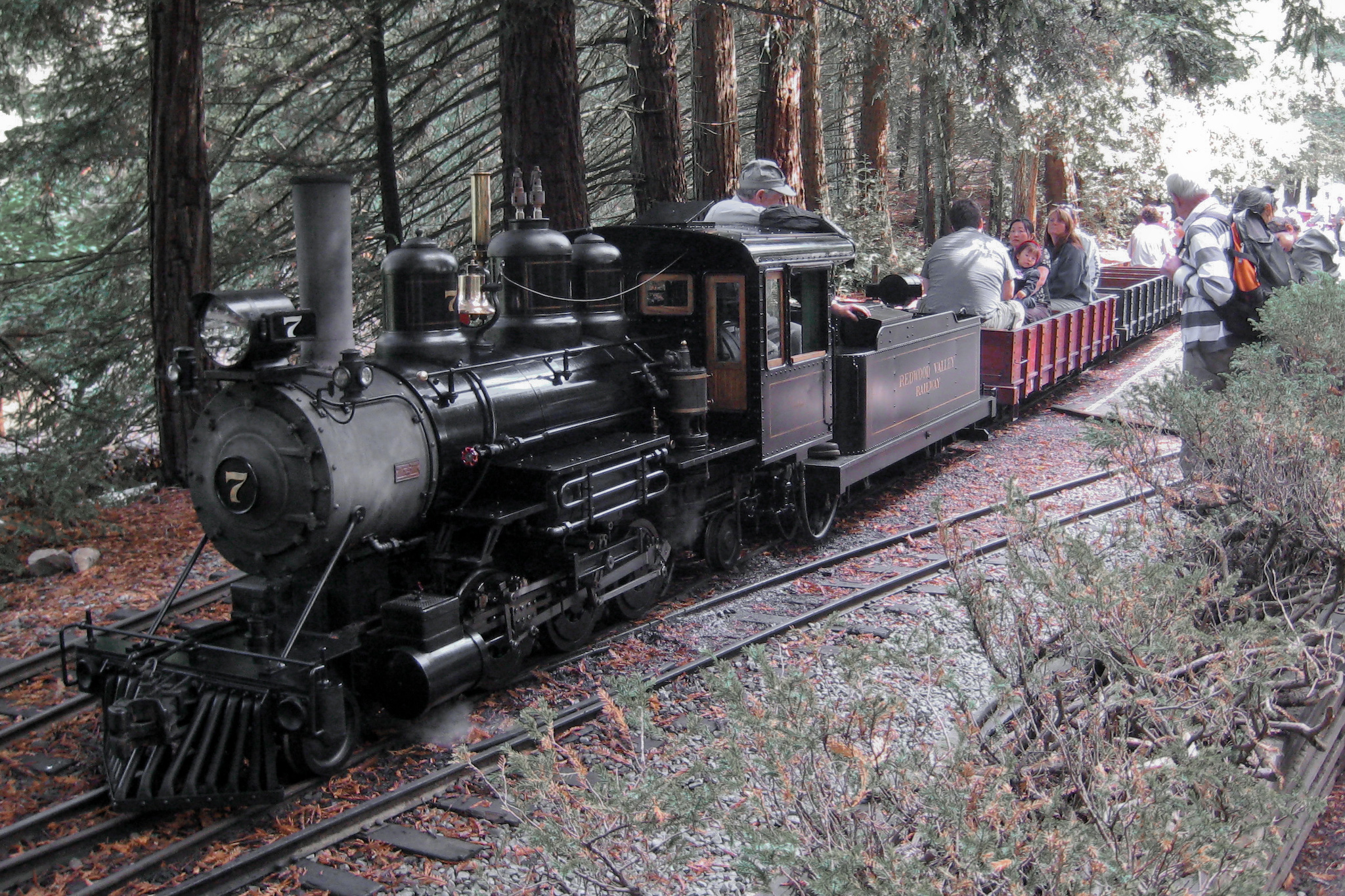
Redwood Valley Railway
Erich Thomsen had a problem that most railroad engineers would envy: he loved steam locomotives too much to let them disappear. Working in the engineering department of the Western Pacific Railroad during the 1950s, Thomsen watched as diesel engines steadily replaced the steam power that had defined American railroading for a century. His solution was unusual. He pitched the East Bay Regional Park District on a miniature railroad -- not a toy, but a working, steam-powered tribute to the narrow-gauge lines that once threaded through the mountains of the American West. In 1952, on a patch of land near the base of Vollmer Peak that had previously served as an anti-aircraft gun emplacement, the Tilden South Gate and Pacific Railway began carrying its first passengers through the Berkeley Hills.
An Engineer's Obsession
Thomsen built the original railroad on a 12-inch gauge, but soon expanded it to 15-inch gauge with 5-inch scale equipment -- large enough for two adults to ride side by side. He designed locomotives in his basement workshop that were not replicas of any single full-size engine but instead drew details from Baldwin Locomotive Works designs built between 1875 and 1910. Number 4, named Laurel, emerged from that basement in 1965 as a 2-4-2 Columbia type. Thomsen held at least three patents from his engineering work, and he channeled that same precision into his miniature railroad. The wooden gondola cars he built seated up to eight adults and were modeled after rolling stock found on 36-inch narrow-gauge lines in the American West. A caboose based on a Denver and Rio Grande Western prototype has graced the end of most trains for over 30 years. Nothing about the Redwood Valley Railway was halfhearted.
A Forest Planted by Hand
When Thomsen laid out the original route, he planted 800 redwood trees along the right-of-way. Today those trees are mature, their canopy transforming a 1.25-mile loop of miniature track into something that feels far removed from the suburban East Bay. The train winds through wooded terrain dotted with miniature buildings made to look like a frontier town, past three storage barns and a roundhouse with a viewing window where visitors can peer in at resting locomotives. There is even a tunnel that was meant to be part of an expansion line until it collapsed mid-construction. It now holds four cars in permanent storage -- a detail that seems more charming than tragic at this scale. After Thomsen died in 1995, his daughter Ellen took over operations and continued the tradition, planting 900 more redwoods by 2019.
Steam Under Pressure
The railway's fleet tells its own story of dedication. Number 5, Fern, is a 4-4-0 American type built in the Redwood Valley Shops in 1986 and rebuilt in 2014. Number 7, Oak, took nearly three decades to complete -- begun around 1978 by Ray Pimlott and finally entering service in 2006 as a 2-6-2 Prairie type. Two of the railway's locomotives have traveled to England and run on the Ravenglass and Eskdale Railway, one of Britain's oldest miniature lines. Parts for a 2-4-4 Forney and a 2-6-0 Mogul sit waiting to be assembled, and as of late 2024, the boiler and frame for the Mogul have been manufactured and delivered. Meanwhile, 13 maintenance-of-way cars called "jimmies" handle welding, tie replacement, and ballast duties -- the kind of workaday fleet that most visitors never notice but that keeps the whole operation running.
A Family Railroad's Uncertain Future
The Redwood Valley Railway has never received a dime from the East Bay Regional Park District. Operations, maintenance, landscaping, and fire hazard abatement all come from private funds -- the ticket revenue from some 250,000 annual visitors. When the railway's 10-year lease with the park district expired in 2019, Ellen Thomsen and the district could not agree on terms for a long-term renewal. The dispute has drawn coverage from Berkeleyside, SFGate, and CBS San Francisco, all under headlines warning that the attraction's days may be numbered. For a railroad that has operated continuously since 1952, carrying over 160,000 paying passengers a year, the lease stalemate feels like a threat not just to a business but to a piece of Bay Area identity. Every June, the Anniversary Meet brings most of the fleet under steam. Every December, Winterfest runs trains into the evening while "Father Solstice" -- in a green suit and white beard -- rides along. Whether these traditions survive depends on negotiations that have nothing to do with steam pressure and everything to do with the ordinary pressures of land and money.
From the Air
Located at 37.88°N, 122.22°W in the Berkeley Hills within Tilden Regional Park. The railway sits near the base of Vollmer Peak. Nearest airports: KOAK (Oakland International, 14nm south), KCCR (Buchanan Field, 10nm northeast), KSQL (San Carlos, 20nm south). Best viewed at 2,000-3,000 ft AGL. The mature redwood canopy along the 1.25-mile route is visible as a distinctive dark green corridor. Look for the clearing near Vollmer Peak where the roundhouse and storage barns cluster together.