Reed Gold Mine
For three years, a seventeen-pound gold nugget served as a doorstop in a North Carolina farmhouse. No one in the Reed family knew what it was. In 1799, twelve-year-old Conrad Reed had plucked the heavy yellow rock from Little Meadow Creek while fishing on a Sunday morning, skipping church with his siblings. His father John, a former Hessian soldier who had deserted the British army during the American Revolution and reinvented himself as a Carolina farmer, set the curious stone by the door and thought nothing more of it. It took a Fayetteville jeweler visiting in 1802 to identify it as gold -- and when Reed named his price at $3.50, roughly a week's wages, the jeweler eagerly paid. The nugget was worth closer to $3,600.
A Soldier's Second Life
The story of Reed Gold Mine begins not in Carolina clay but in the German village of Raboldshausen. Johannes Reith served as a Hessian soldier in the Garrison Regiment von Wissenbach during the American Revolution, fighting on the British side. On June 21, 1782, stationed outside Savannah, Georgia, he made a fateful decision: he deserted, taking his arms and equipment with him. He drifted north into the Carolina backcountry, settling among the ethnic German communities of what was then upper Mecklenburg County, later Cabarrus County. He anglicized his name to John Reed, married Sarah Kiser, and took up farming. He had no idea he was sitting on one of the richest gold deposits east of the Mississippi.
The $3.50 Fortune
After the jeweler's visit revealed the true nature of Conrad's creek-side find, John Reed began to understand what ran through his property. By 1803, he organized a small mining operation along Little Meadow Creek. The results came fast. An enslaved man named Peter soon discovered a twenty-eight-pound nugget, even larger than Conrad's original find. Word spread through Cabarrus County and beyond, drawing prospectors and fortune seekers. What followed was the Carolina Gold Rush, the first gold rush in United States history. North Carolina led the nation in gold production from 1803 all the way until 1848, when the California Gold Rush finally eclipsed it. At its peak in the 1830s and 1840s, the state hosted roughly fifty-six mining operations and employed a workforce of some 25,000 people. The gold was so plentiful that the U.S. government established a branch mint in Charlotte to process it.
Underground and Underfoot
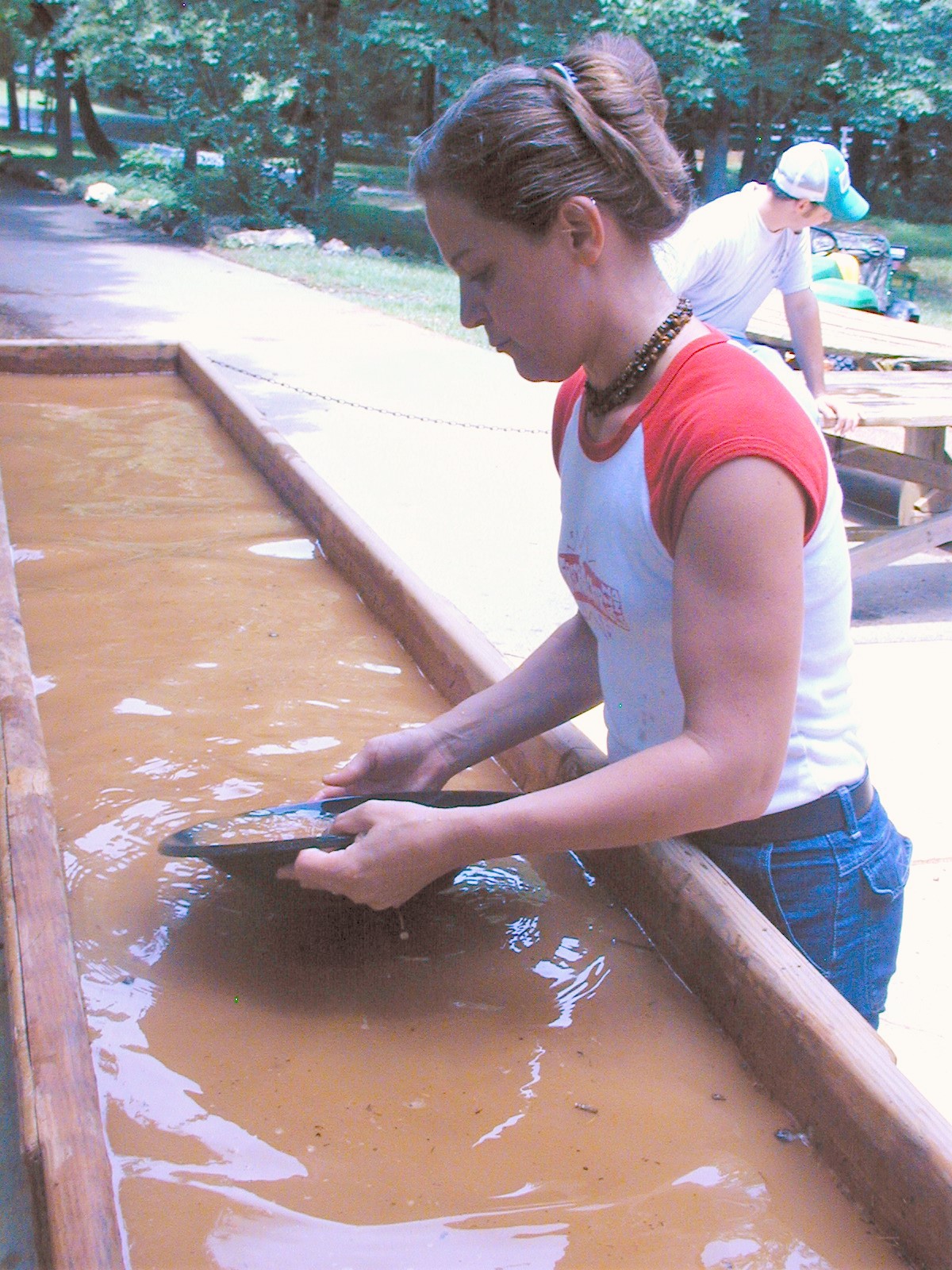
Mining at Reed's property evolved from simple placer panning in the creek to underground tunnel operations that bored into the surrounding hillsides. The mine produced gold for decades, though its output eventually waned as richer veins were exhausted and western strikes drew miners away. Today the Reed Gold Mine is a North Carolina State Historic Site, preserved as a National Historic Landmark. Visitors can descend into several hundred feet of restored tunnels, walking the same passageways where miners once chipped at quartz veins by candlelight. Above ground, a museum chronicles the broader story of North Carolina's gold heritage, and visitors can try their hand at panning for gold in the same creek where Conrad made his discovery more than two centuries ago.
The Rush Before the Rush
Reed Gold Mine holds a unique place in American history as the spark that ignited gold fever decades before Sutter's Mill. The Carolina Gold Rush trained a generation of skilled miners whose expertise proved invaluable when gold was discovered in California in 1848. Many of these experienced prospectors headed west, carrying techniques honed in the Carolina Piedmont to the Sierra Nevada foothills. The Reed Mine itself stands as a reminder that the American gold story did not begin at a sawmill in Coloma but in a quiet creek in Cabarrus County, where a boy playing hooky from church picked up a rock that changed the economic trajectory of a young nation.
From the Air
Reed Gold Mine sits at 35.285N, 80.470W in the rolling Piedmont of Cabarrus County, North Carolina. The site is roughly 8 nautical miles east of Concord-Padgett Regional Airport (KJQF) and about 25 nautical miles northeast of Charlotte Douglas International Airport (KCLT). From the air at 2,000-3,000 feet AGL, look for the cleared historic site along Little Meadow Creek amid the rural landscape between Midland and the town of Georgeville. The surrounding terrain is gentle, low hills typical of the Carolina Piedmont.