Reesor Siding Strike of 1963
The hamlet of Reesor Siding no longer exists. It is a ghost town today, a clearing in the boreal forest just west of Opasatika, roughly halfway between Kapuskasing and Hearst in Northern Ontario. But in the winter of 1963, this tiny Francophone settlement became the site of one of Canada's bloodiest labour confrontations, a midnight shooting that killed three men, wounded eight others, and left scars on Northern Ontario communities that have never fully healed.
Woodcutters in the Cold
On January 14, 1963, fifteen hundred members of the Lumber and Sawmill Workers Union, Local 2995 of the United Brotherhood of Carpenters and Joiners of America, walked off the job. Their employer, the Spruce Falls Power and Paper Company, wanted a wage freeze and proposed that woodcutters work seven days a week for two months to meet production quotas. The men who felled trees in the Algoma and Cochrane districts worked in brutal conditions, deep in the bush through Northern Ontario winters, and they refused. The strike halted the flow of wood pulp to the mill, which supplied newsprint to major customers including The New York Times. But the strikers were not the only ones who cut wood for Spruce Falls. Independent farmer-settlers in the region supplied roughly 25 percent of the company's annual pulp needs. When the union asked these farmers to stop selling their timber in solidarity, the farmers refused. Tensions between the two groups escalated quickly.
A Chain Across the Tracks
Union members began sabotaging the farmers' stacked lumber piles, rendering the wood unsaleable. On January 23, the mayor of Kapuskasing, Norman Grant, told The Globe and Mail that the farmers were growing desperate enough to go into the bush with guns. The warning proved grimly prophetic. On the night of February 10, a shipment of 600 cords of pulp wood was scheduled to be loaded onto railcars at the Reesor Siding. Four hundred unarmed union members marched to the loading station, determined to block the shipment. A force of 12 to 20 Ontario Provincial Police officers waited there, along with twenty farmers who had come to protect their lumber. The police stretched a chain across the tracks to separate the two groups. It was not enough. The union men breached the thin cordon and moved toward the stockpiled wood. Farmers stepped out from behind a hut by the tracks and opened fire.
Three Men Dead Before Dawn
Eleven union members were hit. Fernand Drouin was killed. Brothers Irenee and Joseph Fortier were killed beside him. Eight others fell wounded: Harry Bernard, Ovila Bernard, Joseph Boily, Alex Hachey, Albert Martel, Joseph Mercier, Leo Ouimette, and Daniel Tremblay. The shooting happened before the union men even reached the chain line. Later, Donald MacDonald, leader of the Ontario NDP, revealed that affidavits indicated the police knew the farmers had brought firearms that night but took no precautions to prevent their use. Within hours, 200 additional OPP officers were dispatched to the scene. The Provincial Ministry of Labour intervened, and on February 17, after a 33-day strike, the woodcutters voted to return to work under the terms of their old contract while arbitration continued.
Justice Denied
All twenty farmers present that night were charged. Police confiscated five .22 rifles, three 12-gauge shotguns, two .30-30 rifles, two Lee-Enfield rifles, a .30-06 rifle, and a .38 Smith & Wesson revolver. But it was the union members who bore the heavier legal burden. A total of 237 strikers were charged with rioting and held in the former Monteith POW camp south of Iroquois Falls until the union posted bail. Eventually, 138 were found guilty of illegal assembly and the union paid their fines. The farmers' case was heard in October 1963 in Cochrane before Supreme Court of Ontario Chief Justice McRuer. After three days of deliberation, a seven-man jury dismissed the non-capital murder charges. Three farmers were convicted of firearms violations and fined.
A Monument in the Bush
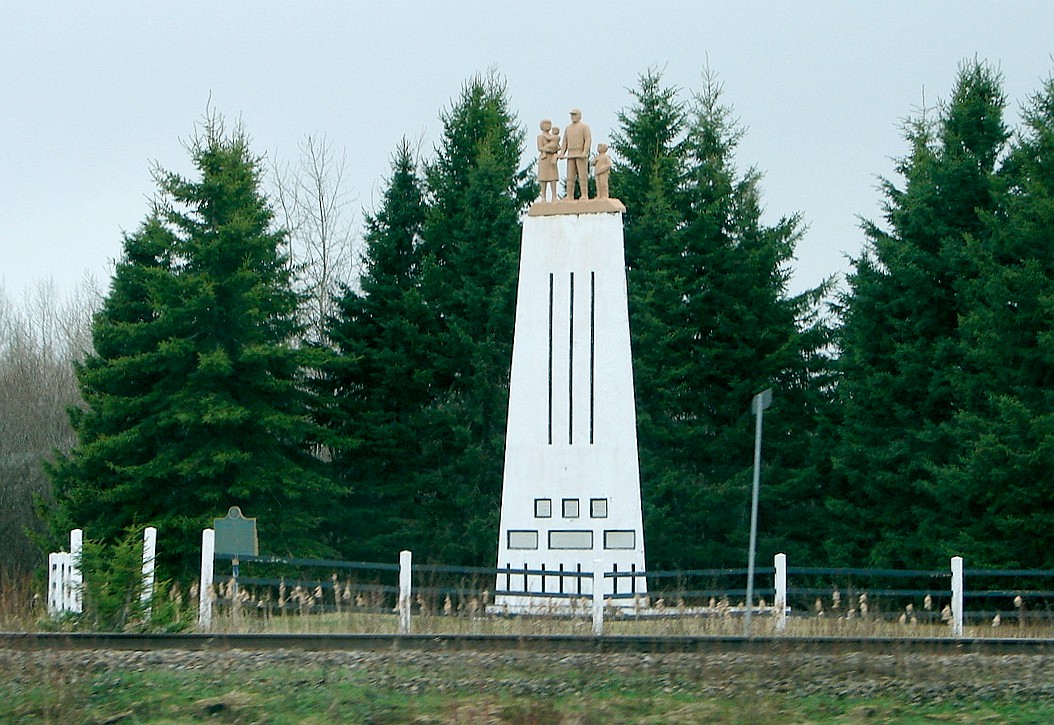
The union erected a memorial to the dead and injured workers at the site, drawing public outcry. The Globe and Mail reported threats to destroy the monument. The Province of Ontario later installed its own historical plaque. In 1969, Stompin' Tom Connors included the Reesor shooting on his album On Tragedy Trail. He reported receiving death threats warning him not to perform the song at upcoming venues. The incident has since been commemorated in folk songs, plays, a CBC radio documentary in Quebec, and the 2003 historical novel Defenses legitimes by Doric Germain. In 2005, Member of Parliament Brent St. Denis marked the 42nd anniversary of the confrontation in the House of Commons. The ghost town of Reesor Siding sits silent in the bush, but the story of what happened there on a frozen February night continues to echo through Canadian labour history.
From the Air
Located at 49.57N, 83.08W, approximately halfway between Kapuskasing (CYYU) and Hearst (CYHR) in Northern Ontario. The site is just west of Opasatika along the rail line. From the air, the area is dense boreal forest with scattered clearings. Best viewed at 3,000-5,000 ft AGL. The rail siding itself is difficult to spot from altitude, but the rail corridor through the forest is visible as a linear clearing. Kapuskasing is the nearest sizable town and airport.