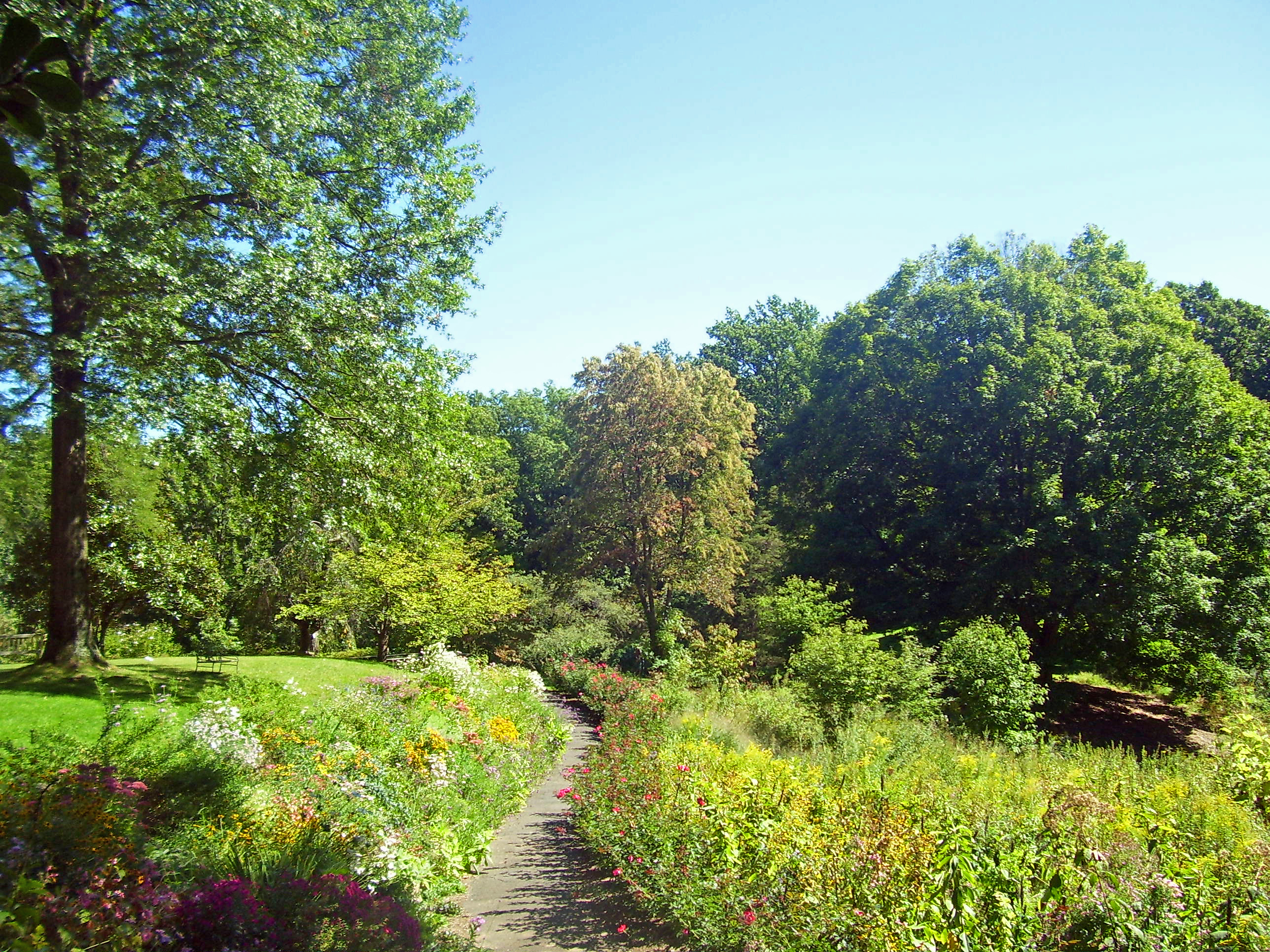
Reeves-Reed Arboretum
Before the first daffodil bloomed, before the lilac garden perfumed spring afternoons, the Lenni Lenape people walked this ground. Their path ran from the coast near Elizabeth up to the highlands of Schooley's Mountain, and the ridge that would one day become Beacon Hill served as a signaling point during the American Revolution. History has moved across these 13.5 acres in Summit, New Jersey for centuries — and in 1889, someone finally decided to plant it.
The Merchant's Dream
John Hornor Wisner had spent years navigating the China trade before he decided to put down roots in New Jersey. In 1889 he purchased about 12 acres from the Swain farm and hired the New York architectural firm Babb, Cook and Willard to build a Colonial Revival house that faced south over the rolling Watchung hills. For the grounds, he turned to Calvert Vaux — the landscape architect who co-designed Central Park with Frederick Law Olmsted. Wisner and his wife Isabelle, whose three children had been born in China, called their new home 'The Clearing.' Working with Vaux, they planted specimen trees that still stand today, created wandering flower beds, and laid out a meandering path that invited exploration rather than efficiency. It was a garden designed for contemplation.
Susie Reeves Leaves Her Mark
In 1916, the estate passed to Richard and Susie Reeves. Where the Wisners had built broadly, Susie Reeves refined. Between 1924 and 1925 she commissioned two of the most prominent landscape architects of the era: Ellen Biddle Shipman and Carl F. Pilat. Shipman, one of the first professional women landscape designers in America, brought a naturalistic sensibility to the formal garden beds. Pilat, who had trained in Germany before working on parks throughout New York, added structure to what might otherwise have drifted into wildness. The result was a layering of visions across decades — Vaux's specimen plantings, Shipman's perennial compositions, and Pilat's organized beds all coexisting on the same ground, each era legible in the landscape.
The Arboretum Grows Up
The property eventually transitioned from private estate to public institution, becoming the only arboretum in Union County. In 1993, it was listed on the National Register of Historic Places under its original name, The Clearing — a recognition of both its architectural heritage and its significance as a work of designed landscape. Today the arboretum's features include the Wesson Nature Grove, a Lilac Garden, an Herb Garden, a Vernal Pool, and woodland trails that weave through the mature trees Wisner and Vaux planted more than a century ago. Since 2014, a small herd of Nubian goats has served as a living landscaping crew, clearing excess vegetation from sections of the property.
A Living Classroom
The arboretum's educational mission runs deep. Schoolchildren arrive for science field trips; scouts earn badges through specialized programs; summer camps built around nature themes draw children of different ages throughout the warm months. Adults come for Gardening 101 sessions and backyard birding workshops. A square-foot gardening pilot program launched in 2018 puts children's hands directly into soil, growing organic vegetables in raised beds. The arboretum collaborates with arts organizations to bring performances to the grounds — the Sounds of a Summer Night series turns the gardens into an outdoor concert venue, while the annual Celebrate Fall draws families for cooking demonstrations and pumpkin carving. Open every day from dawn to dusk without charge, it remains one of the genuinely free pleasures of the region.
The Long Arc
What makes Reeves-Reed unusual is the completeness of its story. Most historic landscapes survive in fragments — a great house without its grounds, a garden without records of who designed it, specimen trees with no documentation of who planted them. Here, the lineage is intact: Lenape trail to Revolutionary War signal station to merchant's estate to designed landscape to public arboretum. Calvert Vaux's influence is traceable in the bones of the planting plan. Susie Reeves's ambition is visible in the garden rooms that still define the property's character. The arboretum doesn't just preserve plants — it preserves decisions made about land, and the sensibilities of the people who made them.
From the Air
Located at 40.7267°N, 74.3481°W in Summit, New Jersey, near the Second Watchung Mountain ridge. Nearby airports include Newark Liberty International (EWR), approximately 12 miles east. The arboretum sits within a densely wooded suburban neighborhood and is most visible in late fall when leaf canopy thins. Recommended viewing altitude is 1,500–2,500 feet MSL for context within the Watchung ridgeline.