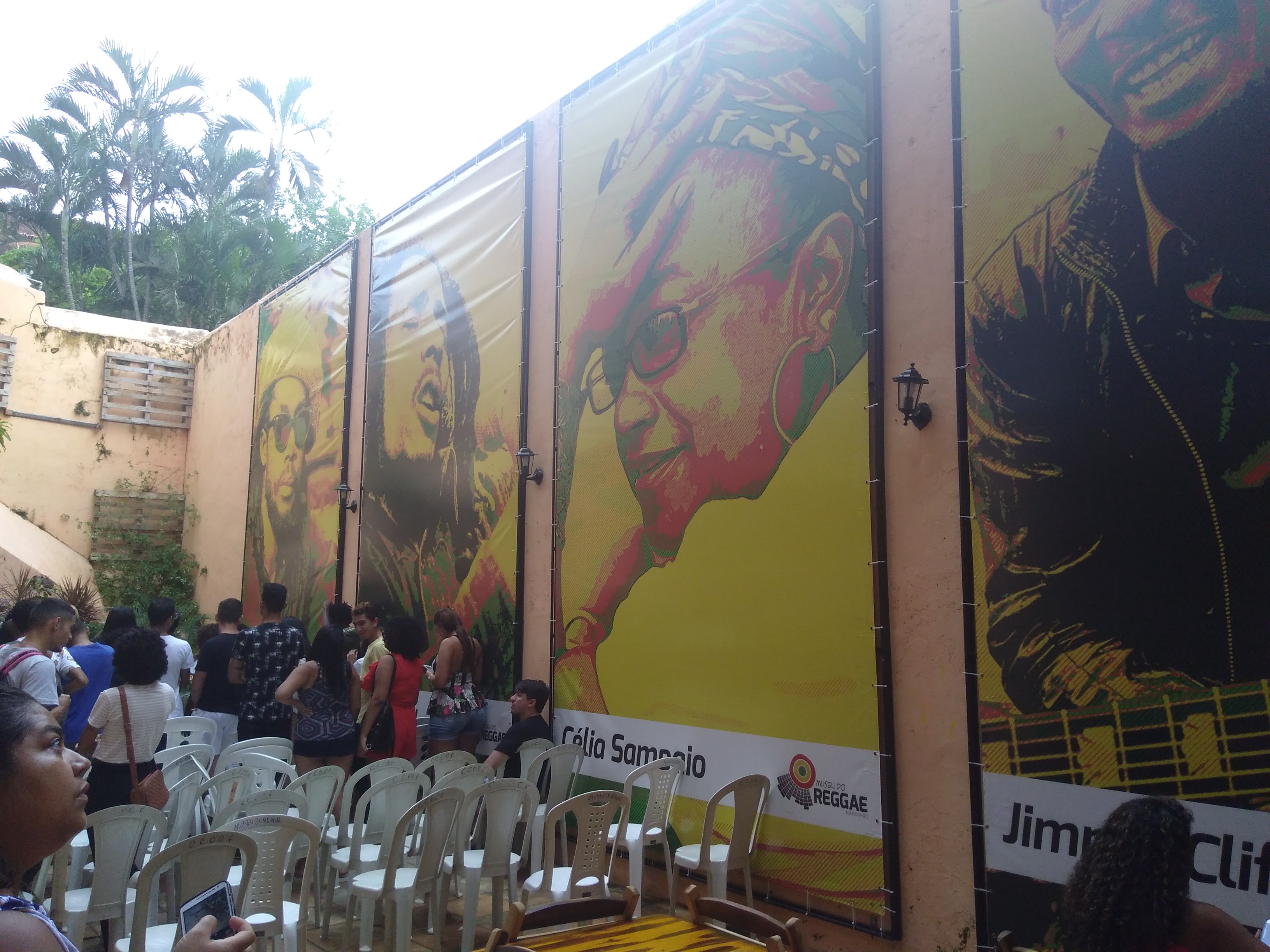
Reggae Maranhão Museum
The question answers itself once you hear the bass. Why is there a reggae museum in a 400-year-old Portuguese colonial city perched on an island off the northeast coast of Brazil, roughly 3,400 kilometers from Kingston? Because São Luís has spent the better part of five decades turning Jamaican rhythms into something unmistakably its own, and by 2018 the city's relationship with reggae had grown dense enough to deserve a building of its own. The Reggae Maranhão Museum opened on January 18 of that year, painted in the yellow, green, and red of Rastafarian tradition, tucked into a sobrado in the UNESCO-protected historic center. It is only the second reggae-themed museum in the world. The first is in Jamaica. The second is here, in the city locals call Jamaica Brasileira.
The Sound of the Radiolas
São Luís does not play reggae the way Kingston does. By the time Jamaican records reached Maranhão in the 1970s, mostly by way of sailors passing through the Port of Itaqui, the rhythm had to negotiate with what was already here: the call-and-response of Tambor de Crioula, the narrative pageantry of Bumba Meu Boi, the slow Atlantic air. What emerged was slower, more romantic, more openly sensual than its Caribbean cousin, and it developed around a local institution called the radiola - a sound system of stacked amplifiers run by DJs who competed for followings in dance halls across the city. São Luís now counts more than 200 such radiolas. A successful track in this scene earns one of two nicknames: melô or pedra, the latter meaning "stone," a local badge of permanence.
Five Rooms, Many Voices
The museum is organized around five spaces, each with a purpose. The Hall of Immortals honors the Maranhão reggae figures who have died, giving their memory something more durable than a dance floor. Four other rooms each belong to one of the city's legendary clubs - Pop Som, Toque de Amor, União do BF, and Espaço Aberto - the venues where the scene took shape in the 1980s and after. Visitors walk among rare records, historical photographs, reggae fashion across the decades, and recorded testimonies from DJs, dancers, and musicians who lived the scene. A research library quietly digitizes books, theses, and articles on the subculture; the Roots Café handles the coffee. The architects painted the whole building in Bob Marley's colors as a deliberate salute.
Relics That Traveled
Museums live and die by their objects, and this one has chosen carefully. A guitar used by the Maranhense band Tribo de Jah sits in a case - the instrument accompanied the group through more than twenty countries and appears on their main recordings. Nearby stands the radiola "Voz de Ouro Canarinho," built by Edmilson Tomé da Costa, known as Serralheiro, one of the pioneers who brought reggae to São Luís in the 1970s and kept it moving through the decades when the rest of Brazil was not listening. To stand in front of that stack of amplifiers is to stand in front of the physical infrastructure of a genre. The radiola is not a prop. It played.
A City That Dances
The museum is a node, not a destination on its own. In the historic center around it, a guided reggae tour threads together the places the scene shaped - old dance halls, the homes of key DJs, Reggae Square where live acts still perform. The building also hosts its own programming: shows, festivals, workshops, dance classes. The goal, stated openly, is to make visitors feel like they have stepped into a party rather than a display case. That ambition matters in a country where Afro-Brazilian cultural forms have often been treated as folklore to be archived rather than practiced. Here the archive and the practice share a roof, and the radiolas keep making stones.
From the Air
Reggae Maranhão Museum at 2.53°S, 44.31°W, in the Rua da Estrela block of São Luís's UNESCO-listed historic center on the southeast edge of São Luís Island. Cruise at 5,000-8,000 feet for a clear view of the island, the twin bays of São Marcos and São José, and the compact colonial grid along the Anil River. Marechal Cunha Machado International Airport (SBSL) lies about 13 km southeast; Alcântara's spaceport (SBAL) sits across São Marcos Bay to the west. Coastal visibility is best in the August-November dry season.