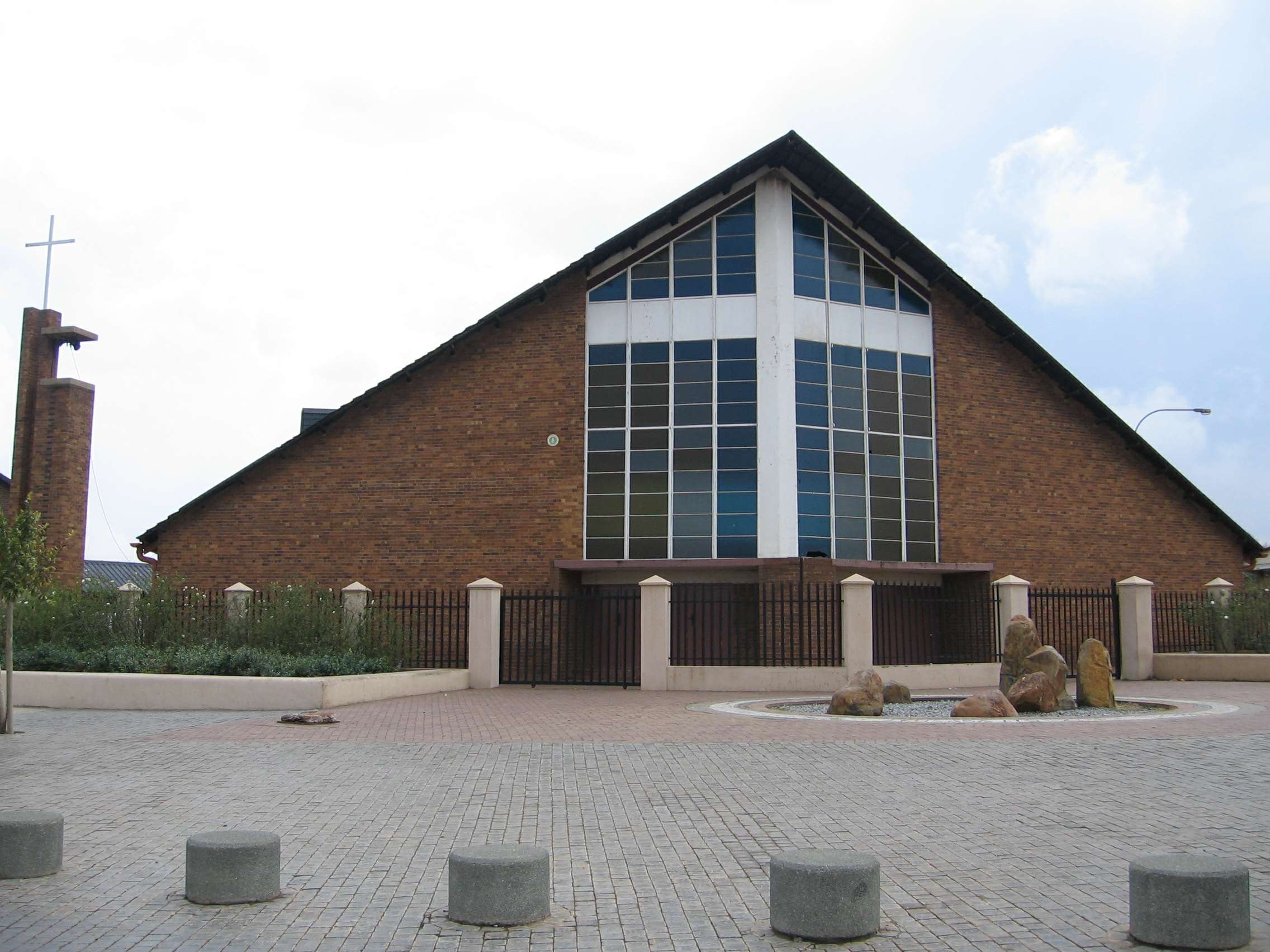
Regina Mundi Catholic Church (Soweto)
The bullet holes are still there. Look up at the ceiling of Regina Mundi Catholic Church in Soweto's Rockville neighborhood, and you can see where South African police fired into the building on June 16, 1976, when thousands of students fleeing the Soweto Uprising poured through its doors seeking sanctuary. The church offered it. It had been offering it for years, and it would continue to do so for years more. In a country where the apartheid government banned political gatherings in public spaces, this Roman Catholic church -- the largest in South Africa -- became the one place where the people of Soweto could meet, organize, mourn, and resist.
A Cathedral for the Township
Designed by architect Anthony Noel Errol Slaven, Regina Mundi was completed in 1964 in the Rockville section of Soweto, within the neighborhood of Moroka. Its name is Latin for "Queen of the World," but the people who fill its pews gave it another title: "the people's church." The building's scale matters. This was not a modest parish chapel tucked into a side street. It was a cathedral-sized statement in the middle of a township that the apartheid government had designed to be temporary, invisible, and controlled. The church's very presence contradicted the logic of Soweto's creation -- that the Black residents housed there existed only to serve Johannesburg's labor needs, not to build institutions of their own.
The Black Madonna's Gaze
Inside the church hangs a painting that crystallizes Regina Mundi's meaning. Created by artist Larry Scully in 1973 as part of a campaign to fund education for Black South Africans, the work depicts a Black Virgin Mary holding a Black Child Jesus. A benefactor purchased the painting and donated it to the church, where it became one of the most symbolically charged artworks of the anti-apartheid era. Beneath the Madonna, a large eye stares outward. Journalist Mpho Lukoto of The Star interpreted the image: the pupil represents Soweto itself, two forks directed at the pupil from either side represent the violence inflicted on Soweto's people during apartheid, and a cross at the center represents the church illuminating the people with hope. The painting did not need explaining to the congregants who lived under that violence. They understood the eye looking back at them.
Where Funerals Became Rallies
Because the apartheid government prohibited political assemblies in most public spaces, Regina Mundi became, by necessity, the primary gathering place for Soweto's residents. Church services were permitted. Funerals were permitted. And so funerals routinely became political meetings -- eulogies shading into speeches about liberation, hymns carrying double meanings, mourning for the dead intertwined with organizing for the living. Anti-apartheid leaders from across Gauteng province used the church as a de facto headquarters. The strategy was straightforward: the government could ban meetings in parks and community halls, but shutting down a Catholic mass carried a different kind of political cost. Regina Mundi exploited that gap with courage and consistency, earning its reputation as one of the main centers of anti-apartheid activism in the province.
Presidents in the Pews
After apartheid ended, Regina Mundi's significance only grew. A park with a fountain and memorials was built in front of the church, including a peace pole donated by Japanese Christians. In March 1998, U.S. President Bill Clinton and his wife Hillary visited the church -- a visit that generated headlines less for its diplomatic symbolism than for its awkward timing. The Clintons received Holy Communion despite not being Catholic, and the sermon that day focused heavily on adultery, a topic of particular discomfort for the president then embroiled in the Lewinsky scandal. Years later, First Lady Michelle Obama addressed the Young African Women Leaders Forum at Regina Mundi, with the Archbishop of Johannesburg in attendance. The church that had sheltered Soweto's resistance had become a stage where world leaders came to pay respect.
Living Memory
Regina Mundi stands today as both an active parish and a living monument. The bullet scars in its ceiling have been deliberately preserved -- not as decoration, but as testimony. They mark the moment when a house of worship absorbed the violence that the state directed at its people and refused to close its doors. In a post-apartheid South Africa still grappling with the legacies of that era, the church offers something uncommon: a physical space where the story of resistance is not abstract or historical but embedded in the walls themselves. Visitors walk through the same entrance that fleeing students once rushed through. They sit in the same pews where funerals became acts of defiance. The Black Madonna still watches from the wall, her eye still open.
From the Air
Regina Mundi sits at 26.262°S, 27.883°E in the Rockville section of Soweto, southwest of Johannesburg's city center. From 3,000-5,000 feet AGL, the church's large roof is visible amid Soweto's dense township layout. The nearest major airport is O.R. Tambo International Airport (FAOR/JNB), approximately 30 nm east. Lanseria International Airport (FALA) lies about 20 nm northwest. The Johannesburg CBD skyline is visible to the northeast. Conditions are typically clear on the Highveld, with afternoon thunderstorms common in summer months (October-March).