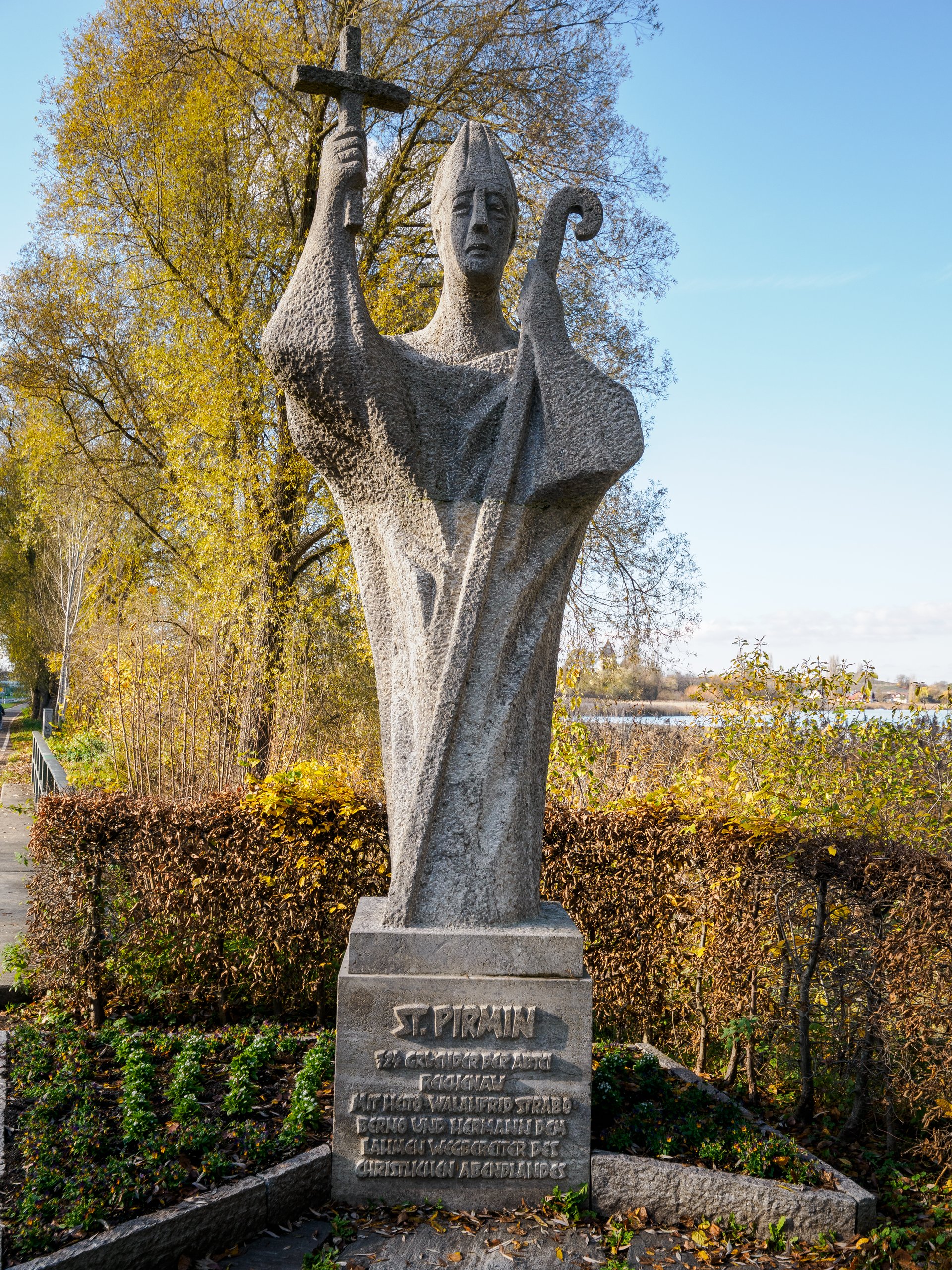
Reichenau Abbey
Saint Pirmin was running from one invasion when he helped launch another -- of a very different kind. Fleeing Visigothic Spain ahead of the Moorish advance, the itinerant monk found patronage from Charles Martel and, more locally, from Count Berthold of the Ahalolfinger and the Alemannian duke Hnabi. In 724, Pirmin founded a monastery on Reichenau Island in Lake Constance, in what is now southern Germany. He lasted only three years before a conflict with Duke Hnabi forced him out. But the institution he planted on that small, flat island would grow into one of the most consequential intellectual centers of the medieval world.
The Island on the Highway
Reichenau's location was its first advantage. The island sat along a main north-south route between Germany and Italy, and the lake crossing eased what was otherwise an exhausting overland journey through the Alps. Greek and Italian travelers passed through. So did Irish and Icelandic pilgrims. This steady stream of foreign visitors brought ideas, texts, and artistic influences that accumulated in the monastery's library and scriptorium like sediment. Under Abbot Waldo (740-814), Reichenau gained influence within the Carolingian dynasty by educating the clerks who staffed imperial and ducal chanceries -- the men who drafted the laws and letters that held the empire together. Abbot Reginbert (died 846) built up the monastery's book collection, and Abbot Walahfrid Strabo (842-849), a poet and Latin scholar educated at Reichenau, brought further intellectual prestige.
Where Books Were Made Beautiful
The abbey's scriptorium and artists' workshop have a strong claim to having been the largest and most artistically influential center for producing illuminated manuscripts in Europe during the late 10th and early 11th centuries. The monks of Reichenau did not merely copy texts -- they created lavishly decorated books that combined theological content with visual artistry of extraordinary sophistication. Their work is now known collectively as the Reichenau School. Among its masterpieces is the Pericopes of Henry II, a lectionary created for the Holy Roman Emperor and now preserved in Munich. The manuscripts produced here shaped how biblical narratives were visualized across medieval Europe, establishing iconographic conventions that persisted for centuries.
Principality of the Spirit
Carolingian patronage fueled Reichenau's rapid ascent through the medieval hierarchy. The abbey was granted successive privileges that elevated it from a simple monastery to a political entity: immunity from secular authority, the status of a principality of the empire, and complete exemption from episcopal jurisdiction. The abbot answered to no bishop and no local lord. Bishop Egino of Verona, who had relocated to Reichenau, built the parish church of St. Peter at Niederzell in 799 -- a small Roman basilica with two towers where he retired to live as a hermit until his death in 802. Charles the Fat, a Carolingian emperor, was buried at Reichenau, as were Burchard III and Herman I, both Dukes of Swabia. The island monastery was, for a time, a power center that rivaled courts.
Thirteen Centuries on the Lake
After 1540, Reichenau's independence ended when the bishops of Constance became its ex officio abbots. The monastery was formally dissolved in 1803. But the island and its buildings survived, and recognition followed. UNESCO inscribed Reichenau Island as a World Heritage Site, acknowledging the monastery's extraordinary contribution to art, scholarship, and religious culture. In 2024, Deutsche Post issued a commemorative stamp series marking 1,300 years since Pirmin's founding. The three medieval churches still stand: the Minster of St. Mary and St. Mark, St. Peter and St. Paul at Niederzell, and St. George at Oberzell, whose 10th-century wall paintings are among the oldest surviving north of the Alps. The island remains inhabited, its residents tending gardens and vineyards that the monks cultivated a millennium ago. What Pirmin started in three contested years took thirteen centuries to fully appreciate.
From the Air
Located at 47.70N, 9.06E on Reichenau Island in Lake Constance (Bodensee) in southern Germany, near the Swiss border. The island is connected to the mainland by a causeway and is easily identifiable from the air as a flat, cultivated island in the western arm of Lake Constance (the Untersee). The three medieval churches are visible as distinct structures amid the island's fields and gardens. Nearest airports include Friedrichshafen (EDNY) approximately 30 km east and Zurich (LSZH) approximately 60 km southwest. The city of Constance (Konstanz) is visible just to the southeast. Best viewed at 3,000-5,000 feet to appreciate the island's setting in the lake.