Reichstag dome
Walk up the spiral ramp inside Norman Foster's glass dome and you are walking, quite literally, on top of the German government. The Bundestag's debating chamber sits directly below. A mirrored cone in the center of the dome funnels daylight down into the room and reflects the faces of the legislators back up to the visitors above. The architecture is making an argument. Below, the politicians work. Above, the public watches. After what happened in this same building in the twentieth century, the symbolism could not have been more deliberate. When the dome opened in 1999, Germany was nine years into its second attempt at democratic reunification, and the Bundestag had just moved back from Bonn to Berlin. The first thing the new German republic did with its old imperial parliament was put a transparent ceiling on it.
The architect did not want a dome
Norman Foster won the 1993 commission to rebuild the Reichstag, but his original design called for a vast translucent canopy stretched above the building like a parasol. The Bundestag rejected it as too expensive and, more importantly, as too much of a break from the building's history. They wanted a dome, partly to echo Paul Wallot's original 1894 dome that had been destroyed in the war. Foster pushed back. He had spent his career arguing against the symbolism of cupolas as monuments to power. Then he saw a 1988 sketch by the German architect Gottfried Bohm proposing a glass cupola with visitors walking spiral ways to the top. Foster adapted Bohm's idea, made it his own, and stopped resisting. Years later he reused the same spiral-walkway-in-a-conical-shell at City Hall in London. The Reichstag dome was the first.
How the light works
The dome is not just a viewing platform. It is also a piece of building physics. The mirrored cone in the center, faceted with 360 individual mirrors, channels natural daylight down into the debating chamber, reducing the need for artificial lighting and the carbon footprint that comes with it. A motorized sun shield tracks the sun's position electronically and rotates to block direct beams that would otherwise dazzle the politicians or overheat the room. Hot air rises into the cone and vents at the top. Visitors walking the two intertwined ramps, which curve up the inner glass like a double helix, travel 230 meters of ramp to reach the top viewing platform, which sits 40 meters above the roof terrace. From there, in clear weather, they look out across the Tiergarten to the Brandenburg Gate, the new Hauptbahnhof, the television tower at Alexanderplatz.
The first dome and what happened to it
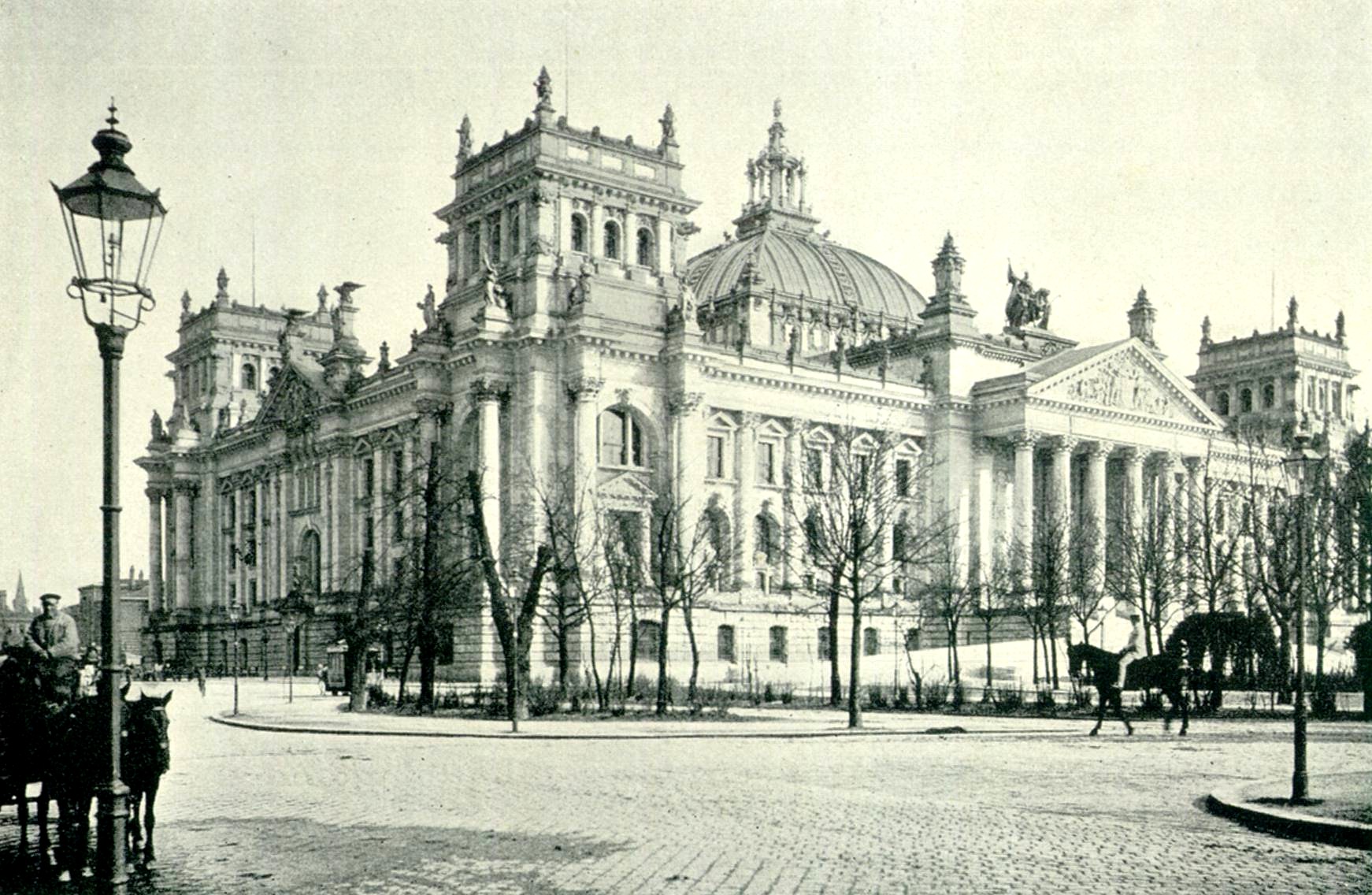
The original Reichstag building was the result of a long political fight Otto von Bismarck mostly lost. Bismarck wanted the new German Empire's parliament kept modest and out of his way. The Reichstag itself wanted a building grand enough to assert its place in the constitutional order. After two architectural competitions, the Frankfurt architect Paul Wallot won in 1882. His building opened in 1894 with a striking glass-and-steel dome that was, for its moment, a piece of engineering as much as architecture. The plenary chamber burned in the Reichstag fire of February 27, 1933. The shell of the building survived, but Hitler had no use for it; he ruled Germany without ever convening the Reichstag in any meaningful way. Allied bombing finished what the fire had started, and after the war the partial reconstruction in the 1960s did not bother replacing the dome.
The wrap and the rebirth
Before the dome went up, something else happened to the Reichstag. In June 1995, the artists Christo and Jeanne-Claude wrapped the entire building in 100,000 square meters of silvery polypropylene fabric tied with eight kilometers of blue rope. Five million people came to see it during the two weeks it stood. The wrapping was, among other things, a ritual cleansing, a way to erase the ghosts before the building became Germany's parliament again. When the fabric came off, the rebuilding began. Foster gutted the interior, kept the exterior walls, and put the new chamber and the new dome in place. The Bundestag held its first session in the renovated Reichstag in April 1999. Visitors have been walking the ramps ever since, more than three million people a year, climbing above their politicians on a piece of glass that means exactly what it looks like.
From the Air
The Reichstag stands at 52.52 N, 13.38 E on the Platz der Republik in central Berlin, with the dome forming a distinctive faceted glass crown 47 meters in diameter on the building's roof. Berlin Brandenburg Airport (EDDB) is 25 km southeast. From low altitude in clear weather, the dome is highly visible, glinting against the Tiergarten's green to the west and the curve of the Spree to the east. The Brandenburg Gate is 400 meters south.