Reiterdenkmal
On Christmas Day 2013, police cordoned off the area in front of Windhoek's Alte Feste fortress. The press was kept at a distance. By evening, a crane had lifted a 4.5-meter bronze horseman off his granite plinth and lowered him into the fortress courtyard, where he remains in storage. The Reiterdenkmal -- the Equestrian Monument, the Rider of the South West -- had stood in one form or another in central Windhoek since 1912. Its removal was neither sudden nor simple. It took twelve years of official debate, two relocations, and a nation's reckoning with whose suffering deserves a monument.
A Birthday Gift for the Kaiser
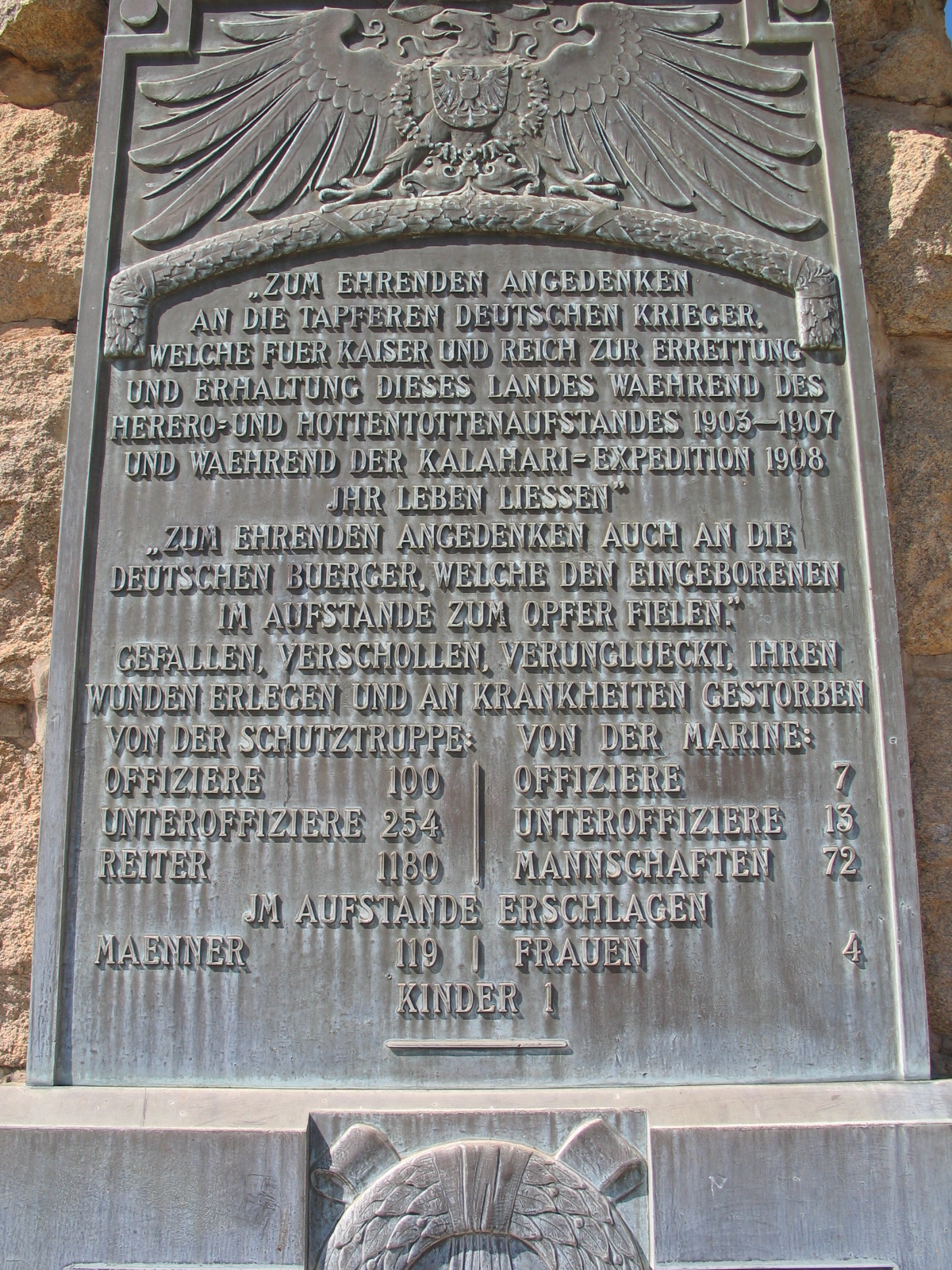
Berlin sculptor Adolf Kurle designed the statue. It was cast in bronze, shipped from Germany to the port of Swakopmund in 1911, and transported by train inland to Windhoek. The plinth, 5 meters tall, was assembled from approximately 180 granite rocks quarried in Okahandja. On 27 January 1912 -- the 53rd birthday of Kaiser Wilhelm II -- Governor Theodor Seitz inaugurated the monument opposite the Christuskirche, Windhoek's landmark Lutheran church. The inscription honored the German soldiers, sailors, and civilians who died during the Herero and Nama Wars of 1904-1908, as well as the Kalahari Expedition of 1908. It listed them by rank: 100 officers, 254 non-commissioned officers, 1,180 soldiers, 47 naval personnel. Then 119 men, 4 women, and 1 child killed during the uprising. The dead on the other side -- the Herero and Nama people, whose population was devastated in what is now recognized as a genocide -- went unmentioned.
Victor's Justice in Bronze
German historian Joachim Zeller argued that equestrian statues have always symbolized imperial rule and power, and the Reiterdenkmal was no exception. It stood next to the German colonial fort, on the site of a wartime concentration camp, erected by the colonial administration as a declaration that their rule was permanent. That declaration lasted three years. World War I broke out in 1914, and by 1915 South African forces had overrun German South West Africa. The Schutztruppe surrendered. Germany lost all its colonies after the Treaty of Versailles. But the monument stayed. Between the world wars, it became the most important site of remembrance for the German minority -- a community that mourned its dead and maintained its cultural identity through ceremonies at the rider's base. For the Herero and Nama communities, the same monument commemorated the forces that had slaughtered their ancestors.
Crosses, Flags, and a Slow Reckoning
The controversy intensified after Namibian independence in 1990. In 2001, the Cabinet unanimously decided to build an Independence Museum on the site where the Reiterdenkmal stood, explicitly endorsing the statue's removal. But action took years. In July 2008, someone erected 51 wooden crosses around the monument's base, each bearing a name or expression in Otjiherero -- a memorial to the victims the original inscription ignored. Three months later, a Namibian flag appeared in the rider's rifle barrel. Each intervention reignited debate in the press: was the monument historical heritage or a glorification of genocide? In 2009, when construction of the Independence Museum finally began, the statue was disassembled and placed in a warehouse. Private donors funded the move, fearing the bronze would otherwise be destroyed.
The Rider's Last Ride
In 2010, the Reiterdenkmal was re-erected in front of the Alte Feste, the old German fortress just meters from its original location. The relocation cost 773,000 Namibian dollars. Controversy did not subside. For three more years, the bronze horseman presided over the approach to the Alte Feste, still mounted, still facing outward over the city the German colonial government had once administered. On 25 December 2013, the government acted. Police Inspector-General Sebastian Ndeitunga confirmed the removal. The statue came down that evening, lifted off its plinth and transported into the Alte Feste's courtyard. It has not been re-erected. The Independence Memorial Museum now occupies the original site, a glass-and-concrete tower that looks out over the same cityscape the bronze rider once surveyed. Windhoek chose what story to tell with that hilltop, and the Reiterdenkmal was not it.
From the Air
The Reiterdenkmal's former site is at 22.57S, 17.09E in central Windhoek, adjacent to the Christuskirche and the Alte Feste fortress. The Independence Memorial Museum now occupies the prominent hillside location and is visible from the air as a tall, modern structure near the historic church. Nearest airports: Eros Airport (ICAO: FYWE) approximately 4 km south for domestic flights, and Hosea Kutako International Airport (ICAO: FYWH) approximately 45 km east. Best viewed below 3,000 feet AGL. The compact colonial-era city center is clearly distinguishable from surrounding development.