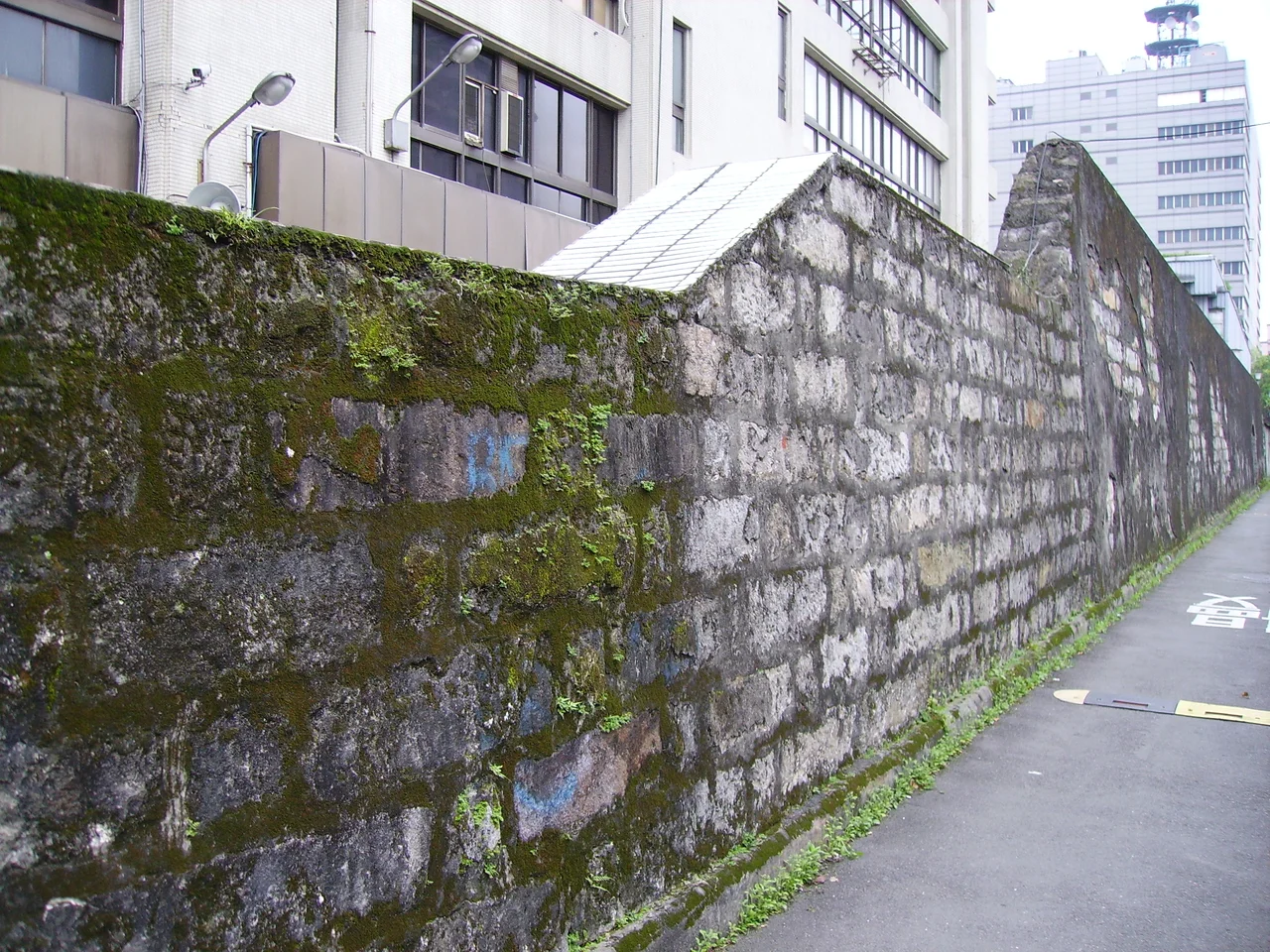

Remains of Taipei Prison Wall
The stones in this wall were cut for a different purpose. They came originally from the quartzose sandstone quarries in the Dazhi and Neihu areas of Taipei and were shaped by hand for the Qing dynasty's city wall, built in the 1880s to define and protect the growing settlement of Taipei. When Japan took control of Taiwan after the First Sino-Japanese War in 1895, the colonial government dismantled much of that city wall and used the stones to build a prison. The material endured. About one hundred meters of the resulting prison wall still stand today, at the corner of Aiguo East Road and Jinshan South Road in Zhongzheng District, next to a Chunghwa Telecom operations building. It is a remnant of something larger and darker — and it deserves to be understood as such.
Stones Repurposed by Conquest
The recycling of the Qing city wall stones into a prison wall was not an accident or an act of careless economy. It was characteristic of how colonial governance worked: existing infrastructure was absorbed, redirected, and made to serve new purposes. The Qing had built their city walls for defense and prestige; the Japanese colonial government needed walls for containment.
The Taipei Prison followed a radial floor plan, a standard prison design of the nineteenth century in which cell blocks radiated outward from a central observation point — a panopticon logic that let a small number of guards monitor a large number of prisoners. Built to hold political prisoners and others caught up in the apparatus of colonial control, the prison was part of a network that included a similar facility in Tainan Prefecture. Anti-Japanese resistance was widespread in Taiwan after 1895, and the colonial government's response included not only military suppression but the systematic imprisonment of those it considered threats.
Political Prisoners and Resistance
In the decades following 1895, the prison held many Taiwanese who had resisted Japanese rule. The uprisings of those early decades — sometimes armed, sometimes organized around traditional community structures — were met with disproportionate force, and the prisons filled. Most of the men and women imprisoned were Taiwanese, held for acts of resistance that colonial law characterized as crimes and that later history has recognized as expressions of a people unwilling to accept occupation on the terms the colonial government dictated.
The wall that remains does not bear their names. This is one of the painful silences of colonial history: the records of who was held, for how long, under what conditions, and with what outcomes are incomplete. What survives is the structure itself — the cut stones, the mortar joints, the height and thickness of walls designed to prevent escape — as a physical testimony to the scale of the colonial carceral system.
May 29 and June 19, 1945
In 1944 and 1945, Allied airmen who had been shot down over Taiwan were held in the Taipei Prison by the Japanese Army. They were prisoners of war, men who had been flying combat patrols when their aircraft were brought down, and they were entitled under the laws of war to be treated as such.
On May 29, 1945, fourteen of these men were given what the record calls a mock trial and sentenced to death. On June 19, 1945 — 57 days before the end of World War II in the Pacific — they were executed in the prison courtyard. The war ended on August 15, 1945, when Japan announced its surrender following the atomic bombings of Hiroshima and Nagasaki. The men who died on June 19 did not live to see it. When the war concluded, the Allied airmen who had survived their imprisonment were released and returned to their families. Plaques mounted on the remaining prison wall today commemorate those who were executed.
Those fourteen men — their names, their nationalities, the details of their service — deserve to be remembered not as statistics or footnotes, but as individuals whose deaths came at the hands of a judicial process that was not legitimate and in a war whose end was already visible. The wall stands near where they died.
What the Wall Holds
The Remains of Taipei Prison Wall are not a grand monument. They are two sections of wall, about one hundred meters in total, flanking a Chunghwa Telecom property in a quiet part of Zhongzheng District. The cut sandstone is old — older than the prison itself, having first been shaped for the Qing city walls in the 1880s — and the texture is visible if you look closely. There are plaques. There is a gate fragment.
Memorials of this kind occupy an uncomfortable position in urban space. They are too small to dominate their surroundings, too significant to be ignored. People walk past them on their way to other things. The wall does not compel attention the way a museum or a plaza does. But it is there, and the history it carries — of colonial imprisonment, of Taiwanese resistance, of Allied airmen killed weeks before peace — is not diminished by the ordinariness of the surroundings. Some of the most important historical witnesses are easy to miss. This is one of them.
From the Air
The Remains of Taipei Prison Wall are at approximately 25.033°N, 121.527°E in the Zhongzheng District of southern central Taipei, near the intersection of Aiguo East Road and Jinshan South Road. At 2,000–3,000 feet, the site is not individually distinguishable, but the surrounding area — south of the Presidential Office district, north of the National Taiwan University campus — is recognizable. Taipei Songshan Airport (RCSS) is roughly 7 kilometers to the northeast; Taiwan Taoyuan International (RCTP) is approximately 36 kilometers to the west. The wall sits in a residential and civic neighborhood a short distance east of the old city center axis.
Nearby Stories
- Dapu Incident 9.3 km away
- Shuanglianpi Wetland 18 km away
- Toufen 41 km away
- North Jiangsu Main Irrigation Canal 980 km away
- General Cliff Rock Paintings 1050 km away
- Sinking of MV Sewol 1061 km away
- Yellow Sea 1111 km away
- Twin Forts of Romblon 1358 km away