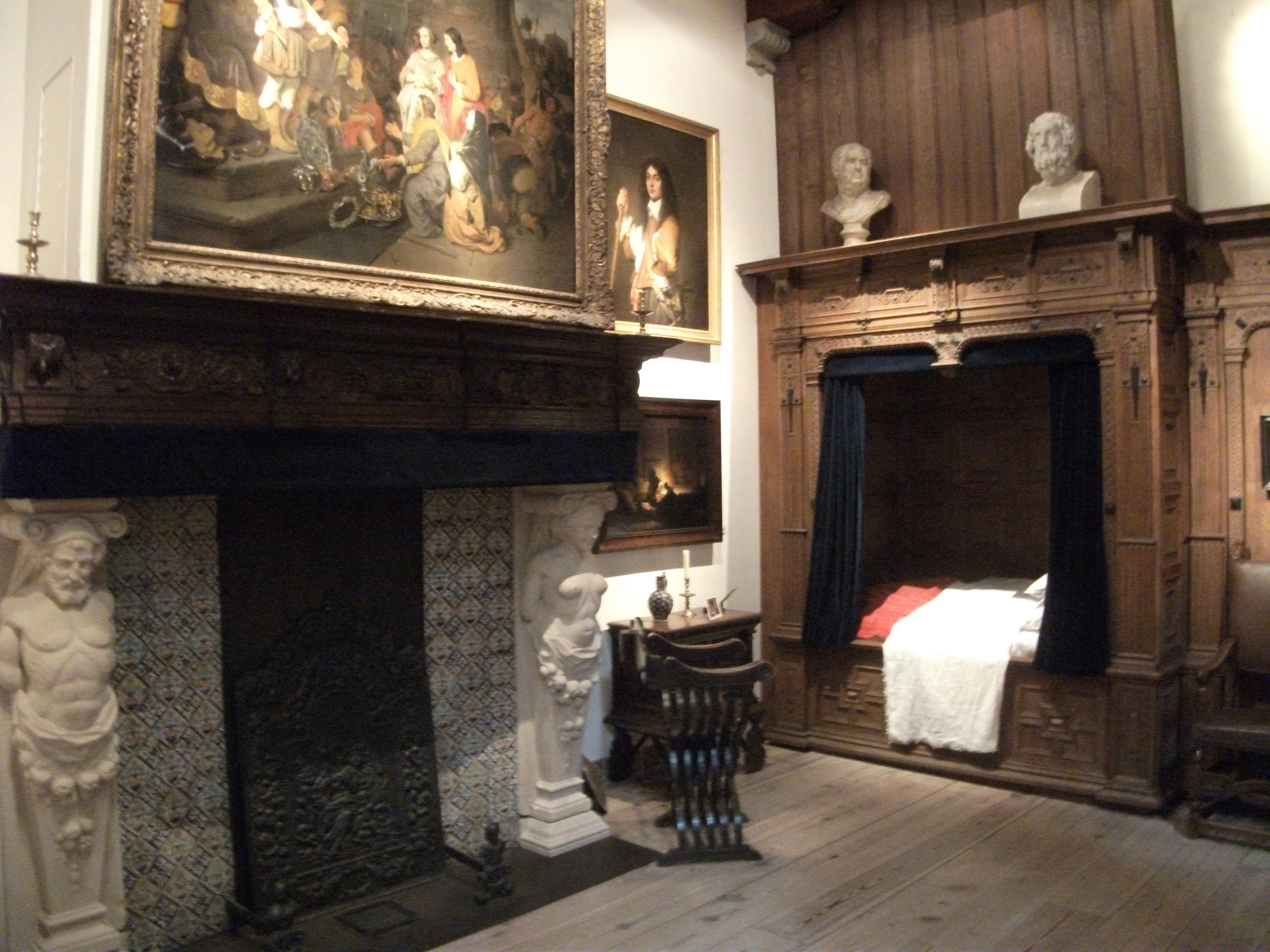
Rembrandt House Museum
Rembrandt van Rijn bought the house on Jodenbreestraat for thirteen thousand guilders on January 5, 1639. It was a grand purchase for an artist at the height of his fame. Nineteen years later, bankrupt and unable to pay his debts, he watched the same house sell at auction for eleven thousand guilders. The detailed inventory drawn up during his financial collapse became, centuries later, the blueprint for recreating exactly what visitors see today: the rooms where the Dutch master lived, collected, taught, and painted some of history's most celebrated works.
A House Twice Transformed
The building dates to around 1606, renovated in 1627 probably under the supervision of architect Jacob van Campen, who added an extra floor and a new facade with a triangular pediment. When Rembrandt moved in, Amsterdam's Jodenbreestraat was a thriving commercial district. He used the house not only as home and studio but also as an art dealership, displaying his own collection of works by other artists and selling paintings to wealthy clients. After his bankruptcy in 1658, the house passed through various owners and underwent multiple renovations.
From Ruin to Restoration
By the early 20th century, the building had deteriorated badly. The Rembrandt Year celebrations of 1906 inspired action: the municipality of Amsterdam purchased it in 1907 and donated it to the Rembrandthuis foundation. Architect Karel de Bazel led a restoration from 1907 to 1911, and on June 10, 1911, the museum opened its doors. Queen Wilhelmina and Prince Hendrik were the first visitors. The painter Jozef Israels had championed the initiative. Today, the museum draws around 200,000 visitors annually, with a record 280,000 in 2019.
The Master's Workspace
Walk through and you see Rembrandt's living room, his art room filled with curiosities and collected objects, and the studio where natural light falls on easels arranged much as they would have been in the 1640s. Works by his teacher Pieter Lastman and pupils Ferdinand Bol and Govert Flinck hang in the period rooms. The museum owns an almost complete collection of Rembrandt's etchings, along with some of his original copper plates, regularly displayed in the etching cabinet and temporary exhibitions.
Secrets from the Cesspool
In 1997, archaeologists excavating Rembrandt's cesspool found two ceramic pots. For years, their purpose remained unclear. Then in 2019, material-technical research revealed one contained remnants of quartz soil - a mixture of quartz and clay that Rembrandt used to prepare his canvases before painting. Curator Leonore van Sloten noted that Rembrandt started using this technique from the moment he lived in the house, and as far as researchers know, he was the only artist who did. The mixture was likely convenient for practical and financial reasons. Those two pots, recovered from the artist's own waste, now sit on display in the museum.
Legacy in Light and Shadow
The museum extends into the neighboring house, which provides modern gallery space and a museum shop. Temporary exhibitions explore Rembrandt's contemporaries and artistic descendants. Recent shows have examined "Rembrandt's Social Network," the elephant Hansken that the artist famously sketched, and the presence of Black individuals in Rembrandt's Amsterdam. Contemporary artists including Marlene Dumas and Natasja Kensmil now join the collection, their work in dialogue with the 17th-century spaces. The house that Rembrandt lost to debt has become his most enduring studio.
From the Air
Located at 52.3694N, 4.9013E on Jodenbreestraat in central Amsterdam, near the Waterlooplein metro station. The 17th-century canal house is difficult to distinguish individually from the air but sits in the historic Jewish Quarter, close to the Portuguese Synagogue. Nearest airport: Amsterdam Schiphol (EHAM), approximately 14 km southwest. The museum district can be identified by its proximity to the Amstel River and the characteristic grid of canals.