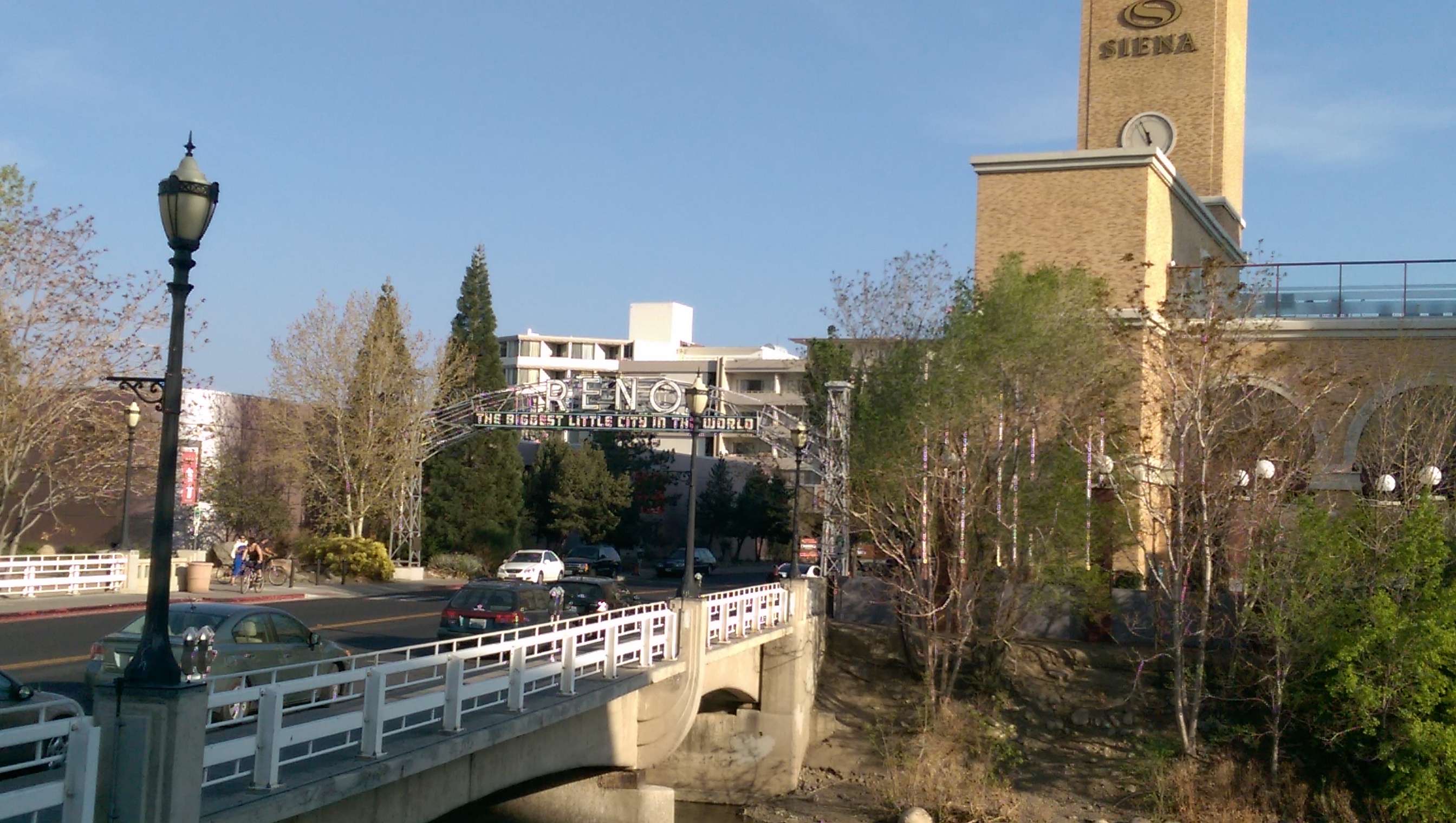
Reno Arch
G.A. Burns of Sacramento won $100 for five words: "The Biggest Little City in the World." It was 1929, and the Reno city council had just decided to keep their three-year-old arch as a permanent gateway. They needed something to replace the exposition lettering, so they held a contest. Burns's slogan first blazed to life on June 25th of that year, flanked by illuminated torches. Nearly a century later, those same words still crown Virginia Street, though the arch beneath them has been rebuilt twice and the torches are long gone.
A Gateway to the West
The original arch rose on October 23, 1926, not as a permanent landmark but as a promotional stunt. The Nevada Transcontinental Highway Exposition was coming the following summer, celebrating something genuinely momentous: the completion of the Lincoln and Victory Highways through the Silver State. These routes would become the corridors of U.S. Route 50 and Interstate 80, arteries carrying generations of travelers across the continental divide. Reno positioned itself as the gateway, the last stop before California or the first taste of the frontier heading east. The exposition ran just one week in 1927, but the arch outlasted it. The city council saw what they had: a defining landmark that announced arrival.
The Slogan Wars
Not everyone loved "The Biggest Little City in the World." By 1934, enough residents had complained that the city council bowed to pressure and replaced Burns's slogan with a simple green neon "RENO." The backlash was swift and fierce. The slogan returned with new lettering, though the torches were removed in the redesign. This tension between boosterism and restraint would echo through the arch's history. When the original structure was replaced in 1963, the old arch found temporary exile at Idlewild Park before spending years in storage. It emerged briefly in 1994 for the movie "Cobb," then found permanent display on Lake Street near the Truckee River, where the first arch still stands as a monument to the second's shadow.
Three Arches, One Identity
The current arch, installed on August 8, 1987, is the third to span Virginia Street. For over two decades, it glowed in gold and red. On November 17, 2009, the city celebrated a small revolution: 2,076 incandescent 11-watt bulbs gave way to 2.5-watt LEDs. Spectators received the old bulbs as commemorative souvenirs. Then in 2018, after a contentious 4-to-3 city council vote, the arch traded its gold legs for silver and blue, aligning with University of Nevada, Reno's colors. The $225,000 makeover also addressed a practical problem: the gold paint had proven difficult to maintain and showed every scratch. The arch has appeared in films from "Kingpin" to "Sister Act," served as the backdrop for Hot August Nights, and remains the first image most visitors associate with the city.
More Than a Sign
What makes the Reno Arch endure is not the steel or the bulbs but the paradox it embraces. Biggest little. The phrase captures something true about a city that has always punched above its weight class, a place that legalized gambling and quickie divorces when such things were scandalous, that sits in the rain shadow of the Sierra Nevada and makes its own weather of neon and noise. The arch doesn't just welcome visitors; it makes a promise about what lies beyond. Every western town has an arch or a sign, from Modesto to Bakersfield to the famous "Welcome to Las Vegas." But only Reno claims to be both the biggest and the littlest, and dares you to figure out which is true.
From the Air
The Reno Arch spans Virginia Street at Commercial Row (39.526N, 119.810W) in the heart of downtown Reno. From the air, look for the distinctive neon glow at night along the main north-south corridor. The arch sits approximately 3 miles southeast of Reno-Tahoe International Airport (KRNO). Best viewed at lower altitudes during evening approaches from the east. The Truckee River runs just north of downtown, providing a useful visual reference.