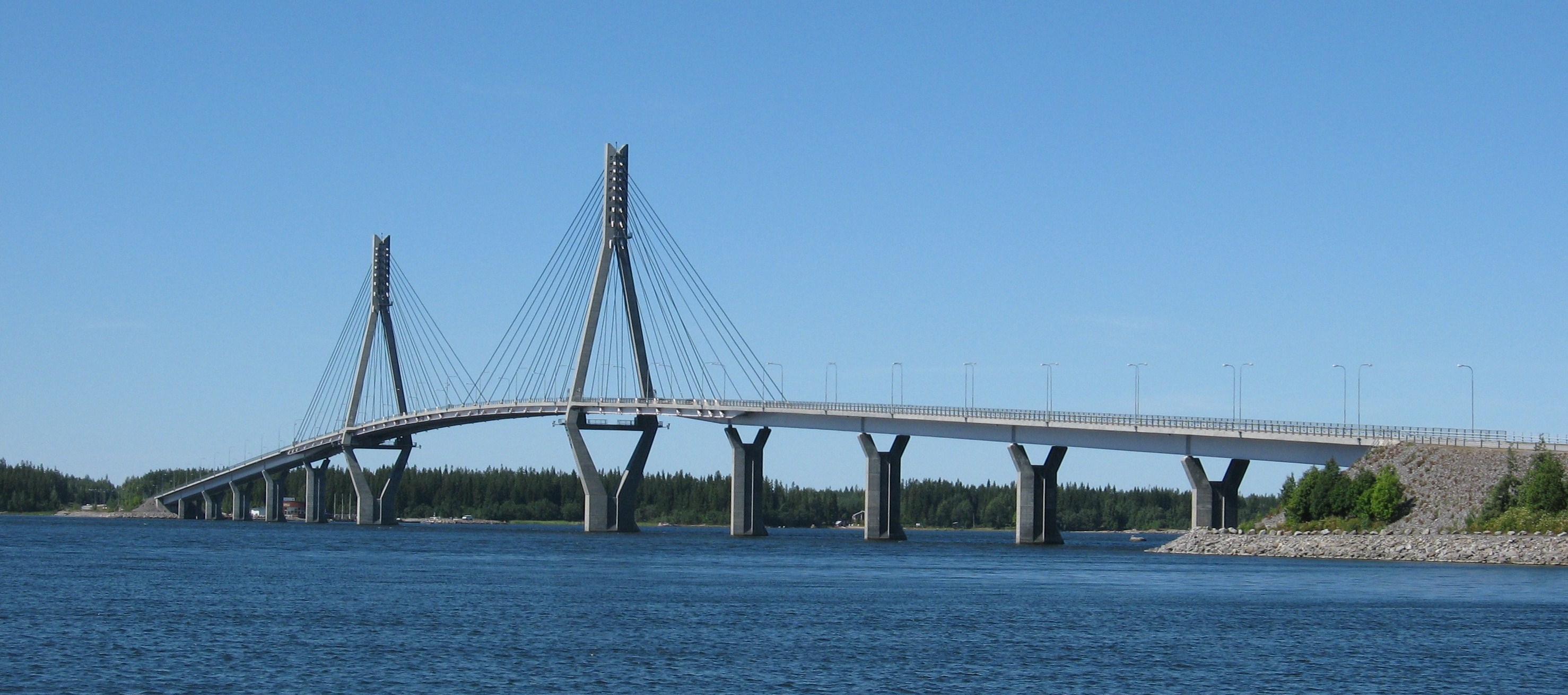
Replot Bridge
For most of its history, Replot was an island that demanded patience. Reaching the Finnish mainland from this Ostrobothnian outpost in the Kvarken Archipelago meant waiting for a ferry, checking the weather, and accepting that the Gulf of Bothnia set the schedule. That changed on 27 August 1997, when President Martti Ahtisaari -- who would win the Nobel Peace Prize eleven years later for his international mediation work -- cut the ribbon on the Replot Bridge. At 1,045 meters, it became Finland's second-longest bridge and transformed the relationship between island and mainland overnight.
Steel and Cables Over the Gulf
The Replot Bridge is a cable-stayed structure, its deck suspended from steel cables anchored to two pylons that rise 82.5 meters above the water. The design is elegant in its engineering economy: cable-stayed bridges use fewer materials than suspension bridges while spanning similar distances, and the twin pylons give the structure a distinctive silhouette visible for kilometers across the flat Ostrobothnian landscape. The bridge crosses the Replot Sound, a strait that separates the island from the municipality of Korsholm on the mainland near Vaasa. In winter, the surrounding waters freeze into a vast white plain, and the bridge's pylons stand like sentinels above the ice. In summer, the low-angle Arctic light catches the cables at dawn and dusk, turning them into golden threads against the sky.
Island Life Before the Span
Replot sits in the Kvarken Archipelago, a landscape shaped by post-glacial land uplift -- the ground here is still rising, roughly a centimeter per year, as it rebounds from the weight of ice sheets that retreated ten thousand years ago. The archipelago's shallow waters, rocky islets, and shifting shorelines made it a challenging place to build permanent connections to the mainland. Before the bridge, Replot's residents relied entirely on ferry service, which meant seasonal isolation when ice was too thick for boats but too thin to walk on. The bridge did not just save commuters time. It reshaped the island's economy, its school system, its emergency services. An ambulance that once depended on ferry schedules could now reach the mainland hospital in minutes.
A Presidential Ribbon
Martti Ahtisaari was two years into his presidency when he inaugurated the bridge in 1997. He was already known as a diplomat and mediator -- he had overseen Namibia's transition to independence as a United Nations special representative in the 1980s -- but his most celebrated work lay ahead. In 2008, he received the Nobel Peace Prize for his efforts resolving conflicts in Namibia, Aceh, and Kosovo. The bridge inauguration was a modest event by comparison, a domestic ribbon-cutting for a regional infrastructure project. But it carried its own significance. In Finland, where the relationship between periphery and center is a perennial political question, connecting an island community to the mainland is never purely an engineering achievement. It is a statement about who belongs to the national fabric.
The View from Above
From the air, the Replot Bridge draws a clean line across the dark water of the strait, its cables fanning outward from each pylon like the ribs of an open fan. The Kvarken Archipelago spreads in every direction -- a maze of low islands, skerries, and shallow bays that UNESCO recognized as a World Heritage site in 2006 for its outstanding geological value. The bridge connects this fragmented landscape into something continuous, a thread of concrete and steel that stitches island to continent. On grey autumn days, when fog rolls in from the Gulf of Bothnia, the pylons disappear into the mist and the bridge seems to float above nothing at all. It is the kind of structure that rewards a second look -- understated at a distance, impressive up close, and quietly essential to the thousands of people who cross it every day.
From the Air
Located at 63.21N, 21.47E, crossing the Replot Sound in the Kvarken Archipelago near Vaasa, Finland. The twin 82.5-meter pylons are the tallest structures in the area and are visible from considerable distance. Vaasa Airport (EFVA) is approximately 15 km to the southeast. Best viewed at 1,000-3,000 feet for the full span and its archipelago context. The UNESCO-listed Kvarken Archipelago extends north and west, a distinctive landscape of shallow bays and emerging islands.