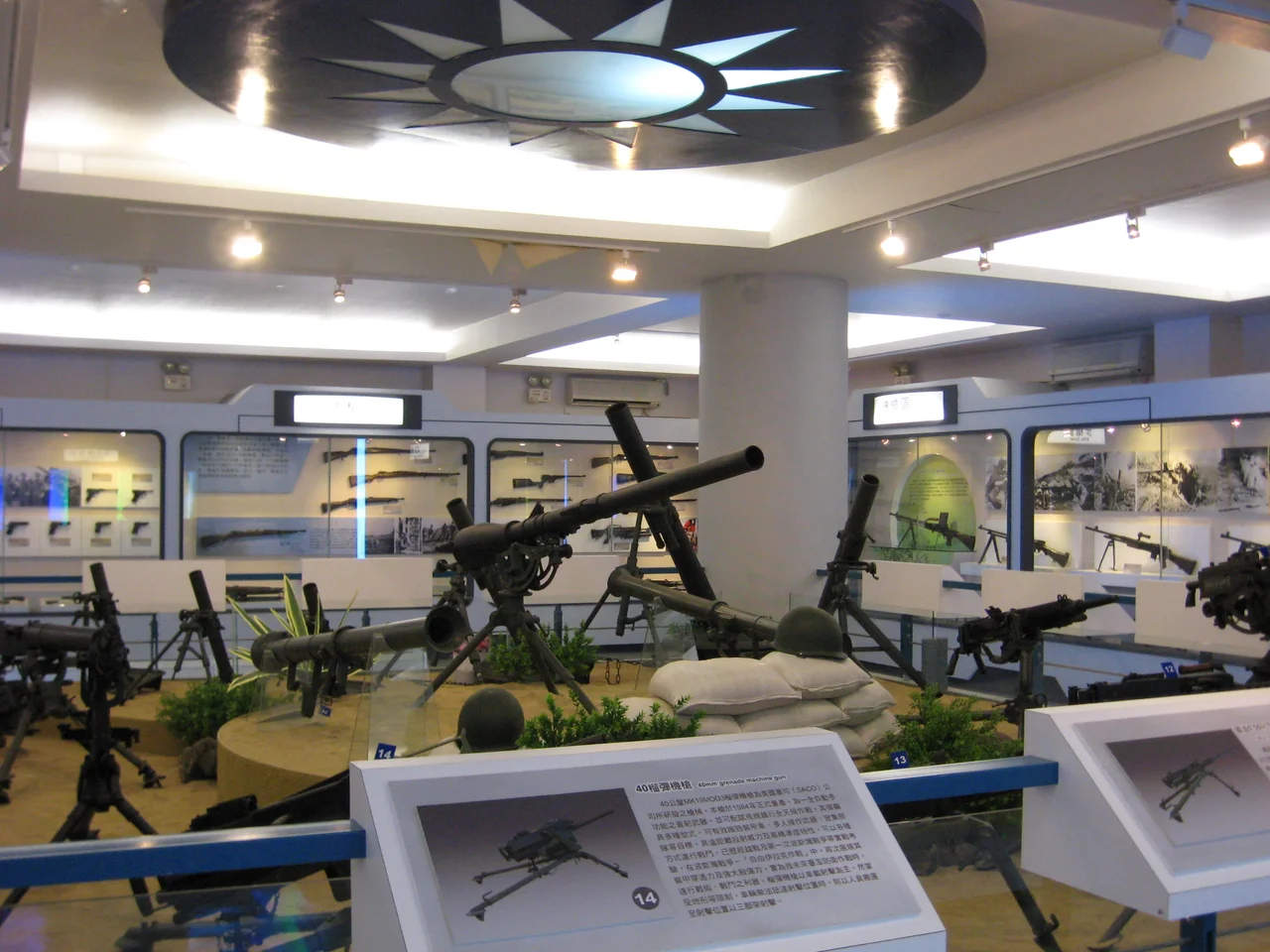

Republic of China Armed Forces Museum
It opened on 31 October 1961, just twelve years after the Republic of China government retreated to Taiwan, and for sixty years it stood as the military's attempt to explain itself — to its own people, to history, and perhaps to itself. The Republic of China Armed Forces Museum on Guiyang Street in Taipei's Zhongzheng District was never simply a collection of hardware and uniforms. It was an argument: that the ROC military's decades of sacrifice, from the battlefields of mainland China through two Taiwan Strait crises to the Cold War standoff that still defines the Taiwan Strait, meant something. On 30 December 2021, it closed permanently.
Shaped by the Long War
The museum's permanent galleries traced a military biography written in extraordinary upheaval. The first room walked visitors from the Whampoa Military Academy — the institution that shaped a generation of officers on both sides of the Chinese Civil War — through the Northern Expedition that briefly unified China in the late 1920s. From there, the story moved into the War of Resistance against Japan, the eight grinding years of the Second Sino-Japanese War. Among the artifacts were captured Japanese military equipment, including swords associated with some of the conflict's darkest chapters. These were displayed not as trophies but as evidence, part of a historical reckoning with wartime atrocities that shaped how Taiwan's military saw its own mission. Each gallery built on the last, constructing a narrative of sacrifice that culminated in the retreat to Taiwan and the long watch that followed.
Cold War at Close Range
Few exhibits in any Asian museum made the Cold War as immediate as those covering the Taiwan Strait crises. For visitors born after 1958, it can be difficult to grasp how close the shooting came. The Battle of Guningtou in 1949 repelled a People's Liberation Army amphibious assault on Kinmen Island with close-quarters fighting that lasted through the night. The First and Second Taiwan Strait Crises brought artillery barrages and naval engagements to waters most maps still mark as the Taiwan Strait. The Black Cat Squadron — ROC Air Force U-2 pilots who flew reconnaissance missions over mainland China, some of whom did not return — had their own exhibition here. These were not distant conflicts but defining ones, and the museum treated them with the seriousness they deserved.
The Exhibition Calendar
Beyond the permanent galleries, the museum mounted a changing program of temporary exhibitions that tracked the breadth of ROC military history. Some were ceremonial — the 90th Anniversary of Whampoa Military Academy in 2014, the Thunder Tiger aerobatic team the same year. Others were grimmer: a 2005 exhibition on Japanese prisoner-of-war camps in Taiwan, a 2012 show on chemical and biological defense. The 50th anniversary exhibition of the Second Taiwan Strait Crisis in 2008 brought out survivors and archival materials rarely seen in public. Taken together, the exhibition calendar amounted to a decades-long conversation between the military and Taiwanese society about what the armed forces had done and what they were for.
An Institution at Its End
The museum's closure in December 2021 was not a surprise. The Ministry of National Defense had announced it would be replaced by an upgraded National Military Museum, a larger institution intended to serve a new era. What the closure meant in practice was the end of a particular kind of institutional memory — housed in a three-floor building a short walk south of Ximen Station, accessible to anyone curious enough to show up. For sixty years, schoolchildren, veterans, foreign visitors, and ordinary Taipei residents had passed through those galleries. The building's specific weight — the specific weight of a museum that had been part of a living city since 1961 — is not something that can be simply moved to a new address. The National Military Museum will carry the artifacts forward. What it will do with the accumulated atmosphere of the old building on Guiyang Street remains to be seen.
A Witness to the City
Zhongzheng District is Taipei's civic and governmental core, and the Armed Forces Museum sat within it as a particular kind of landmark — quiet by the standards of more touristic destinations, important to those who sought it out. The district takes its name from Chiang Kai-shek's courtesy name, a reminder that this part of the city carries layers of twentieth-century history in its very geography. The museum was part of that layering: a place where the Republic of China's military past and Taiwan's complicated present-day identity existed in the same rooms. History rarely resolves itself neatly inside museum walls. At the Armed Forces Museum, it made no pretense of doing so.
From the Air
The museum site sits at approximately 25.040°N, 121.508°E in Taipei's Zhongzheng District, near the Danshui River. Flying into Taipei Songshan Airport (RCSS) puts you directly over the heart of the city; the museum was roughly 1.5 km southwest of the runway threshold. From 3,000 feet on approach to RCSS Runway 10, the dense urban grid of Zhongzheng spreads below, interrupted by the wide green belt of the Presidential Office grounds and 228 Peace Memorial Park nearby. Taipei Taoyuan International Airport (RCTP) lies about 40 km to the west. Visibility permitting, the Taipei 101 tower in Xinyi District provides the clearest geographic reference point from altitude.
Nearby Stories
- Dapu Incident 9.3 km away
- Shuanglianpi Wetland 18 km away
- Toufen 41 km away
- North Jiangsu Main Irrigation Canal 980 km away
- General Cliff Rock Paintings 1050 km away
- Sinking of MV Sewol 1061 km away
- Yellow Sea 1111 km away
- Twin Forts of Romblon 1358 km away