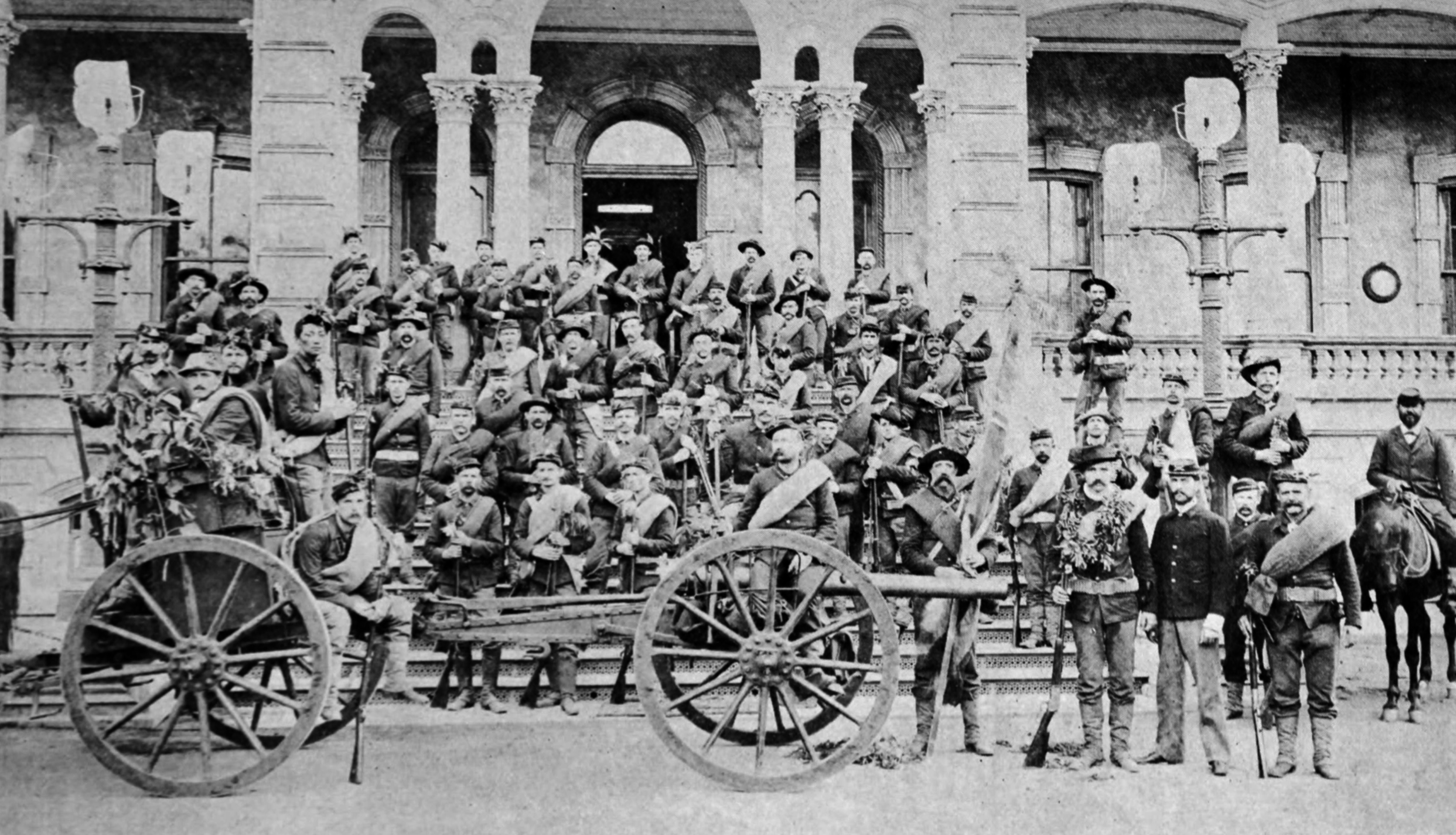
Republic of Hawaii
On August 12, 1898, the Hawaiian flag was lowered over Iolani Palace for the last time. The Stars and Stripes rose in its place, and the Republic of Hawaii -- a government that had existed for exactly four years, one month, and eight days -- ceased to be. It had never been intended to last. The republic was a holding pattern, a political structure built by men who had overthrown a queen and needed something to govern with while they waited for the United States to say yes.
The Bayonet and the Coup
The roots of the republic lay in a document forced on King Kalakaua in 1887. The so-called Bayonet Constitution, imposed by the Reform Party under threat of violence, stripped the monarch of most governing authority and concentrated power in the hands of a legislature dominated by American and European property owners. When Kalakaua's successor, Queen Liliuokalani, moved to replace that constitution with one restoring royal authority, the reaction was swift. In January 1893, the Committee of Safety -- a group of roughly 1,000 armed men led by wealthy sugar planters and businessmen, many of them Hawaii-born descendants of American missionaries -- overthrew the queen. There was no bloodshed; the royal forces did not resist. U.S. Marines landed to support the conspirators, and American officials recognized the new provisional government almost immediately. The Blount Report, commissioned by President Grover Cleveland, later concluded that the United States had carried out "unauthorized partisan activities" instrumental to the revolution, and that it was accomplished "against the wishes of a majority of the population of Hawaii."
A Republic That Was Never Meant to Be
The coup's leaders -- Sanford B. Dole, a former justice of the Kingdom's Supreme Court, and Lorrin A. Thurston, a former interior minister under Kalakaua -- wanted annexation by the United States, not independence. But President Cleveland, a Democrat who opposed imperialism, refused. He asked Dole to resign. Dole ignored the request. Cleveland sent an investigator, whose Blount Report supported restoring the queen, but the Senate produced a competing Morgan Report that reached the opposite conclusion. In May 1894, the Senate unanimously passed a resolution opposing the queen's restoration. Cleveland dropped the issue. Left to their own devices, the plotters convened a constitutional convention and proclaimed the Republic of Hawaii on July 4, 1894 -- the date chosen deliberately. Article 23 of the new constitution named Dole as president by name, dispensing with the pretense of an election. He would be the republic's only president.
The Queen's Last Stand
Not everyone accepted the new order. In January 1895, Robert William Wilcox -- a Hawaiian revolutionary who had previously led an uprising against the monarchy itself -- organized an armed counter-revolution to restore Liliuokalani. Royalist supporters smuggled weapons from San Francisco to a secret location in Honolulu. On January 6, conspirators gathered to plan a surprise assault on government buildings, but a chance encounter with a police squad blew the operation. Wilcox fled to the mountains and was captured days later. The republic's government found arms, ammunition, and documents at Washington Place, the queen's private residence, including notes in her handwriting outlining her planned cabinet. Liliuokalani was charged with misprision of treason. She denied the accusations but was convicted and sentenced to five years of hard labor and a $10,000 fine. The "hard labor" was served in a large bedroom at Iolani Palace, furnished with a piano and a private bathroom. After eight months, she was moved to house arrest at Washington Place.
Annexation and Erasure
With the opposition broken, the path to annexation opened. The 1897 election -- the republic's last -- saw less than one percent of the population vote. Royalists boycotted; the American Union Party won every seat. When Republican William McKinley took the presidency, the political winds shifted. Annexation was accomplished through the Newlands Resolution, which required only a simple majority in Congress rather than the two-thirds Senate vote needed for a treaty. It passed the House 209 to 91. The debate over Hawaii became a proxy for America's larger argument about imperialism. Andrew Carnegie, Mark Twain, and William Jennings Bryan opposed expansion. Theodore Roosevelt, Alfred Thayer Mahan, and newspaper magnates Hearst and Pulitzer championed it. McKinley's pragmatic argument carried the day: Hawaii could not survive alone, he said, and if America did not take the islands, Japan would. Already a quarter of Hawaii's population was Japanese. On August 12, 1898, sovereignty transferred. The flag came down. Dole became the territory's first governor, completing a transition he had engineered from the start.
What the Petitions Said
The annexation was not unopposed by the people it affected most. Native Hawaiians submitted two petitions carrying over 20,000 signatures -- representing more than half the indigenous population -- protesting the transfer of sovereignty. Liliuokalani herself traveled to Washington to lobby for her restoration. The republic's own constitution limited voting to male citizens of the former kingdom, excluding most Japanese, Chinese, Portuguese, and European immigrants. Under those rules, Native Hawaiians held a two-thirds voting majority and were the largest represented group in the legislature. The Speaker of the House was Hawaiian -- John Lot Kaulukoo. The irony was bitter: a government built by haole businessmen to advance American annexation governed with a legislature where Hawaiians were the majority, while those same Hawaiians overwhelmingly opposed the very annexation the government existed to pursue.
From the Air
The Republic of Hawaii was centered at Iolani Palace in downtown Honolulu, located at 21.311N, 157.796W. The palace and surrounding government district are visible from the air just east of Honolulu harbor. Honolulu International Airport (PHNL) is 5 miles to the west. Washington Place, the queen's residence, is adjacent to the State Capitol building, two blocks northeast of the palace.