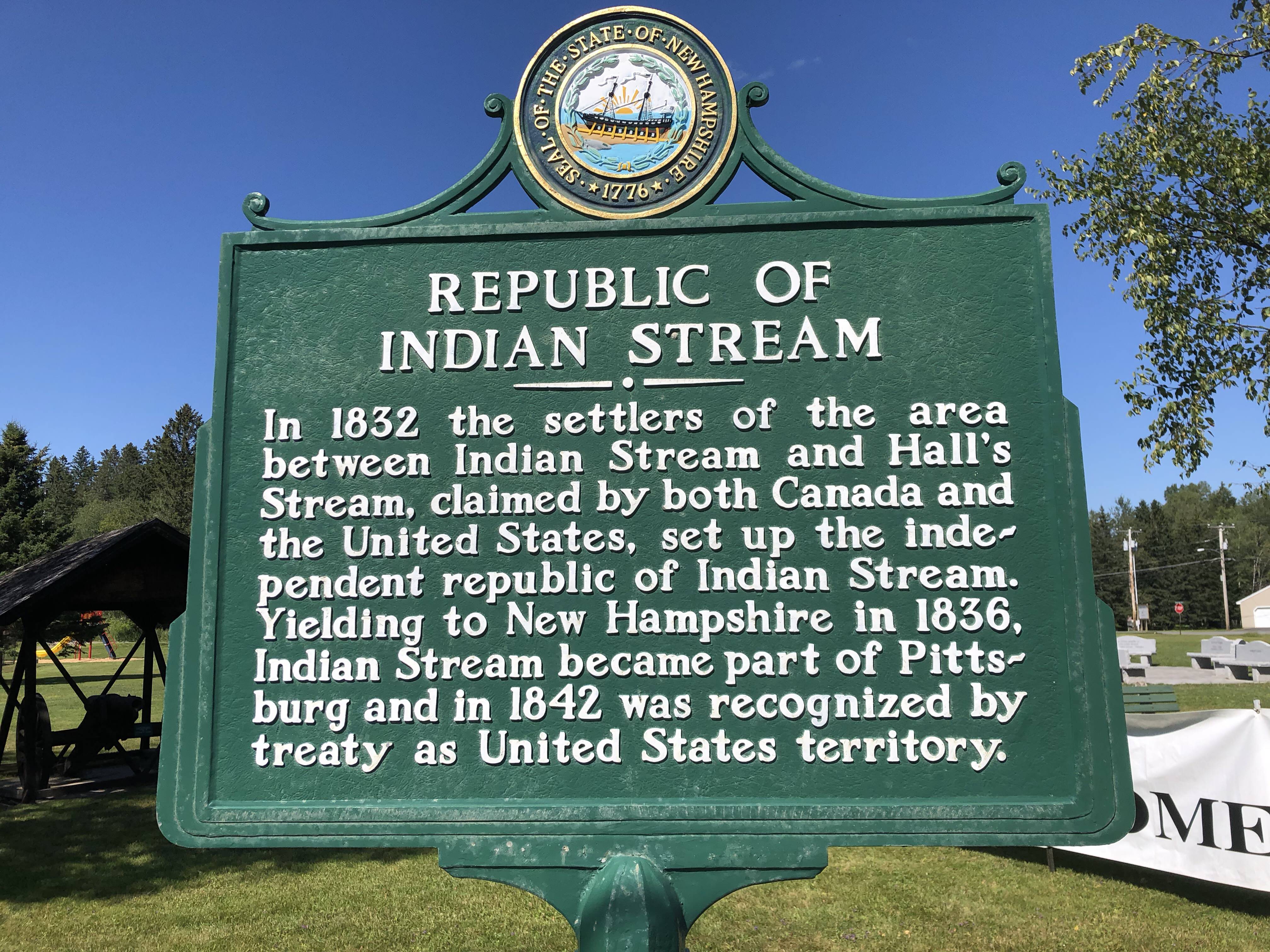
Republic of Indian Stream
Three hundred people, a confusing treaty, and a hardware-store debt nearly started a war between the United States and the British Empire. In the remote highlands where New Hampshire meets Quebec, a pocket of settlers spent the early 1830s being taxed by two countries at once -- the Americans and the British both claiming jurisdiction over the same rocky, forested territory at the headwaters of the Connecticut River. Fed up with double taxation and dueling sheriffs, the residents did something extraordinary: on July 9, 1832, they declared independence, wrote a constitution, elected a government, and called their new nation the Republic of Indian Stream. It lasted exactly three years and twenty-seven days.
A Border That Nobody Could Find
The problem began with the Treaty of Paris in 1783, which ended the American Revolution by drawing a boundary line along 'the northwesternmost head of the Connecticut River.' The treaty's authors apparently assumed this phrase was self-explanatory. It was not. The Connecticut River is fed by three tributaries at its northern extreme, and each one could plausibly be called the northwesternmost headwater. The British claimed the boundary ran along the southeasternmost branch -- the chain of Connecticut Lakes. The Americans argued for Halls Stream, the westernmost tributary. The disputed zone between these interpretations encompassed the four Connecticut Lakes and roughly 282 square miles of wilderness. For decades after the Revolution, the area remained a jurisdictional no-man's-land. Settlers arrived anyway, originally under overlapping land grants traceable to competing claims by Abenaki leaders. Both the Americans and British sent tax collectors. Both sent sheriffs to collect debts. The residents found themselves caught in the middle, forced to pay twice for the privilege of living in territory that neither nation could definitively call its own.
A Constitution for Three Hundred Souls
By the early 1830s, the settlers had had enough. The Indian Stream assembly declared independence on July 9, 1832, and produced a written constitution that established a formal government for their tiny republic. Luther Parker, who served as justice of the peace from 1832 to 1835, was one of its drafters. The constitution created an elected governing structure for a community of roughly 300 citizens -- an entire nation that could have fit inside a single church. The republic was named after Indian Stream, a small watercourse running through the territory. The 1830 United States census had already noted the area as 'Indian Stream Territory, so-called,' an acknowledgment that even federal officials recognized the place existed in a kind of sovereign limbo. Some citizens viewed themselves as part of the United States but emphatically not part of New Hampshire -- a distinction that mattered deeply to people who had been subjected to the competing legal systems of two empires and wanted control over their own affairs.
Invasion by Ultimatum
Independence did not bring peace. The sheriff of Coos County, New Hampshire, continued intervening in local disputes, and tensions escalated until the situation reached a breaking point. On July 30, 1835, the sheriff requested militia support. Two companies of infantry from towns around Colebrook mustered at Stewartstown, prepared to march into the disputed territory. The sheriff moved ahead of them and on August 4 confronted between 30 and 40 members of the Indian Stream assembly, delivering an ultimatum: submit to New Hampshire or face forcible occupation. Outnumbered and outgunned, most of the assembly capitulated. The next day, August 5, five leaders of Indian Stream wrote to a British official in Sherbrooke, Lower Canada, explaining that their petition for British protection had not been answered in time and that Indian Stream had agreed to annexation by New Hampshire. One of the 'Streamers,' Richard I. Blanchard, agreed to serve as a deputy sheriff of Coos County. The militia, having accomplished its mission without firing a shot, dispersed from Stewartstown on August 6.
A Hardware-Store Debt and a Diplomatic Crisis
The annexation triggered an international incident. The British ambassador to the United States protested directly to President Andrew Jackson and the Secretary of State. Both governments were appalled -- not at the principle of the thing, but at the absurdity of the trigger. The underlying dispute that had brought the sheriff into Indian Stream in the first place involved, among other mundane grievances, an unpaid hardware-store debt. The prospect of armed conflict between two great powers over such a trivial matter concentrated diplomatic minds. In July 1837, Lord Palmerston in London dismissed all charges in the British judiciary arising from the incident and restated the British position that the territory belonged to British North America. The area continued to be described as Indian Stream in the 1840 U.S. census, when 315 people were counted. That same year, the residents petitioned to incorporate as the town of Pittsburg, New Hampshire -- the name it carries today.
Resolved by Treaty, Remembered by Marker
The border was finally settled in 1842 by the Webster-Ashburton Treaty, which assigned the territory definitively to the United States and New Hampshire. The boundary line confirmed the American interpretation, running along Halls Stream to the west. An 1845 Lewis Robinson map of New Hampshire shows the border just south of modern-day Pittsburg and north of Clarksville. Today, a New Hampshire historical marker -- number one in the state's series -- stands in Pittsburg to commemorate the republic. The four Connecticut Lakes still stretch northward toward the Canadian border, their quiet shores giving no hint of the jurisdictional tug-of-war that once made this remote corner of New England a flashpoint between empires. Pittsburg remains the largest town by area in New Hampshire, a sprawling expanse of forest and lake where three hundred stubborn settlers once built a nation that lasted just long enough to make its point.
From the Air
The former Republic of Indian Stream corresponds to the modern town of Pittsburg, New Hampshire, at approximately 45.15N, 71.33W. This is the northernmost point of New Hampshire, directly on the Quebec border. The four Connecticut Lakes are the dominant visual features from altitude -- a chain of progressively smaller lakes stretching north toward the border. The territory is heavily forested with minimal development. Nearest airports: Colebrook-Dixville Notch Airport (private strips) and Berlin Regional Airport (KBML) roughly 60 miles south. Quebec's Sherbrooke Airport (CYSC) is approximately 50 miles northeast. Best viewed at 3,000-6,000 feet AGL. The Canada-US border crossing on Route 3 is visible as a cleared strip through the forest.