Republic of Mahabad
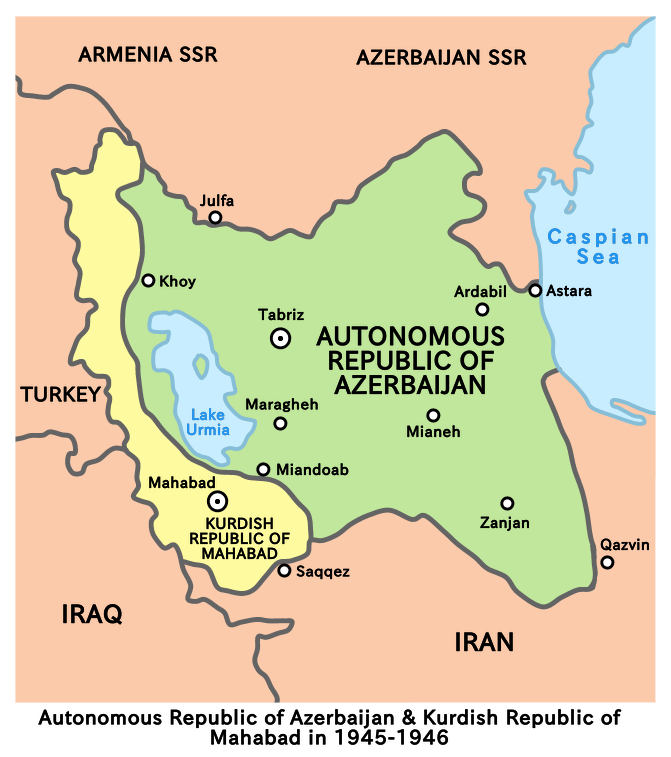
It lasted 328 days. From January 22 to December 15, 1946, the Republic of Mahabad -- also called the Republic of Kurdistan -- governed a handful of towns in northwestern Iran as a self-declared Kurdish state. The territory was small: Mahabad and the neighboring cities of Bukan, Oshnavieh, Piranshahr, and Naghadeh, plus claims on Urmia, Khoy, and Salmas that were never realized. The republic was born in the vacuum left by World War II, sustained by Soviet ambiguity, and destroyed by Cold War calculation. Its leader, Qazi Muhammad, became the first and last president of a Kurdish nation-state. His execution cemented the republic's place not as a political experiment that failed, but as a promise that was broken.
Born from Occupation
The Allies invaded Iran in August 1941, and the Soviets took control of the north. With Iran's central government unable to project authority into the occupied zones, the Soviets began promoting Kurdish nationalism as a tool of influence. In the town of Mahabad, a committee of middle-class Kurds supported by tribal chiefs took over local administration. They formed the Society for the Revival of Kurdistan -- Komeley Jiyanewey Kurdistan, known as JK -- and elected Qazi Muhammad, head of a family of respected religious jurists, as chairman. Although the republic was not formally declared until January 1946, Qazi's committee had been governing the area for more than four years. The groundwork was local, but the opportunity was geopolitical.
Between Patrons and Principles
How much the republic owed to Moscow has been debated ever since. Kurdish nationalist leaders like Abdul Rahman Ghassemlou and Jalal Talabani emphasized Soviet friendship. American observers like Robert Rossow Jr. and historian William Linn Westermann branded it a puppet state. The truth was more complicated. The Soviets never stationed a garrison near Mahabad. They had no civil agent of sufficient standing to dictate policy. Their support took practical forms: motor transport, buying the entire tobacco crop, keeping the Iranian army at a distance. But they also pressured the Kurdish leadership to merge with the larger Azerbaijan People's Government, a similarly Soviet-backed entity to the north. Qazi Muhammad refused. The Soviets wanted an asset. What they got was a partner who insisted on Kurdish independence, even from his benefactors.
The Fall
In 1946, the United Nations Security Council passed resolutions 2, 3, and 5, urging the removal of Soviet forces from Iran. The United States brokered a withdrawal agreement, and Moscow complied. Without Soviet protection, the Republic of Mahabad stood exposed. Mohammad Reza Shah ordered his army into the territory. The government collapsed. Qazi Muhammad was arrested, tried, and hanged on March 31, 1947. Archibald Roosevelt Jr., an American intelligence officer, argued that Qazi had worked with the Soviets out of pragmatism, not ideology, and urged the U.S. ambassador to Iran to intervene. The Shah told the ambassador not to worry. Roosevelt later concluded that the execution order was signed the moment the ambassador left the room.
The March That Would Not End
Mustafa Barzani had brought soldiers from Iraqi Kurdistan to form the backbone of the republic's military forces. When the republic fell, most of the Iraqi soldiers and four officers chose to return home. The officers were condemned to death upon crossing back into Iraq and are honored today alongside Qazi Muhammad as martyrs of the Kurdish cause. Several hundred soldiers took a different path. They stayed with Barzani and fought their way out, defeating every effort by the Iranian army to intercept them during a five-week march through hostile terrain. They crossed into Soviet Azerbaijan, beginning an exile that would reshape Kurdish politics for decades. The republic had lasted less than a year. The movement it represented proved far more durable.
From the Air
The Republic of Mahabad was centered on the city of Mahabad at approximately 36.75°N, 45.72°E, in a narrow valley at 1,300 meters elevation in West Azerbaijan province, Iran. Lake Urmia, one of the largest saline lakes in the world, lies to the north and is a dominant visual landmark from altitude. The republic's territory extended to Bukan (to the east), Piranshahr (to the west), Oshnavieh and Naghadeh (nearby). The nearest major airport is Urmia Airport (OITR). The Kurdish highlands surrounding the valley are mountainous and rugged, characteristic of the Zagros range foothills.