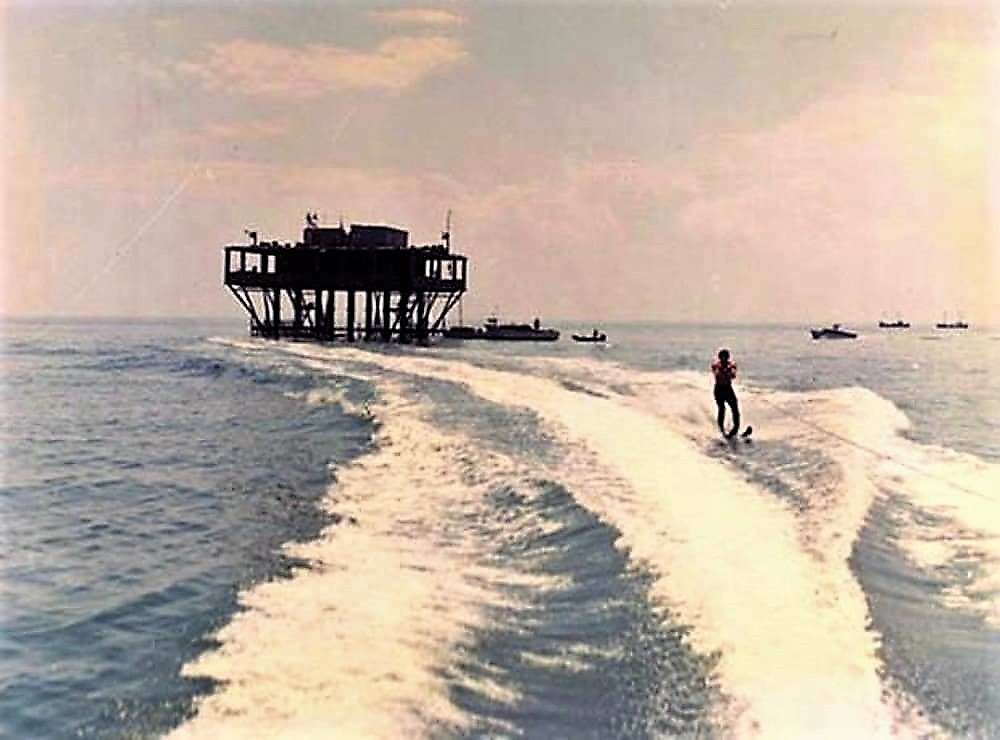
Republic of Rose Island
Italy went to war with a platform. Not a political platform -- an actual physical platform, 400 square meters of steel and concrete standing on nine pylons in the Adriatic Sea, 11 kilometers off the coast of Rimini. Its creator, an Italian engineer named Giorgio Rosa, had spent nearly a decade building it. On 1 May 1968, he declared it an independent nation, gave it an Esperanto name -- Insulo de la Rozoj -- appointed himself president, and began issuing postage stamps. The Italian government was not amused.
An Engineer's Obsession
Giorgio Rosa began construction in 1958, funding the project himself. The concept was straightforward if eccentric: build an artificial island in international waters and furnish it with the trappings of a functioning state. By the time construction was completed in 1967, the platform supported a restaurant, a bar, a nightclub, a souvenir shop, and a post office. The name itself carried a double meaning -- "Rozoj" is Esperanto for roses, borrowed from Rosa's own surname and from his stated desire to "see roses bloom on the sea." The choice of Esperanto as the official language was deliberate, a nod to internationalism and a signal that this micronation aspired to something beyond Italian jurisdiction.
Fifty-Five Days of Sovereignty
The declaration of independence on 1 May 1968 came with all the accoutrements of statehood. Rose Island had a government with Rosa as president. It issued stamps showing the platform's location in the Adriatic. It established the mill as its official currency, though no coins or banknotes were ever actually produced. The Italian government saw something less romantic: a scheme to collect tourist revenue while dodging Italian taxes. Whether Rosa was a visionary or a tax dodger -- and he may have been both -- Rome's patience lasted exactly 55 days. On 26 June 1968, the Italian navy dispatched four carabinieri and Guardia di Finanza officers to the platform. They seized control, evacuated everyone, and established a blockade. The world's smallest republic had lasted less than two months.
The Navy vs. Nine Pylons
Occupation was one thing; demolition proved another. The Italian government first attempted to dismantle the platform, only to discover it was too solidly built -- Rosa had designed his creation to last. The authorities then turned to explosives. The Italian Navy bombed the island twice. The first attempt failed entirely. The second, on 13 February 1969, damaged the structure but left it standing. Rosa's self-declared government in exile responded by issuing commemorative stamps depicting the bombardment, a defiant act of postal sovereignty against a NATO military. The Italian government also billed Rosa for the cost of the naval operation -- war reparations, in effect, for a conflict with a nightclub. Nature finished what the navy could not: on 26 February 1969, a storm finally toppled what remained of the platform.
A Dog, a Dream, and a Legacy
Only one death was ever associated with Rose Island, and it was never confirmed: Rosa's dog was reportedly on the platform during the demolition. The human toll was limited to Rosa's wallet and his pride, though neither deterred him from the quixotic stubbornness that had driven the project from the start. For decades afterward, Rose Island faded into footnote status -- an oddity filed alongside Sealand, the Principality of Hutt River, and other microstate curiosities. But since the early 2000s, the story has experienced a revival, reframed less as a tax dodge and more as a utopian gesture. A 2020 Netflix film directed by Sydney Sibilia brought Rosa's story to a global audience, portraying the engineer as an idealist whose creation, however impractical, represented a genuine desire for freedom from the constraints of the nation-state.
Empty Water, Full Imagination
Nothing remains at the site today. The Adriatic swallowed the last of the pylons long ago, and the spot 11 kilometers off the Emilia-Romagna coast is indistinguishable from the surrounding sea. But Rose Island endures as a story -- a reminder that sovereignty is partly a matter of conviction, that nations are as much imagined as built, and that one stubborn engineer with enough concrete can, for 55 days at least, make the absurd feel almost plausible. Rosa wanted to see roses bloom on the sea. He got stamps, a nightclub, and an argument with the Italian Navy. Some dreams are better for their failure.
From the Air
The former site of Rose Island lies at approximately 44.18N, 12.62E in the Adriatic Sea, roughly 11 km off the coast of Rimini, Emilia-Romagna, Italy. Nothing is visible at the surface today -- the platform was destroyed in 1969. The coastal city of Rimini is the primary landmark, with its long beach strip clearly visible from altitude. Nearest airport is Rimini-San Marino Federico Fellini Airport (LIPR), approximately 11 km to the west along the coast. The flat Adriatic coastline and shallow waters of this area provide excellent visibility in fair weather.