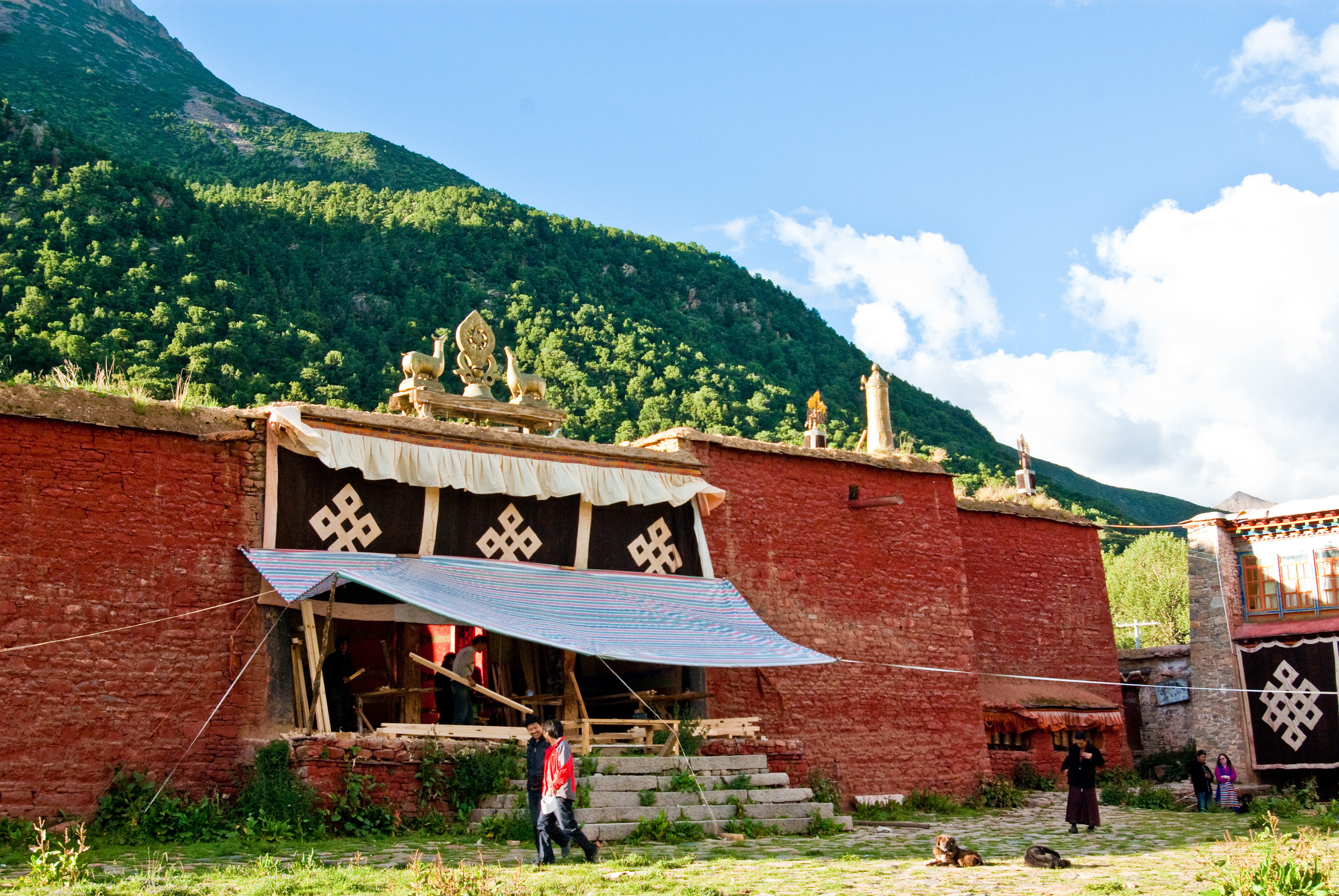
Reting Monastery
Before the great monasteries of Sera, Drepung, and Ganden existed, there was Reting. Founded in 1057 in the Reting Tsangpo Valley north of Lhasa, it was the first major monastery of the Sarma revival, the wave of Buddhist renewal that transformed Tibet's religious landscape. Dromton, the chief disciple of the Indian master Atisha, chose this remote valley and brought his teacher's relics with him. For nearly a thousand years, Reting has stood at the intersection of faith and political power, its abbots serving as kingmakers and regents, its walls bearing the scars of the very conflicts that power invited.
The Kadam Seed
Atisha had arrived in Tibet in 1042, bringing with him a reformed approach to Buddhist practice that emphasized monastic discipline and gradual spiritual development. When he died in 1054, his disciple Dromton carried the teaching forward by establishing Reting as the seat of the Kadam lineage. The monastery became a center of learning and practice in the valley, nurturing a tradition that would shape Tibetan Buddhism for centuries. Three hundred years later, Je Tsongkhapa would draw on the Kadam teachings as the foundation for his reforms, and the lineage was absorbed into what became the Gelug school. Reting made the transition, becoming an important Gelug monastery and the seat of the Reting Rinpoche, a title that would carry political weight far beyond the valley walls.
Regents and Kingmakers
The Reting Rinpoches occupied a peculiar position in Tibetan governance. They were among the candidates eligible to serve as Regent during the minority of a Dalai Lama, a role that placed enormous temporal power in monastic hands. A Reting Rinpoche served as Regent from 1845 to 1855. The more consequential regency came later. The Fifth Reting Rinpoche assumed the post in 1933 and was instrumental in the search that identified the current, 14th Dalai Lama. He became the young Dalai Lama's Senior Tutor. But the same political currents that elevated him eventually destroyed him. He abdicated his position, was accused of colluding with the Chinese, and died in a Tibetan prison in 1947. His supporters attacked Lhasa and destroyed portions of Reting Monastery itself. The political chaos that followed weakened Tibet's institutions at precisely the moment they could least afford it, contributing to the rapid collapse after the Chinese invasion.
A Contested Reincarnation
The Sixth Reting Rinpoche died in 1997. Four years later, in January 2001, Chinese authorities announced the selection of a new incarnation as the Seventh Reting Rinpoche. The timing was striking: the announcement came just two days after the Karmapa, one of Tibetan Buddhism's highest-ranking lamas, fled to India. The Dalai Lama has not recognized this incarnation, viewing the selection as part of a broader effort by the Chinese government to control the institutions of Tibetan Buddhism. The dispute over the Seventh Reting Rinpoche echoes the larger struggle over the Panchen Lama's succession and raises the same fundamental question: who has the authority to identify reborn spiritual leaders in a tradition where that authority has always rested with the religious community itself?
Ruins in the Valley
During the Cultural Revolution, Red Guards devastated Reting. The monastery that had stood for over nine centuries was reduced to partial ruins, its libraries and shrines ransacked. Only partial restoration has followed. What remains is enough to suggest what was lost: the valley setting north of Lhasa, the quiet that settled after the soldiers left, the fragments of a place that was old when the great Gelug monasteries around Lhasa were still being planned. Reting's story is the story of Tibetan Buddhism compressed into a single site: a place of genuine spiritual seeking that could never fully separate itself from the political power it attracted. The monastery's relics of Atisha, the regents who shaped and were shaped by Tibetan politics, the contested incarnation that continues to divide loyalties - all of it layers onto a valley that Dromton chose in 1057 for reasons that may have had nothing to do with politics at all.
From the Air
Located at 30.31N, 91.51E in the Reting Tsangpo Valley, Lhunzhub County, north of Lhasa. The monastery sits in a high-altitude valley in the U-Tsang region of Tibet. From altitude, look for a river valley running roughly north-south with scattered monastic structures along its banks. Nearest major airport is Lhasa Gonggar Airport (ZULS), approximately 100 km to the south-southwest. High-altitude flight conditions prevail; expect terrain-induced turbulence in the narrow valley.