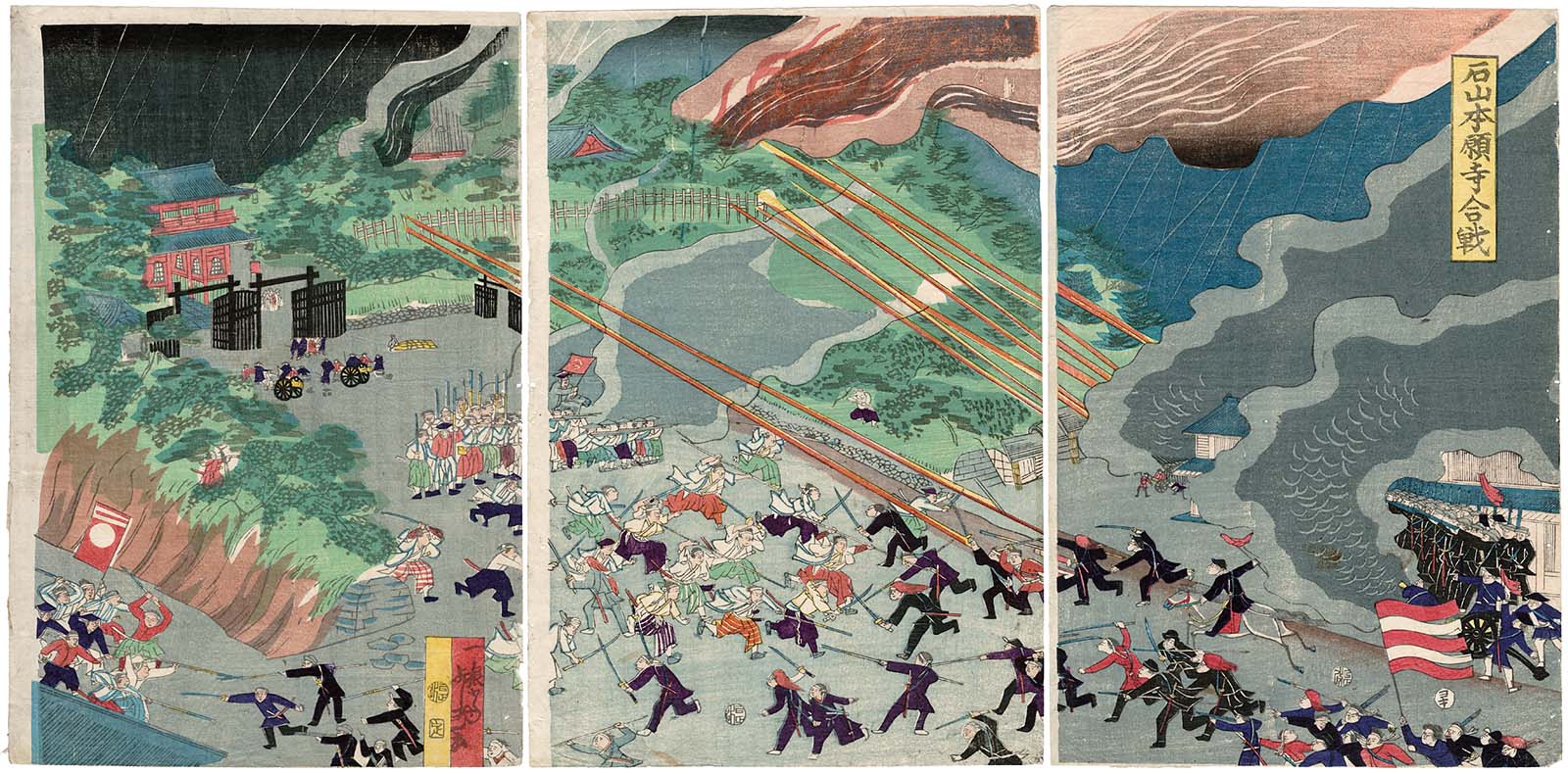
Revolt of Ashikaga Yoshiaki: The Last Shogun's Gamble
The civilians along the road to Sakai did not bow. They laughed. The man stumbling past them in 1573 had been, just days earlier, the fifteenth Shogun of Japan -- the supreme military ruler of an island empire. Now Ashikaga Yoshiaki was fleeing Kyoto with smoke rising behind him, stripped of dignity by a common thief who had robbed him on the highway, jeered by ordinary people as a 'poor Kubo,' a destitute court noble. Within weeks he would shave his head and don the robes of a Buddhist monk, not out of piety but to hide. His revolt against Oda Nobunaga, the warlord who had placed him on the throne and then refused to let go of the strings, had failed spectacularly. With Yoshiaki's flight, 240 years of Ashikaga shogunal rule ended -- not with a heroic last stand, but with humiliation on a dusty road.
A Puppet on Nobunaga's Strings
Yoshiaki's path to the shogunate was forged in blood that was not his own. In 1565, his older brother Ashikaga Yoshiteru, the thirteenth shogun, was besieged in his own castle by forces sent by Matsunaga Hisahide and Miyoshi Yoshitsugu. Surrounded and outmatched, Yoshiteru committed seppuku. Yoshiaki, then a minor figure, was captured and confined at Kofuku-ji Temple in Nara. He escaped, fled through Omi Province and Wakasa Province, and eventually found protection in Mino Province under the emerging warlord Oda Nobunaga and his retainer Akechi Mitsuhide. In 1568, Nobunaga's forces swept into Kyoto, crushed the Rokkaku clan's resistance at Kannonji Castle, and installed Yoshiaki as the fifteenth shogun. It was a restoration in name only. Nobunaga immediately imposed the Denchu on'okite -- a set of nine restrictive articles in January 1569, followed by seven more in 1570 -- that stripped the shogunate of real authority. Yoshiaki held the title, but Nobunaga held the power.
Fire Over Kyoto
By 1572, Yoshiaki had reached his breaking point. He secretly reached out to the Takeda and Matsunaga clans, building a coalition against his patron. The strategy was known as the Nobunaga Encirclement -- an attempt to surround Nobunaga with enemies on all fronts. Yoshiaki and the Matsunaga forces gathered at Makishima Castle, raising the standard of open revolt. Nobunaga's response was swift and ruthless. He marched his armies into the imperial capital, and according to reports, set fire to parts of Kyoto itself to flush out the rebels. The flames that consumed sections of the ancient city were Nobunaga's unmistakable message: no institution, no tradition, no city was sacred enough to shield those who defied him. Yoshiaki fled toward Sakai near Osaka, hoping for sanctuary, but found only degradation -- robbed on the road, mocked by commoners. He renounced his position and took Buddhist vows, shaving his head to disguise himself in hiding.
Fifteen Years of Exile
Yoshiaki's story did not end on that road to Sakai. Sentenced to execution or forced seppuku, he was saved by the intervention of the monk Kennyo of Hongan-ji Temple, who negotiated his banishment to Kawachi Province instead. Yoshiaki sheltered with his brother-in-law Miyoshi Yoshitsugu at Wakae-jo Castle, living as a monk under the name Sho-san. But Nobunaga's reach extended even there -- Oda forces laid siege to Wakae-jo, and Yoshitsugu, betrayed by his own senior vassals, committed seppuku along with his wife and children. Yoshiaki fled again, this time finding refuge with the Mori clan in Bingo Province, where in 1576 he established an extraordinary government in exile at the port town of Tomo-no-Ura. He stubbornly refused to relinquish the title of shogun, issuing orders to feudal lords from a borrowed domain, a ruler without a realm.
The Final Surrender
The Honno-ji Incident of 1582 -- in which Akechi Mitsuhide turned on Nobunaga, who died by suicide in a burning temple -- briefly rekindled Yoshiaki's hopes. With his tormentor gone, perhaps the shogunate could be restored. He sought support from Mori Terumoto, Toyotomi Hideyoshi, and Shibata Katsuie. But the political landscape had shifted irreversibly. Kobayakawa Takakage of the Mori clan opposed aiding Yoshiaki because of his own alliance with Hideyoshi, and Yoshiaki's alignment with Katsuie put him on the losing side of the succession struggle. By 1585, Hideyoshi had consolidated enough power to become the unofficial ruler of Japan. In 1588, Yoshiaki formally relinquished the title of Seii Taishogun. The Imperial Court granted him the honorific title of Jusangu, a fief of 10,000 koku, and lordship of Makishima Castle in Yamashiro Province -- a quiet retirement for the last shogun of a dynasty that had ruled Japan since 1338.
From the Air
Located at 35.026N, 135.762E in central Kyoto, near the site of Makishima Castle where the revolt began. From 3,000-5,000 feet AGL, the area lies within the broader Kyoto basin surrounded by mountains on three sides. The Kamo River runs north-south through the city. Nijo Castle, where Yoshiaki's brother Yoshiteru was besieged, is visible in the central city grid. Nearest major airport is Osaka Itami (RJOO), approximately 25 nautical miles southwest, with Kansai International (RJBB) about 50 nautical miles to the south.