Rhumsiki
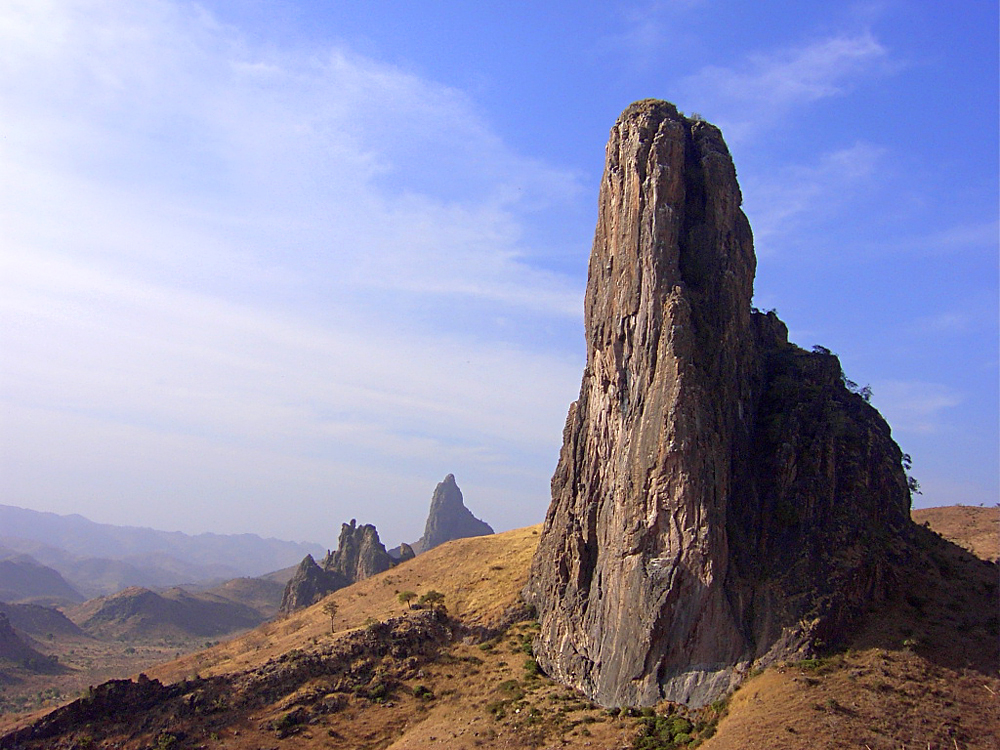
The rock appears without warning. Rising 1,224 meters from the valley floor, Kapsiki Peak is a volcanic plug -- the solidified core of a volcano whose softer outer layers eroded away millions of years ago, leaving behind a dark basalt spire that looks like it was driven into the earth by some enormous hand. Around it, smaller plugs and outcroppings punctuate the landscape of Cameroon's Mandara Mountains, creating a skyline so improbable that first-time visitors tend to fall silent. This is Rhumsiki, a village in the Far North Province that has become one of Cameroon's most photographed places -- and one of its most debated.
Refuge in Stone
Rhumsiki's human story is inseparable from its geology. Local tradition holds that the village was settled by Kirdi peoples -- indigenous animists who fled into the Mandara Mountains during the 18th century to escape the Muslim advances of the Fulani. The rugged terrain that made the mountains difficult to farm also made them difficult to conquer, and the Kirdi found sanctuary among the volcanic formations. The Kapsiki, the ethnic group that inhabits Rhumsiki today, built their homes from the same local stone that surrounds them -- small houses with thatched roofs scattered across the valley floor and hillsides, as if the village grew organically from the rock. They practiced agriculture and animism, weaving the mountains' basalt formations into their spiritual beliefs. The crab sorcerer, a traditional diviner who reads the future in the movements of crabs, remains one of Rhumsiki's most distinctive cultural practices.
The View Everyone Describes
Guidebook writers have struggled to find adequate language for what surrounds Rhumsiki. Gwanfogbe's Geography of Cameroon calls the scenery "remarkable." Lonely Planet opts for "striking." Rough Guides settles on "breathtaking." The effect is created by the combination of volcanic plugs, basalt outcroppings, and the Mandara range itself -- a landscape that looks less like Earth and more like a science fiction illustrator's idea of an alien planet. Kapsiki Peak dominates the view, but it is the ensemble that overwhelms: dozens of smaller plugs rising at odd angles, their dark surfaces contrasting with the green of the valley during the wet season and the brown dust of the dry months. Located 55 kilometers from Mokolo and just 3 kilometers from the Nigerian border in Adamawa State, Rhumsiki sits at a geographic crossroads that has helped make it a standard stop on tourist itineraries through northern Cameroon.
The Paradox of Being Found
Rhumsiki's fame has created an uncomfortable tension. Rough Guides describes the village as "overrun" and "tainted by organized tourism," while Lonely Planet calls it "something of a tourist trap." The standard guided tour leads Rough Guides to doubt the village's authenticity altogether: "The appeal of the visit is largely to get a taste of the 'real' Cameroon, and the built-in flaw is that the more people come, the more distorted and unreal life in the village becomes." It is a familiar paradox -- a place celebrated for its remoteness and tradition that becomes less remote and less traditional with every tour bus that arrives. The Kapsiki continue to live in Rhumsiki, continue to farm, continue to practice their beliefs. But the village now exists in a dual state: it is simultaneously the home its inhabitants have occupied for centuries and the attraction that outsiders have made of it.
Stone Pillars at Sunset
Whatever the guidebooks say about over-tourism, the volcanic plugs remain indifferent. They were old when the Kirdi arrived and they will be standing long after the last tourist departs. At sunset, when the light shifts from white to amber and the basalt spires cast long shadows across the valley, Rhumsiki becomes the place the photographs promise. The air cools, the sounds of the village carry -- chickens, children, the rhythmic pounding of grain. The Mandara Mountains stretch toward the Nigerian border in the east, ridge after ridge fading into haze. For the Kapsiki, this is not a destination. It is home, as it has been for generations, shaped by the same forces that shaped the stone around them.
From the Air
Rhumsiki is located at 10.48N, 13.60E in Cameroon's Far North Province, in the Mandara Mountains near the Nigerian border. From altitude, the volcanic plugs -- particularly Kapsiki Peak at 1,224 meters -- are distinctive landmarks amid the mountainous terrain. The nearest airport is Maroua Salak Airport (FKKL), approximately 100 km to the west. The landscape transitions from Sahel savanna to rugged mountain terrain. Visibility is generally good in the dry season (November-March) but can be reduced by Harmattan dust.